

The sixth Whittington Oration - Is the NHS being privatised? What of the future for Health Care?
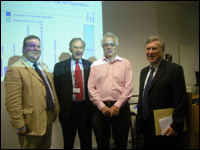 A noisy demonstration in the Archway Campus greeted former editor of the British Medical Journal, Richard Smith when he gave the sixth Whittington oration ‘Is the NHS being privatised? What of the future for Health Care?’ on Tuesday 8 July.
The Whittington Hospital NHS Trust vice chairman Edward Lord and Professor Albert Singer introduced the Oration held in the Whittington postgraduate pentre. Dr Simon Wiseman programme director for primary care gave the vote of thanks.
Dr Smith’s speech began by underlining the great importance and his support of a health system that covers everybody, is free at the point of delivery, and is driven by need rather than an ability to pay. Smith feels, however, that marginal members of society, including the poor would not receive the same service as middle class people who are able to play a complex system.
Smith continued to argue that whilst he has no dispute with the NHS being funded through taxation, he wonders if it will be sustainable as strong evidence shows that as countries grow richer they also spend more on health, and if this is the case then it is unlikely that the extra money will come from the public purse. Similarly Smith feels that whilst he has no great problem with the NHS to have its direction given and managed by the government, many people – including the British Medical Association – would like to see the NHS set free from political control, away from changing governments and political whims that push and pull at it from different directions. Smith’s core argument is that the NHS will be safer if there is a plurality of providers, including hospitals and primary care commissioners. By bringing in new providers including private sector and voluntary organisations the NHS will be in a position to increase capacity, access new skills and inject competition, a quality he argues as being consistently capable of reducing cost. He also argues that private companies can increase capacity, provide missing skills and, through competition raise the existing commissioners. Most importantly they can do this all ‘at risk’ – only being paid if they deliver.
Smith suggests that Valencia in Spain has demonstrated what can be achieved by letting the private sector run the whole show. The local government outsourced a hospital and primary care centre to a private company, which produced high quality services ran at 75 per cent of the cost of similar enterprises in public hands. He attributes this to their redesign of clinical processes, co-ordination of primary and secondary care, superior management and electronic patient records. For Smith the NHS will be safer if it has a selection of competing providers rather than relying simply on state institutions.
The oration ended with questions and comments from the audience, including chief executive David Sloman, non-executive director Maria Duggan and two protestors who were invited in to listen to the talk and share their views, fearful of a healthcare system that will be open to financial corruption and unable to stay true to its NHS principles if money becomes too much of a driving force. A lively and passionate debate, full of intelligent and thought provoking arguments, this year’s Oration showed how equally important the NHS is to all, whilst having many contrasting and conflicting ideas on how to reach the same place for everyone.
Last updated14 Jul 2008