

The Whittington Opens New Simulation Centre
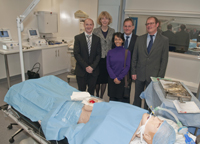 On 15 December, Dr Patricia Hamilton, Director of Medical Education for England, was a guest of honour at the opening of The Whittington Hospital’s brand new simulation centre. Funded by the London Deanery, this hi-tech training and assessment facility will collaborate with nine other simulation centres across the capital to meet the growing demand for scenario-based training. Fully AV enabled, the centre comprises a simulated operating theatre with the capacity to train students on adult and infant patient simulators, a ward setting that includes a neonatal area and emergency department environment, a control room and a large conference/debrief room.
 Patricia told Laerdal, “I am absolutely delighted to be present here today and wish the centre every success. The time has come for simulation to move forward. It has huge potential for improving the confidence and competence of trainees and doctors and improving patient safety – particularly in emergency situations.”
Talking about progress of the Department of Health’s research into current and future simulation provision, Patricia explained, “We have collaborated with simulation leads in brainstorming sessions, visited a number of teaching facilities and conducted surveys. The wealth of experience and innovative practice has been a welcome surprise. A draft of the report is on track to be ready for discussion by stakeholders in January. It will form the framework for a strategy to advance simulation training within the NHS and will enable us to spend the budget in the most effective way possible.”
Excellence in simulation training
Addressing over 50 professionals who had come to celebrate the opening of the centre, Rob Larkman, Chief Executive of The Whittington Hospital, said, “This is a great day for us. For many years, we have had a reputation for excellence in simulation training. The new suite, which contains some impressive equipment, demonstrates our commitment to simulation, to quality and to innovation.”
Nick Harper, Director of Simulation, added, “Anaesthetists have been using simulation for some time. We are eager to provide better training for doctors, midwives, nurses and clinicians. With the funding that we have received from the London Deanery, we can now embed simulation training within the curriculum to enable teams to practise common and uncommon procedures such as cardiac arrest, trauma, lumber punctures, laparoscopic surgical techniques and so on. Using simulation, we can help improve the management of a wide range of complex situations.”
State of the art facilities
The six-month project was instigated and facilitated by a team of dedicated clinicians and The Whittington’s Lead Resuscitation Officer, Mark Madams, together with Nick Harper. Mark explained, “Although we have been running ward-based simulation for some time, our new high fidelity simulators will allow us to expose students to many different scenarios that they may not have experienced during training, such as how to assess and treat anaphylactic shock or meningococcal meningitis, The AV technology allows us to deliver high quality debrief sessions. Well-run scenarios engage participants in a safe, controlled but realistic environment. Only when we see ourselves on footage from the scenario do we realise how our actions impact on others; for instance if we have managed to keep emotion out of our voices or whether we have worked well within a team. We are looking to standardise all courses so that everyone is taught the same way. We are all very excited about the advanced level of training that the new facility will allow us to deliver.”
Course for all levels
The Whittington’s Director of Education, Dr Anna Kurowska, has recently put her own skills to practice in a series of simulation events. She agreed, “There’s nothing quite like being put in the situation and dealing with it. The student can carry over analytical skills gained from participation in the scenario and the debrief into the clinical or ward environment. We are thrilled to be developing paediatric simulation training provision, and will first offer multi-disciplinary training courses for students followed by training for senior registrars and experienced consultants. As well as using the new centre, we will run scenarios in wards, the birth centre, the intensive care unit and emergency departments to test systems and team practice.“
Dr Nathalie Richard, Consultant in The Whittington’s emergency department, will deliver some of the courses in the new centre. “We have been trained in how to run a session and conduct a debrief,” she said. “Our role is to lead the scenario and observe team dynamics. Simulation is powerful so it has to be done correctly – in a way that depersonalises mistakes to enable a positive outcome. I am looking forward to the first of many courses.”
The Whittington’s new simulation centre is dedicated to the memory of Dr Raja Jayaweera, an anaesthetist at The Whittington Hospital for over 35 years, who died on 6 December 2009. Dr Jayaweera was a charismatic and inspirational teacher of national renown and a vigorous advocate of simulation training. His daughter, Dr Ramanie Jayaweera, a Sydney based aesthetist herself – kindly attended the launch ceremony.
Photos by SIRA Studio
Last updated03 Feb 2010