

Pelvic floor muscle exercises for women leaflet
Patient information factsheet
This factsheet explains why you need to exercise your pelvic floor muscles and how to do the exercises.
What and where are the pelvic floor muscles?
- The pelvic floor is a wide group of muscles that works like a hammock.
- It stretches from the front hip bone to the base of your spine at the back.
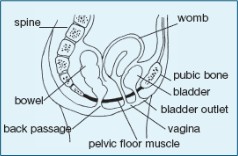
What does the pelvic floor muscles do?
- These strong muscles hold up your bladder, womb, vagina, and bowel.
- They help to keep the bladder from opening and back passage closed so you don’t leak urine, poo, or gas.
- The pelvic floor also plays a role in improving sensation and having orgasms during sex.
Why exercise the pelvic floor?
- It is important to keep these muscles strong.
- Strengthening them helps stop problems from starting or makes them better if they have already happened.
These muscles can get weak or stretched because of things like:
- Pregnancy and having a baby
- Constipation
- A long-lasting cough
- Being overweight
- Often lifting heavy things
- Not being very fit
- Pelvic surgery
- Nerve problems (like after a stroke or spinal injury) and getting older.
Symptoms of weak and/or stretched pelvic floor muscles
These problems can be different for each person, for example:
- Needing to pass urine very quickly or often
- Leaking urine when you cough, sneeze, jump, laugh, or move
- Accidentally leaking poo or gas from the back passage
- Pelvic organ prolapse (a feeling of a lump, heaviness, or something “dropping” in the vagina)
- Less enjoyment during sex.
Exercises
- Pelvic floor muscles need to be exercised just like any other weak or damaged muscle in the body.
- The following exercises will help to maintain or improve their strength.
Basic exercise
- You can do this exercise in any position, like sitting, lying down, or standing.
- Make sure your body is fully relaxed.
- Tighten and lift your pelvic floor muscles by closing and pulling up your back passage, vagina, and urine opening, as if you are stopping wind and urine at the same time.
- You should feel the muscles lift upwards and forwards towards the front of your body.
- It is important to do this without:
- Squeezing your legs together
- Tightening your bottom
- Holding your breath
- Pulling in your stomach muscles strongly
- In other words, only your pelvic floor muscles should be working.
- You should be pulling your stomach muscles in very gently, but not so much that someone would notice you doing the exercise.
- It should be like doing a secret exercise!
How much do I need to exercise to make the muscle stronger?
- Your muscles work all day, but they also need to react quickly, like when you cough or sneeze.
- There are two kinds of exercises. You should do both to keep the muscles working well.
- Slow controlled exercise – for strength and endurance
- Tighten your pelvic floor muscle and hold tight for as many seconds as you can (up to a maximum of 10 seconds).
- Relax for the same number of seconds.
| How long can you hold tight in seconds? | ____ seconds |
- Repeat the exercise (up to a maximum of 10 times).
| How many times can you repeat it? | ____ seconds |
- Short, quick exercise – for speed
- Tighten and lift the pelvic floor muscle as fast as you can to reach your best contraction.
- Then immediately relax the muscle until it is fully at rest, i.e., relax for four to five seconds.
- Repeat the exercise up to a maximum of 10 times.
| How many quick contractions can you do? | ____ contractions |
- The numbers in these boxes are your starting point.
- As your muscles get stronger, do more.
- Try to do the exercises 4 to 6 times each day.
- If you do fewer than 40 exercises a day, the muscles may not get stronger.
- It can take about 2 months to notice changes, and 3 to 6 months for the best results.
Keep it up, it will be worth it. Make it a habit.
The hardest part is remembering to do the exercises. Here are some tips:
- Set alarms on your phone.
- Do the exercises after you go to the toilet.
- Link them to daily habits, like brushing your teeth, washing up, waking up, or going to bed.
- Put reminder stickers where you will see them, like the TV, bathroom mirror, or kitchen sink.
- Use a phone app, like the NHS app “Squeezy”.
- Once the muscles are strong it is important to maintain them.
- Remember the exercises once a day and make it a lifetime habit.
Am I doing the right exercise?
- When you are peeing, you can try to briefly stop the flow near the end.
- If it slows or stops, you are doing it correctly.
- If nothing happens, your muscles may just be weak. Keep doing the exercises and try again in a few weeks before getting help.
- If the flow gets faster, you are doing it wrong. Stop the exercise and ask a health professional to show you the right way.
- This is a test only, do it no more than once a week.
- Otherwise, it may interfere with normal bladder emptying.
Protect yourself for life
- Tighten your pelvic floor muscles before you cough, sneeze, laugh, or lift things.
- Gently tighten them (not as strong as your exercises) and try to hold them when you are standing for a long time or going up and down stairs.
- Avoid heavy lifting (using both hands) for at least 3 months after pelvic surgery.
- Avoid heavy lifting for up to 8 weeks after a normal birth.
- If you are struggling with these exercises, see your GP. They may send you to a nurse or physiotherapist who can help you do them correctly.
Resources
Bladder and Bowel Community (B&BC)
Provides information and support services.
Website: https://www.bladderandbowel.org/
Email: help@bladderandbowel.org
Bladder and Bowel UK
Provides information and support services.
Website: https://www.bbuk.org.uk/
Email: bbuk@disabledliving.co.uk
Telephone: 0161 214 4591
International Urogynecological Association (IUGA)
Provides evidence-based patient information translated into several languages.
Website: https://www.yourpelvicfloor.org/conditions/
Pelvic, Obstetric & Gynaecological Physiotherapy (POGP)
Provides evidence-based patient information which may be recited (audio) in many languages.
Website: www.thepogp.co.uk/patient_information/default.aspx
Contact our service
Whittington Bladder and Bowel Care Service
Email: whh-tr.bladderandbowel@nhs.net
Webpage: https://www.whittington.nhs.uk/?c=33288
Whittington Pelvic Health Physiotherapy
Email: whh-tr.outpatienttherapy@nhs.net
Webpage: https://www.whittington.nhs.uk/?c=42977
North Central London perinatal pelvic health service - Royal Free London
Email: rf-tr.nclpphs@nhs.net
Webpage: https://www.royalfree.nhs.uk/services/maternity-services/maternity-support/north-central-london-perinatal-pelvic-health-service