

Desferal treatment for iron overload
Patient Information Leaflet
Introduction
- Regular blood transfusions are used to treat people with lots of different blood disorders, including sickle cell disease (SCD) and thalassaemia.
- However, transfused blood contains about 200mg of iron in each unit of blood.
- This excess iron can accumulate in the heart, liver and other major organs.
- If this is not treated, serious organ damage will eventually occur.
- Desferrioxamine (Desferal) is a medicine which removes the excess iron from the body.
- It binds to iron and together they leave the body in urine and faeces.
- Your doctor will discuss your Desferal treatment with you and decide on the best method to give you the medicine.
- Your dose will be adjusted to your particular needs.
- Desferal is administered as a slow infusion and can be taken in two ways:
- In a vein: this can be through a temporary device such as a cannula or a more permanent device such as a Port-a-Cath®
- Under the skin (subcutaneously) via a Thalaset needle or a butterfly needle.
- There are three types of infusion devices that can be used to deliver Desferal
- In a bag of saline through a large pump. This method of administration can only be used when you visit the hospital. Desferal can be given at the same time as the transfusion.
- In a portable infusion pump.
- Via a balloon infusor.
- These two methods of administration can be used at home or in hospital.
- Depending on the level of iron in your blood, you will need four to seven infusions a week.
- You can arrange these at times to suit you.
- Some people find it most convenient to have night-time infusions, which take place while they sleep.
- The infusion usually lasts eight to 12 hours.
What is a balloon infusor?
- The balloon infusor (often called the Baxter pump after one of the companies who make them) is a lightweight, disposable device containing Desferal.
- We use it to give a slow, continuous infusion under the skin via a Thalaset needle.
- This allows the Desferal treatment to be given over 8 to 24 hours using an infusor at home.
- The Desferal is contained in a balloon reservoir, inside a casing.
- No batteries are needed (See Figure 1).
- As the Desferal is infused, the balloon deflates and slowly pushes the medicine up through the Thalaset at a fixed rate.
- As this happens, the balloon gradually becomes smaller and moves down the scale on the side of the outer casing.
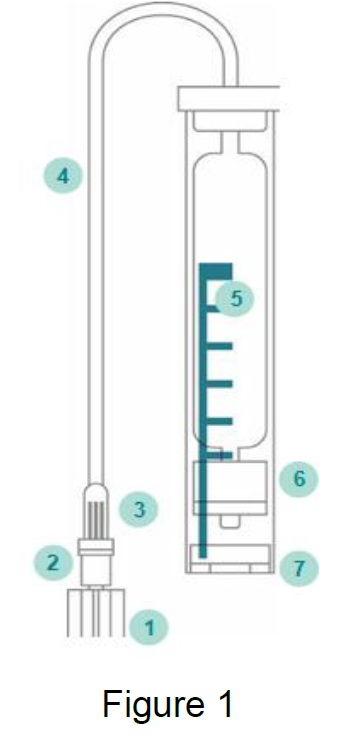
- Winged cap
- Connector attaches the infusor to your Thalaset? line
- Flow restrictor controls how fast your Desferal is given
- Delivery Tubing carries the Desferal
- Balloon holds the Desferal
- Infusion Scale shows how much of your Desferal has been given
- End cap seals and protects the infusor system
- The staff can arrange for the District Nurse to visit you at home to change your infusor pumps.
- However, if you or your carer would like to learn how to change the infusor, we will be happy to show you and give you the necessary equipment.
What are the benefits of an infusor?
- You can have your treatment at home, which allows you to continue with your daily activities.
- It doesn't need any machinery or batteries and so is quiet.
How do I store my infusor?
- Your spare infusor should be stored in the refrigerator and sealed in its outer wrapping.
- Please keep your infusors in a clean place, away from direct sunlight, radiators, fires and out of the reach of children.
- Don't store the infusors in the freezer.
How do I wear my infusor?
- You can choose the way to wear your infusor that is best for you.
- The infusor is supplied with a sock which you can attach to the inside of a shirt, cardigan or jacket, or you may prefer to use a belt/sling.
- Some people adapt their clothing by sewing in pockets for the infusor to sit in.
What do I do if I want to go away on holiday?
- You should discuss this with your doctor.
- Your choice of holiday destination may be restricted, depending on the availability of medical care.
How do I dispose of my empty infusor?
- Seal the empty infusor with the winged cap to prevent leakage and return it to the hospital for safe disposal.
- Don't put the infusor in your bin at home.
- When Healthcare@Home deliver to your home, they will collect your empty infusors.
How do I monitor my infusor?
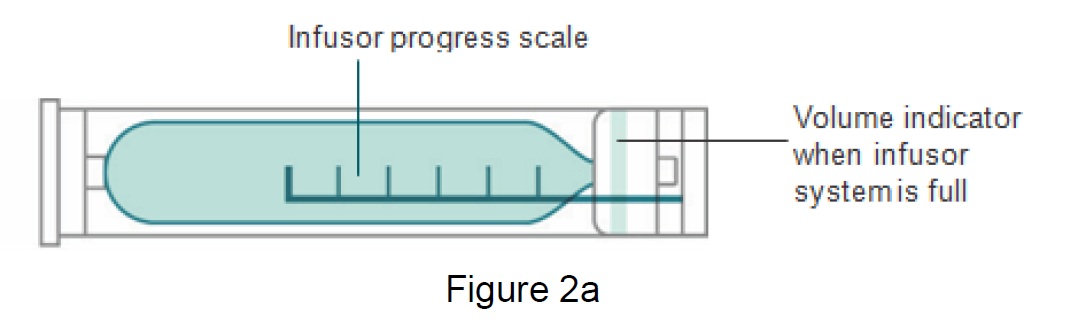
- You should look at the balloon or scale on the side of the infusor every morning to make sure the infusor is working correctly (see Figure 2a).
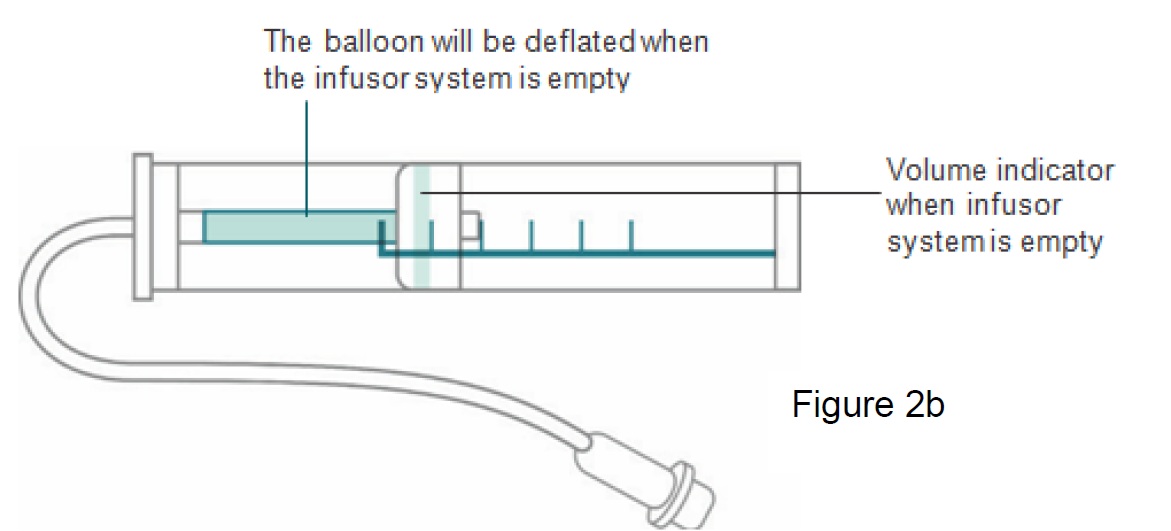
- After using, the infusor will appear empty (see Figure 2b).
How do I change my infusor?
- Please don't attempt to change your pump without previous training from nursing staff.
- If you or your carer will be changing your infusor, you need to follow steps 1 to 10 (below) carefully.
Equipment
- Thalaset needles
- Alcohol swabs (for skin)
- Sharps container
- Cleaning solution for hands
- Cleaning solution for hard surfaces (if needed)
- Clear plastic dressing, such as Tegaderm® (if needed)
Any extra equipment can be discussed with the nursing staff in the Red Cell unit.
Steps
- Prepare clean surface and let it dry.
- Collect together the equipment and place on the dry surface.
- Check name, hospital number and expiry date on the new infusor.
- Wash and dry your hands.
- Open infusor on to the clean surface.
- Wipe the end of your Thalaset line with the alcohol wipe.
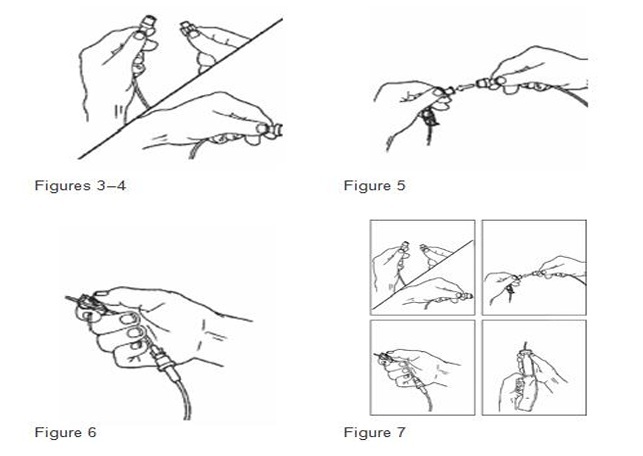
- Remove the winged cap from the infusor and wait for a bubble of fluid to appear at the end of the pump tubing (Figure 3 - 4).
- Attach the infusor by twisting in a clockwise direction onto the Thalaset line (Figure 5).
- Unclamp your Thalaset line (if it has a clamp) (Figure 6).
- Place the infusor in its carrying sock and pin it to your clothing (Figure 7).
Checklist
Don't use your infusor if:
- The name on the label is incorrect
- The balloon has burst
- There is any sign of leakage from the infusor or tubing
- The winged cap is missing
- The bubble does not appear.
Tips
- Ignore small air bubbles within the infusor tubing. They are not harmful.
- If for any reason the infusor has to be disconnected before it is completely empty, a winged cap should always be placed on the end of its tubing to prevent leakage.
Placing the needle
1. Select the skin site for needle insertion.
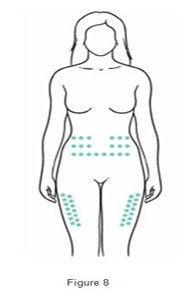
- The places under your skin which are best for needle insertion are the abdomen, thighs and upper arms.
- Study the diagram below (Figure 8) showing you exactly where these places are.
- Choose a different place on your body each day.
- By rotating the site of your infusion in this way, the medication will be absorbed properly.
- Rotation also lowers the risk of skin irritation and scar tissue developing.
2. Prepare the site for needle insertion.
- Using an alcohol wipe, clean the skin in a circular motion starting in the middle and moving outward.
3. Remove the protective covering from the needle.
- When you do this, make sure you don't touch the needle.
4. Pinch the skin around the insertion site.
5. Insert the needle.
- A Thalaset™ needle is inserted at a 90 degree angle.
- Butterfly needles are inserted into the skin at a 45 degree angle.
- The butterfly needle should go into a fold of skin up to the wings.
- The tip of the needle should move freely when the needle is waggled.
- If it doesn't, the tip of the needle may be too close to the skin surface.
- You should then take it out, clean a new site on your skin with an alcohol wipe and try again.
6. Steady/secure the needle and infusion line with a tape or dressing.
- When you fix the infusion line with a tape or dressing, it is best to make a small loop to allow for movement.
- When making the loop, ensure there are no kinks as this will stop the medicine from flowing.
7. Check the insertion site periodically.
- From time to time check the insertion site for redness and fluid leakage, and to make sure the needle has not dislodged.
8. Discard the needle and tubing.
- When the infusion is complete, carefully remove the dressing and withdraw the needle.
- Place the used needle and tubing in the special needle container (sharps bin).
- When the bin is full, return it to the Haematology Day Care, or you can arrange for disposal with your local pharmacy.
Contact details
Your consultant team is:
- Dr Emma Drasar
- Dr Ryan Mullally
- Dr Ana Ortuno-Cabrero
- Dr Ali Rismani
- Dr Zara Sayar
- Dr Annabel McMillan
- Dr Prabal Mittal
- Dr Janine Younis
Adult departmental contacts:
- Haematology Administration Team: whh-tr.haematologyteam@nhs.net
- Adult Sickle Cell Clinical Nurse Specialist (CNS) team: whh-tr.adultsicklecns@nhs.net
- Community link (Sickle cell, Thalassaemia and Rare Anaemia): ncl.redcellteam@nhs.net
Phone: 0203 316 8853 - Whittington Thalassaemia CNS: emma.prescott@nhs.net and niamh.malone-cooke@nhs.net
- Network website: https://www.uclh.nhs.uk/theredcellnetwork/subscribe
If you or your family have any other questions, please do not hesitate to contact any of the above medical team at Whittington Health.
Published:
25 Sep 2024
Review:
25 Sep 2026
Reference:
EIM/Haem/DesferalTIO/02