

Incentive spirometry for adult patients with sickle cell disease
Patient Information Leaflet
What is incentive spirometry (IS)?
- incentive spirometry (IS) is a simple exercise and one of the best ways to prevent chest complications or prevent your chest problem from becoming worse.
- A research trial in 1995 of 29 random patients with sickle cell disease (SCD) who were admitted to hospital 38 times with above-diaphragm chest and back pain, showed that using IS can help to prevent pulmonary (lung) complications [1]
- IS is intended to copy sighing or yawning by encouraging you to take long deep breaths.
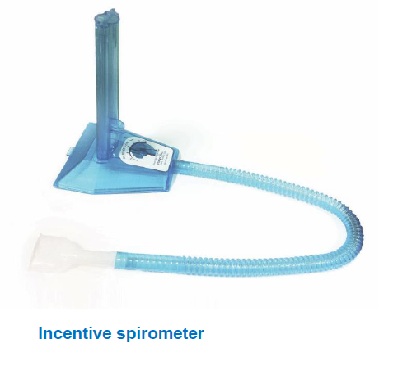
- This is done by using a visual device, called an incentive spirometer, and inhaling at a pre-set flow rate.
- Once you have taken the breath in, we will ask you to try to hold it for a minimum of three seconds before breathing out.
- Bellet PS, Kalinyak KA, Shukla R, Gelfand MJ, Rucknagel DL. Incentive spirometry to prevent acute pulmonary complications in sickle cell diseases. N Engl J Med. 1995 Sep 14;333(11):699-703.
The aims of the exercise
- This exercise aims to increase the amount of air that you breathe in and the pressure in your chest, and to improve the way your breathing muscles work.
- This can then prevent, or reverse, small pockets of lung from collapsing, known as atelectasis.
- Atelectasis can increase the risk of acute chest syndrome which is a severe and potentially life-threatening complication of sickle cell disease.
- IS can help to reduce this risk, especially in people who are not up and about, or those who are not taking deep breaths.
Reasons for using incentive spirometry
- Chest Pain
- Following an operation
- Back pain above the level of the diaphragm
- Acute chest syndrome
- Chest Infection
- Worsening chest X-ray
- Reduced oxygen saturation (drop of 4% from baseline)
When to use your incentive spirometry device
- At Whittington Health the Doctors will prescribe the IS on your drug chart and a member of the nursing team can show you how to use the device initially.
- If there are any concerns, the Physiotherapist will check your technique with you to ensure that you are using the device correctly.
- We would like you to do this simple exercise 10 times in one hour if possible.
- Split the 10 breaths into two or three deep breaths at a time, to avoid getting light-headed from hyperventilation.
How to use your incentive spirometry device
- Make sure you are sitting upright in the bed or on a chair, with the base of the device at mid- chest level.
- Ensure that the dial at the base of the device is set between two and four (low flow rate) to check your base comfort inhalation.
- Place the mouthpiece in your mouth with your lips pressed around it to prevent air leaks.
- As you inhale, you should notice the ball rising in the tube of the device. At the peak of your inhalation the ball should be at the top of the tube.
- See if you can hold the ball up there for one, two, three seconds before breathing out.
- Repeat this sequence one or two times.
- If you can do this exercise with ease, increase the flow rate at the base of the device to six or higher until you find it harder to keep the ball afloat.
- If you find inhalation painful, please let your doctor know so that we can explore the reason for the pain and put your mind at rest.
- This simple breathing exercise can improve your present sickle cell crisis or help prevent chest complications, so it is important that you use your incentive spirometer every hour when you are awake.
Contact details
- Your consultant team is:
- Dr Emma Drasar
- Dr Ryan Mullally
- Dr Ana Ortuno-Cabrero
- Dr Ali Rismani
- Dr Zara Sayar
- Dr Annabel McMillan
- Dr Prabal Mittal
- Dr Janine Younis
Adult departmental contacts:
Haematology Administration Team:
whh-tr.haematologyteam@nhs.net
Adult Sickle Cell Clinical Nurse Specialist (CNS) team
whh-tr.adultsicklecns@nhs.net
Community link (Sickle cell, Thalassaemia and Rare Anaemia)
ncl.redcellteam@nhs.net
Community phone number: 0203 316 8853
Whittington Thalassaemia CNS
emma.prescott@nhs.net
Whittington Thalassaemia CNS
niamh.malone-cooke@nhs.net
Network website:
https://www.uclh.nhs.uk/theredcellnetwork/subscribe
- If you or your family have any other questions, please do not hesitate to contact any of the above medical team at Whittington Health.
Published:
25 Sep 2024
Review:
25 Sep 2026
Reference:
EIM/Haem/ISAPSCD/02