

CT Colon Scan Information Leaflet
Patient Information Leaflet
Your appointment is on.……………………………….…at…………….
What is a CT scan?
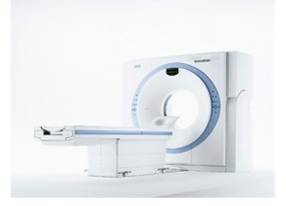
- A CT scan is an examination of any part of your body using a Computed Tomography scanner (CT scanner).
- This provides accurate pictures of the structures inside your body with the use of xrays.
- The scan taken builds up many images of the body, rather like the slices of a loaf of bread.
- It helps the doctor to make a diagnosis of your problem.
Is there any preparation?
- Yes, prior to your scan date you will be telephoned and asked to collect some special medication to prepare the bowel and instructions on the diet to follow before your scan.
- It is very important to follow the instructions carefully to obtain a good quality scan.
- On the day of your appointment, you may drink water, but please do not eat or drink anything else (diabetic patients may eat non-solid food from the diet sheet).
What happens?
- You will be asked to change into a gown which is provided.
- The radiographer (who operates the scanner) will take you into the scanning room where you will lie on the scanner table.
- You may be given an injection to relax the bowel, which makes the examination more comfortable and effective.
- You may also be given an injection of contrast (x-ray ‘dye’) during the scan to enhance the images.
- Both injections will be given through the same needle.
- When you are lying comfortably on your side, the radiographer will gently pass a very small flexible tube into your back passage.
- This will distend the bowel with air, so that it can be seen more clearly on the scan.
- It may be uncomfortable, although not usually painful.
- This tube will remain in place during the scan.
- Pictures will then be taken with you first lying on your back and then on your tummy and/or side.
- The table moves slowly through the scanner, which is shaped like a large ring.
- You can talk to the radiographer throughout the scan.
- You may be asked to hold your breath for approximately 10 seconds whilst pictures are taken.
- The scan itself takes about 30 minutes but you will be in the department for up to 1 hour.
- Please allow for this when considering your transport to and from the hospital.
Is it dangerous?
- This is a safe examination, however there is some risk associated
with most procedures.
- If you are diabetic, please monitor your blood sugar carefully while taking the preparation at home. Seek medical advice if you feel unwell.
- Please telephone the department if you are pregnant or allergic to iodine/contrast.
- There is a small risk with the exposure to radiation as with any x-ray examination.
- There is a small risk of having an allergic reaction to the contrast (x-ray ‘dye’) and bowel medication in some people.
- Please inform the CT radiographer on 020 7288 5888 if you have an allergy to iodine or have had an allergic reaction to x-ray dye in the past, before taking any preparation.
- You may experience a metallic taste, hot flush or a sensation of passing urine during the injection- this is normal and will pass quickly.
- Occasionally some patients experience a mild rash, itchiness or nausea. Inform a radiographer if this happens on the day of your scan.
- You should drink plenty of water/fluids before and after the examination, particularly if you have had any recent episodes of vomiting or diarrhoea.
- Please talk to your doctor or radiographer if you have any concerns about the risks.
What happens after the scan?
- The scan is reported by a radiologist and the report is sent to the doctor in clinic who requested the scan.
- The report will only go to your GP if they have requested the scan.
- Typically, you will receive the results of the scan the next time you visit the doctor looking after you.
- Your doctor will be able discuss what future tests or treatment you may need.
How can I contact you?
- Telephone: 020 7288 5888 (Mon – Fri 9 a.m. to 5 p.m.)
CT Department
Whittington Hospital,
Magdala Avenue,
London,
N19 5NF
Published:
24 Mar 2023
Review:
24 Mar 2025
Reference:
ACW/Imag/CTColonogr/01