

Undisplaced patella fracture
Overview and healing
- An undisplaced patella fracture is a break to your kneecap.
- It can take about six weeks for this fracture to heal.
- It is important to start exercises as soon as possible. Instructions are further down this leaflet.
- Smoking will slow down your healing. We advise that you stop smoking while your fracture heals.
- Talk to your GP or go to www.smokefree.nhs.uk for more information.
Pain and swelling
- Your knee will be swollen, and you will have some pain.
- Swelling is often worse at the end of the day.
- Taking pain medication, raising your foot and using ice or cold packs will help. More information about this is on the next page.
- It is normal to have mild pain and swelling for three to six months.
Walking and your brace
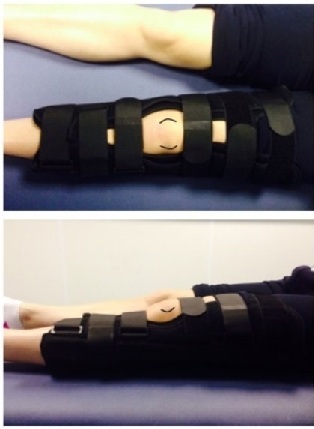
- The knee brace must be worn day and night.
- You can only take it off to wash or use a cold pack.
- You must keep your knee straight and replace the brace when you are finished.
- You are allowed to put weight through your foot.
- You may find it easier to use crutches in the early stages.
Follow up
- You will see a knee specialist about two weeks after your injury.
- They will talk about the next stage of your rehabilitation.
- If you have not received your appointment letter within one week, please contact us.
Any questions
- Contact the Virtual Fracture Clinic team if you are:
- worried about your symptoms
- cannot follow this rehabilitation plan
- have pain anywhere other than your knee.
Caring for your injury
- Remember to wear your brace. The specialist will tell you when you no longer need the brace.
- This video provides you with a guide for fitting your brace: https://vimeo.com/386673392
- Using a cold pack will help with your pain and swelling.
- You can use an ice pack or bag of frozen peas wrapped in a damp towel.
- Put this on your knee for up to 15 minutes every few hours. Make sure the ice is not in direct contact with your skin.
- Try to rest your knee, especially in the first 24-72 hours.
- Raise your leg on a stool or cushions to that it is above the level of your hip. This will help to reduce your swelling.
Exercises
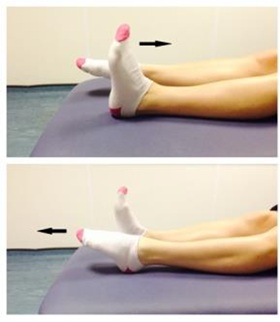
- It is important to move your ankle and foot early. This helps your blood flow and lowers the risk of a blood clot (Deep Vein Thrombosis).
- Do these exercises 3 to 4 times a day. Start today. Stop before the exercises become painful.
Ankle Exercises
- Rest with your leg supported.
- Point your foot up and down.
- Repeat this 10 times.
Static Quadriceps Exercise
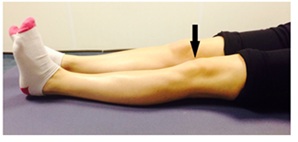
- Rest with your leg supported and straight.
- Gently tense the muscles in your thigh and try to straighten your knee further.
- Hold for five seconds and repeat 7-10 times.
Frequently Asked Questions
I am struggling with my brace. What do I do?
- Make sure all the straps are tight and your kneecap stays in the middle of the opening.
- Check it regularly, as the brace can slip down.
- If you need more advice, contact the Virtual Fracture Clinic.
I am diabetic, does this change things?
- If you have diabetes, please talk to a healthcare professional about this.
When can I start driving?
You can return to driving when:
- You are no longer using your brace
- You can walk comfortably
- You can perform an emergency stop pain free. Always test your ability to drive in a safe environment first.
How can I get a certificate for work?
- You can get a ‘Fitness for work statement’ from your GP or the doctor at your Fracture Clinic appointment.
What do I do with my boot and crutches when I no longer need them?
- We cannot reuse braces. Do not return them to the hospital.
- You can return crutches to the Fracture Clinic or A&E.
How do I contact the Virtual Fracture Clinic?
Call us on 020 7288 3310 (Monday to Friday 9am to 5pm)
email whh-tr.fracturevirtualclinic@nhs.net
With thanks to Brighton and Sussex University Hospitals NHS Trust for kindly sharing their information sheets with us with full permission to use contents and images.
Published:
19 May 2022
Review:
19 May 2024
Reference:
SC/T&O/UPF/02