

Excisional treatment for abnormal cells on the cervix (colposcopy clinic)
Patient Information Leaflet
What is an abnormal smear?
- An abnormal smear usually means that small changes have been found in the cells on the surface of the cervix (neck of the womb).
- In many cases these changes return to normal by themselves, but it is important that these changes are checked by attending for a Colposcopy.
- In some instances, these changes will need treatment, which is 95% effective.
- Infection with the Human Papilloma Virus (HPV) is known to be the main cause of abnormal cells.
- In all women and people with cervix, there is a special area on the cervix called the transformation zone, which changes due to natural hormones.
- This area is particularly vulnerable to infection with HPV.
- This virus can change the normal process of cell development and produces abnormal cells.
- Most abnormalities are mild and will disappear over time, but some require treatment.
- The abnormal cells are called Cervical Intraepithelial Neoplasia (CIN).
- This is graded one to three depending how abnormal the cells are.
- If you have Cervical Intra-epithelial Neoplasia CIN two or Cervical Intra-epithelial Neoplasia CIN three the colposcopist will usually recommend that you have some treatment to remove it to prevent cancer developing in the future.
Treatment
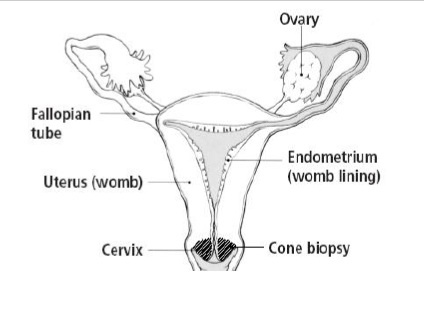
- The treatment is called Large Loop Excision of the Transformation Zone (LLETZ).
- It is a minor procedure to remove pre-cancer cells from the cervix using a hot wire loop.
- This will be performed in the outpatient colposcopy clinic where your colposcopy examination was carried out.
- Please eat as normal.
- You can bring someone with you if you want.
- There will be a Nurse present with you, who will talk to you during the procedure and support you.
- A speculum (a medical device to open your vagina) will be inserted, and solutions applied to the cervix, the same as when you had a colposcopy examination.
- Local anaesthetic is then given to numb the affected area and then the abnormal cells are removed.
- Once the local anaesthetic has been given you may feel heat and movement but no pain.
- The area is then removed and will then be sent off to be retested.
- If you have a coil fitted this may need to be removed before the colposcopist removes the abnormal cells.
- You need to use an additional method of contraception (condoms) or abstain from sexual intercourse for seven days prior to your appointment.
After the treatment
- 95% of patients who undergo treatment will have their follow-up smear return to normal.
- For the remaining 5% some further treatment may be necessary at a later stage.
- It is for this reason that regular follow-up smears are important.
- After the treatment it would be best to have the day off work as you may feel some slight period cramps type of pain.
- You will be able to return to work the following day.
- The procedure will not usually change the timing of your next period.
- You can expect to have some light blood-stained and messy discharge or light bleeding for up to one month following your procedure.
- Bleeding can be as heavy as a period on some days.
- Avoid using tampons, having sexual intercourse and swimming for four weeks. This is to reduce the risk of bleeding and infection.
- Avoid lifting heavy items that need two hands and avoid tiring physical exercise for two weeks. This is to reduce the risk of heavy bleeding.
- Avoid travelling abroad during your recovery period (four weeks) unless the Colposcopist agrees that it is safe for you to do so.
- You will usually receive a letter 4-6 weeks after, informing you of your results and of when you need to return for your follow-up appointment.
Risks and Complications
This is a very safe procedure, but there are some risks, and these include:
Bleeding - as described earlier, some bleeding is to be expected but 3% of patients will experience heavier bleeding, which may require further cautery (burning away of tissue).
If you have a heavy bleed that is not your period and soaks through a sanitary towel within two hours you should contact your GP or attend the Accident and Emergency department.
You may need to have a vaginal pack or some more treatment to stop the bleeding.
It is important that you inform your GP and Obstetrician (specialist pregnancy Doctor) when you are pregnant so they can check the length of the neck of the womb starting from 14 weeks of your pregnancy.
On rare occasions it may be necessary to manage this by inserting a stitch in the cervix.
Infection - 5% of patients undergoing treatment may develop an infection. Most commonly this occurs 10 days after the procedure.
If the vaginal discharge starts to smell or you develop a high temperature you should contact your GP as you may need a course of antibiotics.
As 95% cent of patients remain well, we do not usually prescribe antibiotics for this procedure.
Preterm labour - Having this surgery will not affect your ability to have children.
But if you are already pregnant, there is a small chance (about 4% to 5% more) that your water might break before 37 weeks. This could cause your baby to come earlier than expected.
Closure of the cervix (cervical stenosis) - this may occur in up to 2% of patients after the procedure.
People most at risk of this are those who have irregular or no periods.
This might be because of the menopause (when your body stops having periods), breast feeding after pregnancy, contraceptive injections, or hormonal disorders.
The cervical opening becomes constricted (narrowed), which can result in painful periods and in this instance difficulty in becoming pregnant.
To reduce this risk, those who have gone through the menopause and who are having this treatment will usually be advised to use hormone replacement therapy (HRT) for three months (if there are no problems) to create monthly bleeds whilst the cervix heals.
Those with a hormonal imbalance or using contraception that stops periods are advised to use a combined oral contraceptive pill for at least three months (if there are no problems).
Please talk to the Colposcopist before your operation if you have any concerns about these risks.
Further information
Please contact the colposcopy department on 020 7288 5118
Email: whh-tr.womenshealthadmin@nhs.net Monday - Friday 9.00 am to 5.00 pm
Clinical Advice (Nurses Line): 020 7288 3138.
Please leave a message and someone will get back to you within 24 hours (weekdays).