

Dupuytren's Release Surgery
Patient Information Leaflet
- This information is for patients who have Dupuytren's contracture.
- It explains what it is, the surgical treatment, any risks involved and what you need to do before and after your surgery.
What is Dupuytren's Contracture?
- Dupuytren's contracture is a condition where one or more fingers are gradually forced into a curled position (contracted) by the tightening of the fascia (a deep fibrous cord in the palm of the hand).
- It usually affects the third and little finger but can sometimes affect all fingers and the thumb.
- It is usually painless, but it can gradually get worse and may eventually pull the fingers into the palm.
What causes it?
- The cause is unknown, but it tends to run in families.
- It affects more men than women, usually in middle age.
- It is a condition that tends to affect people of northern European (Celtic or Scandinavian) descent more than others.
Treatment choices
- Surgery is the only successful way of treating this condition.
- There are different types of surgery, and the type of surgery you will be offered will depend on how bad your contracture is and if you have had surgery on it before.
- Surgical options are outlined below. Your Orthopaedic Surgeon will discuss your best option with you.
Needle Fasciotomy
- This uses a needle to cut the fascia (cord) to release the finger.
- The procedure is very simple and leaves very little scarring.
- It is more commonly used in the palm than the fingers.
- This treatment has a much higher risk of the contracture returning than other treatment options but has a very quick recovery.
Fasciectomy
- This is a surgical release of the finger.
- You will go to theatre and have the affected fascia cut out of the hand.
- The skin is then stitched, and a bandage or sometimes a plaster cast is also applied.
Dermofasciectomy
- This is a surgical removal of the Dupuytren's in which a skin graft is taken from your arm or hip.
- This graft is stitched into the palm to replace poor quality skin or to fill the gap left in the skin when a very bent finger is operated on.
Possible complications
- It is rare for problems to occur with these surgeries.
- However, the more severe the disease and the more surgery that has taken place before on the finger, the more likely a complication may occur.
Pain
- You should expect to feel some pain after surgery.
- You will be given pain medication only if your clinician thinks it is necessary.
- If it is prescribed, it will be provided to you on the day to take home.
- In rare cases some people develop Chronic Regional Pain Syndrome, which means the pain and stiffness may last for several months.
Bleeding
- Most wounds ooze a little and the wound dressing will usually soak this up. You should be fine until you are seen at the Orthopaedic Clinic.
- If there is excessive bleeding, please urgently contact the Orthopaedic Clinic on the number at the end of this leaflet and return for a change of dressing and review.
Infection
- This can occur in a small number of cases.
- If you develop a fever and your hand is swollen, red and tender then you should contact the Orthopaedic Clinic on the number at the end of this leaflet. They will arrange a Doctor's consultation for you.
- A course of antibiotics will normally cure the infection.
- The wound will be reviewed in the Orthopaedic Clinic after surgery to assess for any healing issues or any infection.
Nerve damage
- Some of the small nerves in the finger can be damaged in surgery which leads to a temporary or permanent loss of sensation in the finger.
- The nerves usually recover with time, but complete recovery cannot be guaranteed.
- It is rare for this to happen the first time that you have this surgery. However, this risk will increase the more times that you have surgery on the finger.
Stiffness
- The stiffness will depend on how severe the contracture of the finger was and the surgery. It is not always possible to fully straighten it with surgery.
- Sometimes, after surgery, your entire hand might feel stiff. This is usually because of the swelling. Time and following the after-surgery advice given to you by your clinician will help.
Skin graft
- If you need a skin graft during surgery, there is a small risk that the graft might not work.
- Usually after a graft, the wound will heal well with just wound dressings.
- Occasionally repeat surgery will be required.
Scarring
- Scars may be raised and tender for two to three months and in very rare cases, they remain thickened and tight in the palm.
- Scar tissue can continue to adapt and change for up to two years.
Will the contracture return?
- In general, after five years the recurrence rates are 85% for needle fasciotomy, 21% for fasciectomy and 8% for dermofasciectomy*.
- However, not all patients whose contracture returns need or want more treatment or surgery.
Before your surgery
A few weeks before your surgery you will have a medical assessment with a nurse.
This may include some or all the following:
- your medical history
- a blood test
- your blood pressure
- you weight
- an x-ray
- a heart tracing (ECG)
Please bring with you any medications you are taking, in their containers.
Patients taking blood thinning medication like Warfarin or Aspirin must stop taking it a few days before their operation.
Tell the nurse if you have diabetes or any allergies.
The operation will not go ahead if the medical check-up (called a pre assessment) has not been done.
Remove any hand jewellery and nail varnish before you come into hospital.
On the day of your operation please go to the Day Treatment Centre (located on the 3?? floor, opposite Imaging Department of the hospital) on the date and time given in your appointment letter.
A Receptionist will check you in and you will be asked to sit in the waiting area. You will be called by a Nurse who will prepare you for your procedure.
Stopping smoking
- Medical evidence shows that smoking makes healing take longer. In serious cases, it can even stop healing completely.
- If you smoke, it is important that you think about this information and the impact that your smoking will have on your own surgery and recovery.
- Stopping smoking during the healing phase will help your recovery from this surgery.
- For advice on giving up smoking and local support available, please refer to the following website: http://smokefree.nhs.uk or discuss this with your GP.
After surgery advice
- You must bring a friend or relative to take you home.
- You must wear a sling (if provided) for your hand when you are moving around.
- You must rest it on a pillow when sitting or in bed for the first week or until your swelling goes down.
- If you are told to wear a sling, you must remove your arm from the sling every two hours and exercise the shoulder and elbow to prevent them from getting stiff.
- Remember to also wriggle your unaffected fingers and thumb.
- Do not allow your hand to hang down by your side for long periods of time.
- Your hand will have a bulky dressing and possibly a Plaster of Paris splint which will keep the fingers straight.
- Keep this dressing dry and do not disturb the dressing until you have been seen at your follow-up appointment.
- Do not do any heavy, manual work until you have been seen at your next appointment and have been told by your clinician that you are safe to do so.
- Take painkillers as prescribed. This will help the recovery of your hand.
- Your stitches will be removed after 10-14 days during one of your follow up appointments.
Healing
- The wound normally heals within 10-14 days but the whole healing process can take up to 12 weeks.
- You will be referred to a hand therapist who, if they feel that you need one, will make you a thermoplastic splint.
- This will be done within the first few weeks after surgery to help you keep your fingers in a good position.
- You will wear this until the stitches are removed and afterwards, just overnight, until three months after the surgery.
Managing pain and swelling
- Take regular over-the-counter painkillers (such as paracetamol) until you are advised to stop.
- You may find that your hand continues to ache and you have swelling for a few weeks after your surgery: this is normal.
- Once the wound has fully healed you can use something called 'contrast bathing' to help with the swelling. You can place the hand in warm water for one minute and then place the hand in cold water for one minute, repeat six times. Try contrast bathing three to four times a day.
Using your hand
- As soon as the stitches are removed and the wound has healed, you must use your hand for light functions (for example washing, dressing and eating).
- You must use your hand to prevent stiffness.
Scar Massage
- Once the stitches have been removed and your wound has healed, you can safely let your hand get wet in a bath or shower.
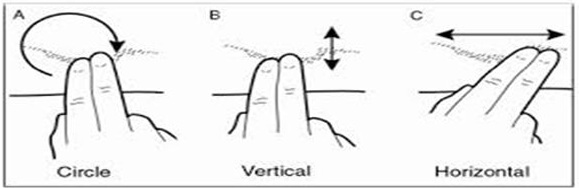
- Massaging the scar can help to reduce sensitivity and improve flexibility.
- Use an un-perfumed, water-based cream (emollient) and rub in a firm motion over the scar as shown in the diagram on the next page.
- It is the massage of the underlying scar tissue which helps the scarring, not the cream itself.
- Massage the scar 3-4 times a day, increasing the pressure gradually.
Driving
- Before driving, ensure you meet the Driver and Vehicle Licensing Agency (DVLA) standards and speak to your insurance company.
- You must be able to control the car and perform an emergency stop safely, and not be affected by pain. If this is not possible, do not drive.
Returning to Work
- You can return to work as soon as you feel ready, depending on the type of work you do.
- Do not use your hand a lot until it is completely healed.
Exercises
Initial Exercises
- The following exercises should be performed slowly and regularly every day.
- Initially pain, swelling and bruising will restrict movements. This is perfectly normal and to be expected.
- Tendon Gliding exercises are an excellent way to help you regain full movement.
- Work your way through the movements as shown in the below picture, ending with straight fingers again.
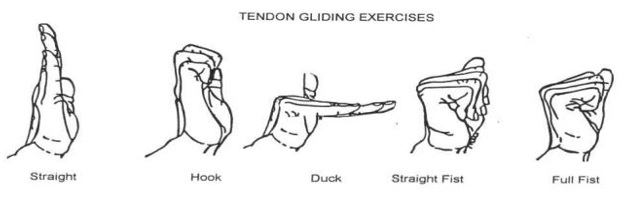
- Move your hand from one position to the next to stretch and glide the tendons. This will help improve the movement of your hand and fingers.
- Hold each position for 2 - 5 seconds. Complete 5 - 10 repetitions, 5 - 6 times a day.
- If exercises are painful, don't give up! Just take your time and increase the number of repetitions gradually.
Strengthening exercises
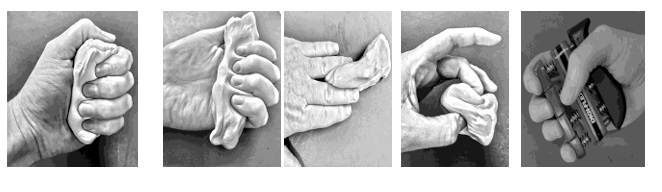
- You can start strengthening exercises with putty, as shown below, when the wound is fully healed, usually between 2 - 4 weeks.
- If you are unable to purchase putty you can use a soft sponge as an alternative.
- The following pictures show therapy putty (use soft therapy putty or playdoh) and grip exercises.
- Start with five squeezes for each exercise, holding for a couple of seconds.
- Rest for two minutes before completing a further set.
- Increase the number of repetitions for each exercise as able, three times a day.
Disclaimer
- Not all exercises are suitable for everyone, and while every precaution has been taken in selecting these exercises, they do not come without risks.
- If you have any concerns regarding your injury, or whether you should do the exercises, then you should consult your Orthopaedic Surgeon or Hand Therapist (on the numbers below) before beginning any exercises in this leaflet.
- The exercise plans shown in this leaflet are designed to be used as a guide and a point of reference; they can be modified and progressed under the supervision of your Hand Therapist.
(*Figures from NHS England: https://www.england.nhs.uk/wp-content/uploads/2022/07/Making-a-decision-about-Dupuytrens-contracture.pdf
Further information
Please contact the Orthopaedic Clinic if you require any further information before your surgery or if you have not received a post-surgical review appointment.
Tel: 020 7288 5659/3799
Email: whh-tr.orthopaedics@nhs.net
Your Orthopaedic Surgeon will refer you to Hand Therapy if required.
If you have not been given an appointment with the Hand Therapist within one week after your surgery, please contact the Physiotherapy Department to book an appointment.
Tel: 020 7288 5660