

Carbon monoxide testing in pregnancy
Patient Information Leaflet
What is Carbon Monoxide?
- Carbon Monoxide (CO) is a poisonous gas.
- You cannot smell it, see it or taste it.
- CO is absorbed into your blood stream when you breathe it in.
- CO is found in both indoor and outdoor air. Some of the causes for it are listed below.
Indoor air
- Tobacco smoke
- Second hand smoke or passive smoking of any tobacco product
- Smoke from burning charcoal
- Open fire and woodburning stove
- Smoke from burning candles and incense
- Unvented kerosene heaters
- Fumes from faulty gas appliances (gas boilers, gas cookers and heaters)
Outdoor air
- Tobacco smoke
- Second hand smoke or passive smoking of any tobacco product
- Traffic exhaust fumes
- Fumes from leaking chimneys and furnaces.
How can CO affect my baby?
- When you breath in CO, the gas is absorbed into your bloodstream and replaces some of the oxygen going into your lungs.
- This reduces the amount of oxygen going into you and your baby's body.
- This is because CO is absorbed into your bloodstream 200 times more quickly than oxygen.
- Breathing in CO is very dangerous when you are pregnant as it deprives your baby of oxygen.
- CO in your blood (and your baby's blood) can make your placenta not work as well as it should.
- This might cause your baby to move less to save energy, which can affect how your baby grows and develops.
- Breathing in CO can also increase the risk of miscarriage, stillbirth and Sudden Infant Death Syndrome (SIDS).
How can you test for Carbon Monoxide?
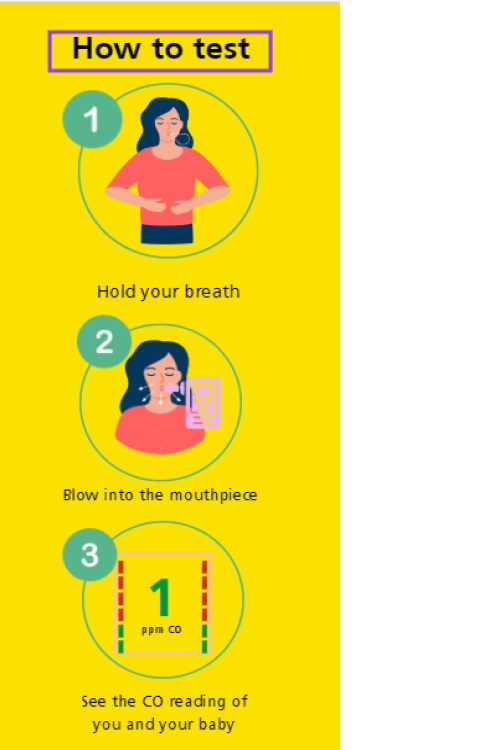
- During your pregnancy you will be regularly tested for CO levels in your blood using a CO monitor.
- This tests the amount of CO in your bloodstream through a simple breath test.
- The CO test results are measured in part per million (ppm), which means the number of CO molecules in one million parts of air.
- Pregnant people with a CO reading of 4ppm or higher will be referred to our Maternity Tobacco Dependency Specialist for advice.
Why 4ppm or higher?
- We refer pregnant people with a CO reading of 4 ppm or higher because carbon monoxide is absorbed quickly into the bloodstream during pregnancy.
- This means that you and your baby can be exposed to higher levels of CO more quickly.
- Whilst you can get rid of the CO in your bloodstream (for example, by breathing it out), your baby cannot.
- This means that your baby will have 10-15% higher levels of CO in their bloodstream.
Why will a referral to the Tobacco Dependency Specialist be done even if I am a non-smoker?
- The Tobacco Dependency Specialist can advise you about the possible causes of higher levels of CO in the environment (outdoor air) and exposure to second-hand tobacco smoke, faulty boilers and other causes (indoor air).
- They can also advise you about CO levels in your home, including your landlord’s legal responsibility to make sure gas appliances meet gas safety standards.
- They can also explain other possible causes of raised CO levels indoors.
- Advice and support are also available for smokers living in or visiting your property.
Where can I find out more information?
- Gas Safe Register: Carbon monoxide poisoning https://www.gassaferegister.co.uk/media/3639/gsw-carbon-monoxide-factsheet.pdf
- Domestic gas health and safety
https://www.hse.gov.uk/gas/domestic/index.htm - NHS: Carbon monoxide poisoning
https://www.nhs.uk/conditions/carbon-monoxide-poisoning/
Who to contact if I am worried about Carbon Monoxide exposure?
- If you are worried about a faulty or leaking boiler or gas appliance, please contact the gas emergency line on 0800 111 999 immediately and ensure that you contact your landlord if applicable.
- If you think you or any of your household have symptoms of CO poisoning, then contact 999/111.
- If you have any questions in relation to treating tobacco dependency and CO, please contact your Midwife or the Maternity Tobacco Dependency Service.
Useful Contacts
Whittington Health Maternity Service: 020 7288 5586
Whittington Health Maternity Tobacco Dependency Service: whh-tr.maternitytds@nhs.net
Published:
19 Dec 2024
Review:
19 Dec 2026
Reference:
ACW/Mat/COTestPreg/01