

Axial spondyloarthritis
Patient Information Leaflet
- Axial spondyloarthritis is a type of arthritis that mainly affects the spine and the joints where the spine meets the pelvis, called the sacroiliac joints.
- It causes inflammation, which can lead to pain and stiffness in the back, especially in the lower back and hips.
- Axial spondyloarthritis is a name that covers different types of problems with the spine and joints. It includes:
- Ankylosing spondylitis (AS): This is when the sacroiliac joints (where the spine and pelvis meet) or the spine itself show changes on an x-ray.
- Non-radiographic axial spondyloarthritis: This is when there are no changes visible on an x-ray, but doctors can see inflammation using an MRI scan or the person has symptoms.
- Around 7 in 10 people with non-radiographic axial spondyloarthritis have visible inflammation in the sacroiliac joints or the spine on an MRI scan.
- Around 3 in 10 may not have any inflammation visible on an MRI scan, even if they have symptoms of back pain.
- Some may never go on to develop visible inflammation on an MRI scan. The reasons for this are still not really understood but may be due to the sensitivity of MRI.
- It often starts in people who are in their late teens or 20s.
Symptoms
- Back pain and stiffness that slowly start to happen over weeks or months.
- Early morning stiffness lasting more than 30 minutes, wearing off during the day and with activity/exercise.
- Lasting for three months or more.
- Feeling better with exercise and worse with rest.
- Weight loss, especially in early stages.
- Fatigue (feeling of low energy) or tiredness.
- Night pain, usually waking in the second half of the night.
- Pain in one or both buttocks and sometimes back of the thighs.
Other possible symptoms include:
- Soreness at the heel or in the arch of your foot.
- Pain and swelling in a finger or toe.
- Tenderness at the base of your pelvis, which can make sitting on a hard chair uncomfortable.
- Chest pain or a tightness around the chest that comes on gradually.
- This can make it difficult to take deep breaths. Your ribs may feel very tender, and you may find that you are short of breath, after even gentle activity.
- Coughing or sneezing may cause discomfort or pain.
- Inflammation of the bowel.
- People with ankylosing spondylitis can develop bowel problems known as inflammatory bowel disease (IBD) or colitis.
- It is a good idea to see your doctor if you have diarrhoea for more than two weeks or have bloody or slimy poos.
- Depression and anxiety.
- Inflammation of the eye, called either uveitis or iritis.
- The first signs are usually a painful and sometimes red eye. It may become uncomfortable to look at bright lights.
- If one or both of your eyes are painful or red, or if you have changes to your vision such as partial loss of sight, blurred vision, floaters or sensitivity to light, you must get medical help as soon as possible.
- The best place to go is an eye casualty department. Your Optician will be able to tell you where the nearest one is.
- You could also go to a GP surgery or an accident and emergency department.
- Treatment is usually with steroid eye drops, which are generally very effective.
Diagnosis
- Symptoms of ankylosing spondylitis can be similar to common back problems, especially in the early stages.
- Because of this, many people put up with the pain for some time before seeking help.
- It is usually diagnosed by a Rheumatologist. These are Doctors who specialise in conditions affecting the joints, bones and muscles.
- There isn't one test that can definitely tell if you have ankylosing spondylitis.
- Doctors will figure it out by looking at several things, including:
- The history of your condition and the symptoms you've experienced.
- Whether pain and discomfort is waking you up during the second half of the night
- A physical examination
- Blood tests, which may show inflammation
- X-rays or a magnetic resonance imaging (MRI) scan
- Your age. It can be diagnosed at any age, but most often begins before the age of 40, and often much younger.
- There are disease activity and pain scores that can help doctors diagnose ankylosing spondylitis.
- Your doctor will ask if you have key symptoms, such as swollen and painful joints, especially around the spine, and fatigue.
- You'll be asked if you have pain in the mornings and how long for. Your answer to these questions could help lead to a diagnosis.
Treatment
- Several treatments can slow it down and treat pain and stiffness.
- Exercise and close attention to your posture are just as important to keep your spine mobile and help you to live a normal life.
- Some of the drugs below can only be prescribed by a Rheumatology Consultant.
Drug treatments
Painkillers and non-steroidal anti-inflammatory drugs (NSAIDs)
- Painkillers, such as paracetamol and non-steroidal anti-inflammatory drugs (NSAIDs), such as ibuprofen, are usually the first choice of treatment for ankylosing spondylitis.
- For people who have symptoms that cannot be controlled by anti-inflammatories, other drugs are available to help reduce pain or limit the effects of the condition.
Disease-modifying anti-rheumatic drugs (DMARDs)
Drugs such as Sulfasalazine and Methotrexate, can treat arthritis in your arms and legs, although they're not usually effective for spine/back symptoms.
These drugs can reduce the amount of inflammation that happens in your body. This means that as well as treating symptoms, they can help prevent joint damage.
These drugs can sometimes take several weeks or months to take effect.
When they do take effect, they can make a big difference to your pain and stiffness. They are often long-term treatments.
When taking DMARDs, you will need regular check-ups and blood tests to monitor their effect.
Biological therapies
- Biological therapies are newer treatments that can be very effective for some people with ankylosing spondylitis and related conditions.
- These drugs have a more targeted approach to stop inflammation than the older DMARDs.
- They are not suitable for everyone and can only be prescribed if your condition cannot be controlled with anti-inflammatory drugs and physiotherapy.
- There are a group of biological therapies called anti-TNF drugs.
- The effect of biological therapies will be monitored, and you will need to complete questionnaires regularly to check how well you are responding to treatment.
Steroids
- Steroids can be used as a short-term treatment for flare-ups.
- They are usually given as an injection into a swollen joint or as a slow-release injection into a muscle.
- They can also treat painful tendons, for example at the heel, although they are not repeated too often as they can cause tendon weakness.
- Occasionally, you may be given a course of steroid tablets called prednisolone.
- While steroid tablets can be very effective at improving pain and stiffness, you may develop side-effects if you use them for long periods.
- If you have been prescribed steroid tablets, talk to your Doctor about the risk of side effects and how you might be able to reduce your chances of getting them.
- As with any drug, report any side effects to your doctor immediately.
- If you develop eye inflammation, it will usually be treated with steroid eye drops.
- In more severe cases of eye inflammation, steroids may be given as tablets or as an injection into the eye.
Physiotherapy
- Physiotherapy is a very important part of the treatment for ankylosing spondylitis.
- A Physiotherapist can put together a programme of exercises to improve your muscle strength and help you maintain mobility in your spine and other joints.
- It is especially important to exercise your back and neck to avoid them stiffening into a bent position.
- Many people with ankylosing spondylitis find exercising in water helpful.
- You can continue these exercises at your local swimming pool or with your local National Ankylosing Spondylitis Society (NASS) group.
Management
- If you have ankylosing spondylitis, keeping active can really help you manage your condition.
- Regular exercise is good for the range of movement of your back and to stop your spine from stiffening.
- Start slowly and gradually build up the amount of exercise you do.
- Too much rest will increase the stiffening in your spine.
- If you are in a lot of pain and finding it difficult to exercise, talk to your Doctor or a Physiotherapist.
- As well as being good for your back, exercise is important for your heart and lungs, and your overall health.
- It can also lift your mood and boost your confidence.
- Specific simple exercises for your back, chest and limbs will help keep them supple.
- You may find stretching exercises after a hot shower or bath are especially helpful to ease stiffness in the morning.
- Try to do at least some exercise each day. Remember you can take painkillers beforehand to help you exercise.
- Pilates, Yoga and Tai Chi may be useful as these can help with posture, strength and flexibility.
- You can ask your Physiotherapist for advice if you have any doubts or questions about a particular activity. If you go to a class, tell the instructor about your condition.
- Swimming is one of the best forms of exercise because it uses lots of muscles and joints without jarring them and because the water supports the weight of your body.
- Swimming provides a great overall workout that improves your strength, stamina and flexibility.
- Speak to your Physiotherapist or a swimming instructor if you have discomfort when swimming, as a different stroke or slight change to your technique could help.
- As an alternative to swimming, your local pool might run aerobic classes in shallow or deep water which you could try.
- The key is to find something you enjoy as this will help you to keep doing it.
- The National Axial Spondyloarthritis Society (NASS) offers regular exercise classes, run by Physiotherapists, at various centres around the country.
- NASS can also provide information about gym-based exercise, an exercise DVD and mobile app.
Exercises
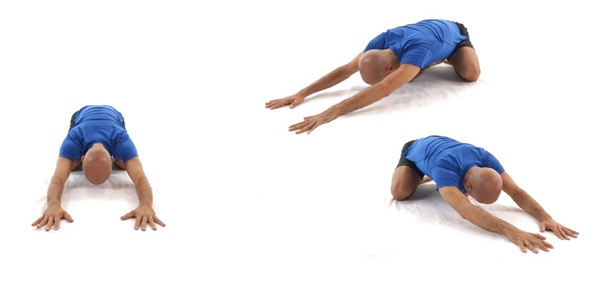
Child pose
- Start on all fours and push your hips back so your buttocks rest on your heels.
- You may want to have your knees apart to be more comfortable.
- Reach forward with your hands and hold the stretch.
- Next, reach to one side with both hands and hold the stretch.
- Then, reach to the other side and hold the stretch.
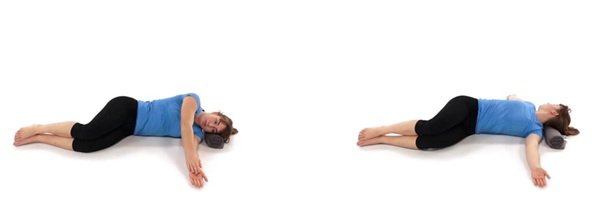
Arm openers
- Lie on your side with your hips and knees flexed, head supported, and arms extended in front of you with your hands together.
- Protract your shoulder blade by reaching forward with your top hand, then retract back and slowly lift your arm and rotate your trunk to reach the ground on the opposite side.
- Make sure you look at your fingertips during the entire movement to make sure you are rotating your spine and not only moving your arm.
- Come back to the starting position and repeat.
- Your lower back, hips and legs should remain still during the exercise.
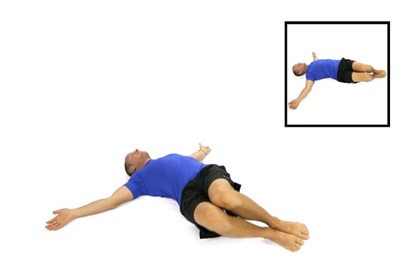
Lumbar rotation
- Lie on your back with your knees bent and your feet on the floor (crook lying).
- Place your arms out to the side for stability.
- Slowly lower your legs to one side until you feel a gentle stretch.
- Return to the central position and repeat.
Keep your knees together during the movement.
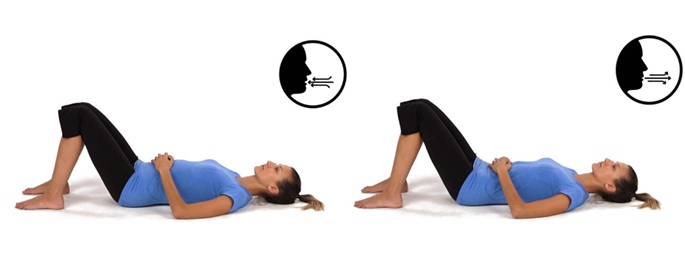
Breathing
- Lie on your back with your knees bent and your back in neutral position (slightly arched).
- Place your hands on your stomach and concentrate on your breathing.
- Inhale (breathe in) while expanding your stomach without any trunk or chest movement and exhale (breathe out) without forcing.
- There should be a short pause after each exhale before the next inhale.
Further information
National Axial Spondyloarthritis Society https://nass.co.uk/
Arthritis.uk - Ankylosing spondylitis and related conditions information booklet: https://shop.arthritis-uk.org/products/ankylosing-spondylitis-information-booklet
NHS.uk - Overview of Ankylosing spondylitis: https://www.nhs.uk/conditions/ankylosing-spondylitis/
MSK CATS and Physiotherapy Services:
Tel: 0207 288 3317
Email: whh-tr.mskinterfaceservice@nhs.net