

Ankle sprain
Patient information factsheet
Introduction
- Ankle sprains can be very painful, but they usually get better on their own.
- They can normally be treated at home without seeing a doctor, but it can sometimes be a good idea to see a GP to get it diagnosed.
- You may have pain in your ankle and notice that it is red and painful for a week or two.
- If your ankle sprain doesn't improve in that time or starts to get worse, contact your GP or pharmacist.
- For the first few days after spraining your ankle, follow the steps of RICE therapy:
- Rest - for the first 24 to 48 hours, avoid any hard exercise, but continue to move around.
- Ice - use an ice pack on the ankle for up to 20 minutes every few hours. Frozen vegetables wrapped in a tea towel will also work.
- Compression - some people find it helpful to wear a support bandage on their ankle, but many people don't need this. A pharmacist will be able to give you advice.
- Elevate - if your ankle is very painful and swollen, keep it raised on a pillow for short periods throughout the day.
- A pharmacist can give you advice on drugs and creams that could help reduce the pain and swelling in your ankle.
- These include painkillers like paracetamol, or non-steroidal anti- inflammatory drugs (NSAIDs) like ibuprofen.
- Putting some weight on your foot by doing things like walking, can really help. Keep moving around, if possible.
- Avoid doing any strenuous exercises (such as running), until the pain and swelling has cleared up.
- It is important to keep moving so that your muscles and ankle don't get stiff.
- Start some gentle exercises once your ankle is less painful.
- You'll need to do exercises that keep your ankle flexible and build up your strength and balance.
Exercises
- Many people find the following exercises helpful. If you need to, adjust the position so that it's comfortable.
- Do these exercises regularly.
- Do each one a few times to start with, to get used to them, and gradually increase how much you do.
Range of movement exercises
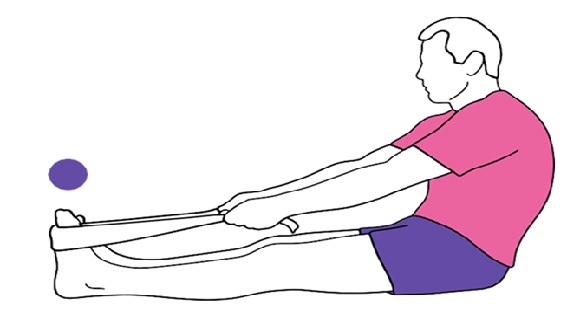
1. Achilles tendon and plantar fascia stretch
Loop a towel around the ball of your foot and pull your toes towards your body, keeping your knee straight.
Hold for 30 seconds. Repeat 3 times on each foot. Take care with this position if you have back problems.
2. Wall push
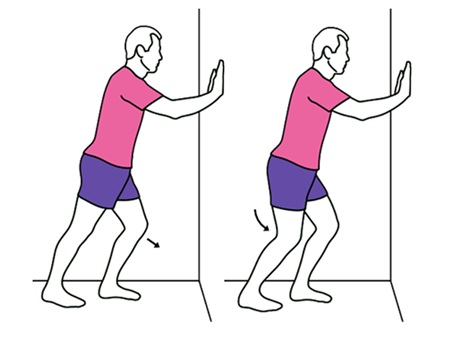
(a) Facing a wall, put both hands on the wall at shoulder height and place one foot in front of the other. The front foot should be approximately 30 cm (12 inches) from the wall.
With the front knee bent and the back knee straight, bend the front knee towards the wall until the calf in your back leg feels tight. Relax and repeat 10 times.
Repeat (a) but bring the back foot forward a little, so that the back knee is slightly bent. Repeat this 10 times.
3. Alphabet writing
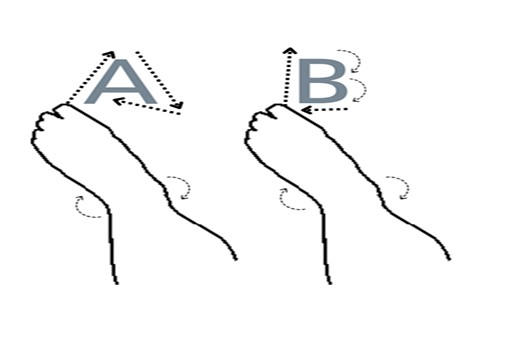
- While sitting down, write the alphabet in the air with your big toe, by only moving your ankle.
- Try to write the whole alphabet twice a day.
Strengthening exercises
4. Ankle out
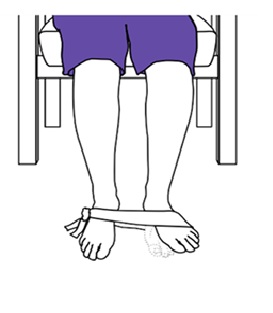
- It is important to strengthen the muscles that turn your ankle outwards.
- Make a loop out of a piece of elastic fitness band, and hold it in place, either with the leg of a table or chair, or with your other foot.
- Place your injured foot in the loop.
- Keeping your heel fixed on the ground, turn your toes outwards against the resistance of the band.
- Bring your foot back to the original position slowly. - Build up to repeating this 10 times. Do the set 3 times a day.
Balancing exercises
This is the most important exercise, as it can help prevent future sprains.
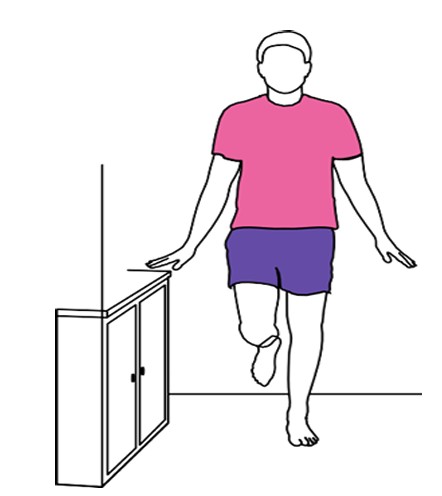
5. Basic balance
- Using a stable object such as a kitchen counter for support, balance on the injured foot.
- Build up how long you do this for, aiming for one minute. Try to do this three times.
- Repeat the set twice a day.
- Take any opportunities to practise standing on one leg - building it into your daily activities will help you get better.
6. Pillow balance
- When you feel confident with basic balance exercise, you can make it harder by standing on a cushion or pillow.
- Build up the amount you do slowly.
7. Balance with eyes closed
- When you can easily balance on a pillow, and if you're feeling confident, go back to standing on the floor.
- Repeat the basic balance exercise with your eyes closed.
Contact
- MSK CATS and Physiotherapy Services
Tel: 0207 288 3317
Email: whh-tr.mskinterfaceservice@nhs.net
Associated leaflets in other languages
Published:
20 Mar 2025
Review:
20 Mar 2027
Reference:
ACS/MSKCATS/AnkSpr/03