

Antegrade ureteric stent insertion
What is an antegrade ureteric stent?
- An antegrade ureteric stent is a small flexible tube.
- It is placed from your kidney into your bladder. It helps urine drain normally when the ureter (the tube that carries urine from your kidney to your bladder) is blocked.
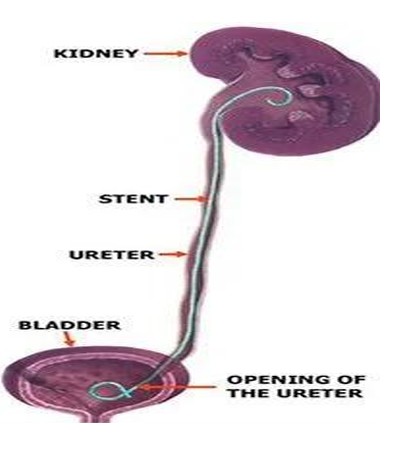
"Antegrade" means the stent is inserted from the top downwards, through the kidney and ureter, rather than from the bladder up.
It is often used if:
- You have a blockage in your ureter (e.g., from a stone or scar)
- Urine cannot drain from the kidney properly
- You have already had a nephrostomy tube (a drain from the kidney to the outside) and are moving to internal drainage.
Why do you need this procedure?
Your Doctor has recommended an antegrade ureteric stent because imaging tests have shown that your ureter is not letting urine pass normally.
The stent allows urine to flow from the kidney into the bladder without needing a drain bag outside your body.
Before the procedure
Preparation
- You may be asked not to eat or drink for several hours before the procedure, depending on your appointment time.
- Please discuss with the Doctor whether you need to stop any medicines.
- If you take blood thinners (e.g., warfarin, apixaban), you may be asked to stop these before the procedure.
- Tell your medical team if you have allergies, especially to X-ray contrast dye, or if you are pregnant.
- You will be asked to sign a consent form after the risks and benefits have been explained.
Who you will see?
- A specially trained Interventional Radiologist and Radiology team will perform your procedure.
- They are experts in using imaging to guide minimally invasive treatments.
During the procedure
- You will change into a hospital gown and may have a cannula (small tube) placed in your arm to give medications.
- You will lie on the X-ray table, usually on your stomach.
- The skin over your kidney will be cleaned and numbed with local anaesthetic.
- You may already have a tube in the kidney (nephrostomy), which will be used to access the ureter. If not, we will insert a new nephrostomy.
- The stent is then placed over the wire so urine can bypass the blockage.
- In some cases, a temporary external nephrostomy tube may be left and removed later.
Will it hurt?
- The local anaesthetic can sting at first, but most people only feel pressure or pushing as the stent is positioned.
- The bladder will be inflated with contrast during the procedure which will also feel uncomfortable, and you will feel the need to urinate (pee).
Duration
- Expect to be in the Radiology department for around 1 hour, although times can vary.
After the procedure
- You will return to your ward and be monitored (pulse, blood pressure, comfort level).
- You may remain in bed for a few hours until you have recovered from sedation/local anaesthetic.
Risks and complications
Antegrade ureteric stenting is usually safe, but possible complications include:
- Failure to place the stent if the blockage cannot be passed. A nephrostomy may be reinserted and a second attempt planned.
- Bleeding from the kidney and blood in the urine, usually minor but occasionally requiring further treatment.
- Leakage of urine or a fluid collection inside the abdomen (stomach area) that may need draining.
- Infection of the kidney or surrounding area, usually treatable with antibiotics.
- Very rarely, damage to the ureter or bladder may occur.
Living with your stent
- The stent allows normal urine drainage, and you can usually carry on with daily activities.
- You may notice some bladder or kidney discomfort, or changes in urinary frequency.
- If your stent needs to stay in place long-term, it is typically replaced every 3 to 6 months as advised by your hospital team.
- This is performed under general anaesthetic by the urology team
- Contact your medical team if you experience severe pain, fever, the stent dislodging, or difficulty passing urine.
Contact our service
If you have any questions about this procedure, your hospital team, Urologist, or Radiologist are available to discuss your care and answer your concerns before or after your appointment.
For questions about your appointment at the Imaging Department please contact us on 020 7288 5888 (Monday to Friday from 9am to 3pm).