

Third or fourth degree tear - advice to improve postnatal recovery
Patient information factsheet
What are third and fourth degree tears?
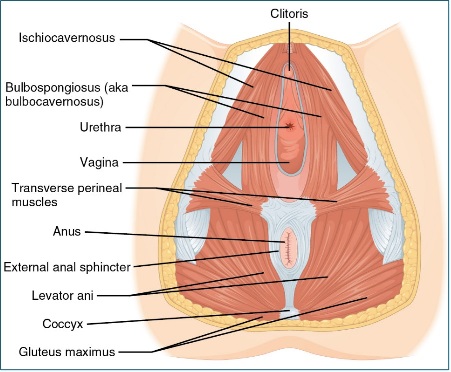
- Third and fourth degree tears are injuries to the perineum, the area between the vagina and the anus.
- They affect the pelvic floor muscles and the ring of muscles around the back passage, including the internal and external anal sphincter muscles.
- Classification is based on the depth of tear:
- 3a - less than 50% of EAS thickness
- 3b - more than 50% of EAS thickness
- 3c - both EAS and IAS injured
- 4 - injury to sphincter complex (IAS and EAS) and lining of the anus
The Female Perineum
What might cause a third or fourth degree tear?
- First vaginal birth
- Assisted birth (forceps or ventouse)
- After an episiotomy (a cut made during birth)
- If the baby is over 4kg
- Long pushing stage or very quick birth
- Baby’s position during labour.
What are the symptoms of third and fourth degree tears?
- The pelvic floor and anal sphincter muscles help keep your anus closed until you are ready to go to the toilet.
- After a severe tear during childbirth (a third or fourth degree tear), some women may have weaker muscles or sometimes minor nerve damage.
- This can make it harder to control bowel movements.
- Common problems include:
- Trouble holding in gas (wind)
- A sudden strong need to go to the toilet
- Leaking faeces (poo) before reaching the toilet
- Weak pelvic floor muscles can also sometimes cause urine (wee) leaks.
- These problems are often small and may get better over time, but sometimes they can last longer.
- Some women only notice them many years later. This is because the muscles in that area can get weaker as you get older.
- Doing pelvic floor exercises after having a baby can help lower the chance of problems in the future.
- It is strongly recommended that you go to a Postpartum Pelvic Floor Clinic or see a specialist pelvic health Physiotherapist.
- They will check you properly and give you the right help.
Initial medical treatment
- After your baby is born, a Midwife or Doctor will check your vagina and back passage to see how bad the tear is.
- An experienced Doctor will repair the tear in an operating room.
- You will be given strong pain relief, like an epidural or spinal anaesthetic, so you don’t feel pain during the repair.
- After the repair, you will be given antibiotics to help prevent infection.
- You will also be given laxatives (medicine that helps you poo more easily) so your poo stays soft.
- This helps the area heal and stops you from straining your muscles and stitches.
Pain relief
- While you are in hospital, you will be given medicine to help with pain. When you go home, you can take pain medicine when you need it.
- Ice can help reduce swelling and pain in your perineum.
- Use an ice pack, like a bag of frozen peas or a frozen water-filled condom.
- Wrap it in a towel first, then place it on the area between your vagina and back passage (the perineum) for 10 minutes.
- Make sure the ice is covered in a towel to avoid burning the skin.
- Repeat several times a day, for as many days as you feel necessary.
- Sitting in a cool, shallow bath can also help. It can reduce swelling and keep the area between your vagina and back passage clean, which helps it heal.
- For the first 2 days after your baby is born, don’t do too much and rest when you feel tired.
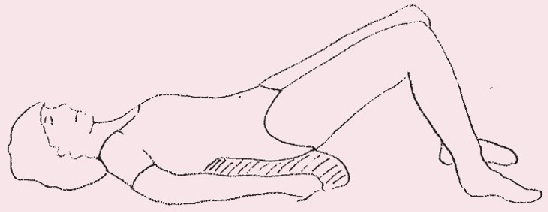
- Try lying on your back with your knees bent and a pillow under your hips. This helps lift the area and can reduce swelling.
Resting position
Positioning
- It is important to find a comfortable position for feeding your baby, resting, and sleeping.
- You may find it more comfortable to lie on your side with a pillow between your knees.
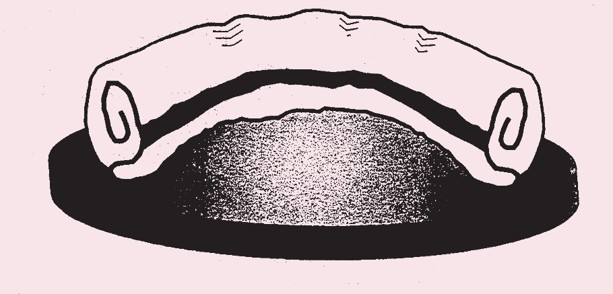
- Try sitting on a rolled towel in an upside down “U” shape on the chair.
Bladder and bowel
- Pouring water over your perineum when you pass urine (pee) can help stop a stinging feeling.
- Try not to get constipated.
- Drink 1.5 to 2 litres of drinks each day that don’t have caffeine, like water, herbal tea, or squash.
- If you are breastfeeding, try to drink 2.5 to 3 litres a day.
- Eat lots of fruit and vegetables - about 5 to 10 portions a day.
- When using the toilet, put your feet on a small stool so your knees are higher than your hips, and lean forward with your elbows on your knees.
- You may also feel more comfortable holding a pad or tissue against the sore area when you poo.
Pelvic floor exercises
- Start pelvic floor exercises as soon as possible after giving birth.
- Exercises can promote healing and reduce perineal pain.
- Exercises are extremely important for rebuilding strength.
- Read a Pelvic Floor Exercise leaflet for full instructions.
How to do pelvic floor exercises
Tighten and lift the muscles inside your bottom, vagina, and wee passage.
It should feel like you are trying to stop wind, squeeze your vagina, and stop wee at the same time.
The muscles should lift up and forward.
In the first week after birth, do this gently and only as much as feels comfortable.
After one week, you can try to squeeze harder.
Slow squeezes:
- Tighten the muscles and hold for up to 10 seconds.
- Then relax for 10 seconds. Repeat 10 times.
Quick squeezes:
- Tighten the muscles quickly, then relax straight away.
- Repeat 10 times.
Try to do these exercises 5–6 times a day for the first 3 months after birth.
After that, do them 3 times a day.
Sexual intercourse
- Wait until you feel ready. Everyone is different.
- Many women wait about 3 months after having a baby before starting again.
- Wait until:
- Bleeding has stopped
- The tear or scar has healed
- o You do not feel pain or discomfort in your vagina
- You may need to use lubricant to make it more comfortable.
- Try different positions if it hurts.
- Some women find it easier and less painful when they are on top because they have more control.
What happens next?
- A check-up with your GP or hospital doctor about 6 weeks after your baby is born will be arranged.
- An appointment between 6 and 12 weeks in a Postnatal Pelvic Floor Clinic or with a specialist pelvic health Physiotherapist will be arranged.
- They will check how your bladder, bowel, and muscles are working.
- We strongly recommend going to this appointment, even if you feel fine and have no symptoms.
- This is a chance for you to ask questions about your tear, your recovery, and what it might mean for the future.
- You may be offered tests, like an ultrasound scan of the tear or other checks to see how strong and sensitive the muscles are.
- The pelvic floor team may include different specialists, such as a Doctor, Physiotherapist, Midwife, or Nurse who helps with bladder and bowel problems.
- You can be referred by your GP to this clinic for up to one year after your baby is born.
- If you have not been given an appointment, contact your hospital postnatal ward or pelvic health Physiotherapy team.
- You may benefit from physiotherapy treatment to help recover your muscle strength.
- If you have poor control of bowel movements or have difficulty doing pelvic floor muscle exercises, please contact your local Pelvic Health Physiotherapy team.
Labour debriefing appointment
- You can ask for a special appointment to talk about your labour experience in detail with a Doctor and Midwife. This is called a labour debriefing appointment.
- You can arrange this by asking for a referral at any of your postnatal hospital appointments.
- You can also ask for it yourself at any time, even up to a year later, through the hospital Patient Advice and Liaison Service (PALS).
- If you feel that you would like to be referred to a women’s health counselling service, please request a referral at one of your postnatal hospital appointments or through the hospital Patient Advisory Liaison Service.
| Type of Appointment | Date and Time |
|---|---|
| Six Week Postnatal Check | |
| Postpartum Pelvic Floor Clinic | |
| Specialist Pelvic Health Physiotherapist |
Resources
International Urogynecological Association (IUGA)
Provides evidence-based patient information translated into several languages.
Website: https://www.yourpelvicfloor.org/conditions/
Pelvic, Obstetric & Gynaecological Physiotherapy (POGP)
Provides evidence-based patient information which may be recited (audio) in many languages.
Website: https://www.thepogp.co.uk/patient_information/default.aspx
Royal College of Obstetricians and Gynaecologists (RCOG)
For patient information and leaflets on many topics including exercise.
Website: https://www.rcog.org.uk
Contact our service
Whittington Bladder and Bowel Care Service
Email: whh-tr.bladderandbowel@nhs.net
Webpage: https://www.whittington.nhs.uk/?c=33288
Whittington Pelvic Health Physiotherapy
Email: whh-tr.outpatienttherapy@nhs.net
Webpage: https://www.whittington.nhs.uk/?c=42977
North central London perinatal pelvic health service - Royal Free London
Email: rf-tr.nclpphs@nhs.net
Webpage: https://www.royalfree.nhs.uk/services/maternity-services/maternity-support/north-central-london-perinatal-pelvic-health-service