

Diastasis rectus abdominus muscle – advice and management
Patient information factsheet
What is diastasis rectus abdominis?
- Your stomach has 4 layers of muscles. The top layer is called the rectus abdominis.
- It runs from the bottom of your ribs down to your pelvis. It has 2 sides (left and right).
- The two sides are joined in the middle by a strong band called the linea alba.
- During pregnancy, your body makes hormones that change how your muscles and ligaments work.
- These hormones make your muscles and ligaments softer and more relaxed.
- This helps your body get ready for pregnancy and giving birth.
- As your hormones change and your baby grows, your womb (uterus) gets bigger.
- This can make the tissue between your stomach muscles stretch, becoming thinner and wider.
- This is normal during pregnancy and after having a baby.
- Many women get this condition during pregnancy: about 33% by the second trimester, and up to 100% by the third trimester.
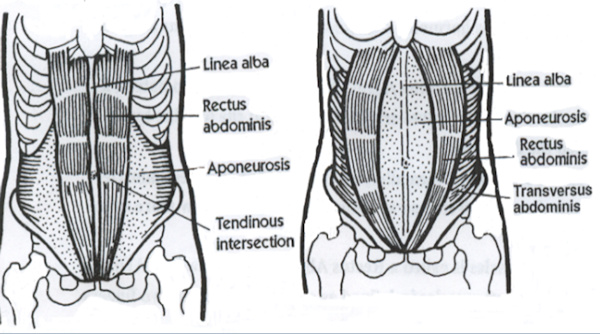
Signs and symptoms
- You may see your stomach bulge or “dome” in the middle when you move in certain ways.
- You might also notice a gap between your stomach muscles down the centre.
- If this happens, try to change how you move. Use your deep stomach muscles to help support your body.
What about after my baby is born?
- After your baby is born, you might still see a gap or bulging (doming) in your stomach muscles during some movements.
- If this happens, try to change how you move to make it easier on your body
- You may also have lower back pain or feel weak in your stomach and core muscles.
- Your pelvic floor muscles work together with your tummy muscles to support your back and pelvis.
- They also help support your bladder, bowel, and sexual function.
- Try the exercises below to help strengthen your deep stomach and pelvic floor muscles.
Deep Abdominal Exercises
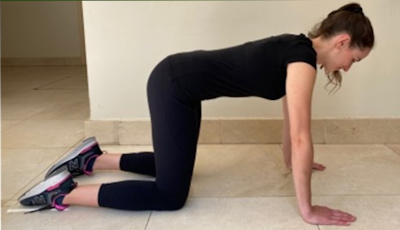
- Your deep abdominal muscles help to support and strengthen your back and pelvis.
- Gently draw lower tummy muscles in towards your spine. Hold this position for up to 10 seconds as you continue to breathe normally. Avoid bracing your abdomen or holding your breath. Rest for 5-10 seconds, then repeat until you get tired or for a maximum of 10 repetitions.
- You can exercise these muscles in any position; for example, lying on your side, sitting, on all fours and standing.
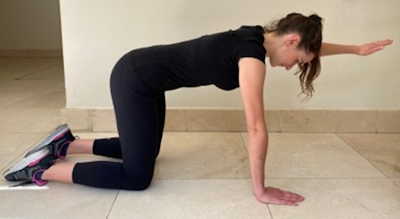
- To progress this exercise, lift one arm in front whilst you keep your deep abdominal muscles drawn in. Keep your shoulder blades still and your back level. Hold this position for up to 10 seconds and then bring back to the resting position. Repeat up to 8-10 times alternating arms.
Pelvic floor exercises
How do I do a pelvic floor exercise?
- Tighten the muscles around your back passage (bottom), vagina, and front passage (urethra)
- It should feel like you are trying to stop yourself from passing wind and urine (pee) at the same time
- Don’t stop and start your pee when you go to the toilet
- This is not a safe or recommended way to exercise your pelvic floor muscles
- You should aim to do 10 long holds and 10 short lifts 3 times each day.
- Practice these in lying or sitting to start with and then aim to progress into standing.
- Apps such as NHS Squeezy can be helpful to get you into a good routine. For the first 12 weeks postnatal you should do these 5-6 times per day.
Long holds:
This helps make your muscles stronger and able to work for longer.
- Hold the squeeze for up to 10 seconds
- Rest for 5–10 seconds
- Repeat until you feel tired, or do up to 10 times
Short Lifts:
This helps the pelvic floor so that it can react to stresses such as coughing, laughing or exercise.
- Quickly tighten your pelvic floor muscles, then fully relax them
- Repeat this pattern of tighten and relax
- Do it up to 10 times
- Try to make each squeeze strong.
Advice and self-management for the first 6 weeks postnatal
- Avoid sit ups/stomach crunches or similar exercises.
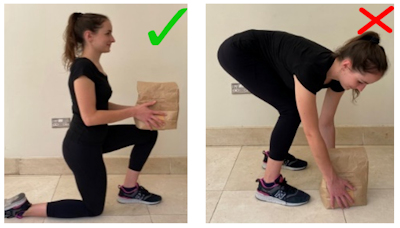
- Try to avoid heavy lifting. If you must lift, try to bend down on one knee rather than bending from your back (see picture). Draw in your lower stomach muscles and buttock (bottom) muscles to help support your back and pelvis as you return to standing.
- Keep good posture when bathing or caring for your baby.
- Make sure surfaces are at a comfortable height.
- This helps you avoid bending too far down or reaching too high.
- Avoid straining on the toilet. Sit down fully on the toilet, with your feet supported on a stool and your arms resting comfortably on your legs.
- Take care getting in and out of bed. Try to bend your knees, roll on to your side and use your arms to push yourself up.
- If you are not sure which stomach exercises to do or avoid, ask your physiotherapist for advice
Further advice and information
- If things are not getting better, or you are worried about your stomach muscles during or after pregnancy, speak to your GP.
- Ask your GP to refer you to your local physiotherapy service
Resources
Pelvic, Obstetric & Gynaecological Physiotherapy (POGP)
Provides evidence-based patient information which may be recited (audio) in many languages.
Website: <www.thepogp.co.uk/patient_information/default.aspx>
Contact our service
Whittington Bladder and Bowel Care Service
Email: whh-tr.bladderandbowel@nhs.net
Webpage: https://www.whittington.nhs.uk/?c=33288
Whittington Pelvic Health Physiotherapy
Email: whh-tr.outpatienttherapy@nhs.net
Webpage: https://www.whittington.nhs.uk/?c=42977
North central London perinatal pelvic health service - Royal Free London
Email: rf-tr.nclpphs@nhs.net
Published:
05 Jun 2026
Review:
05 Jun 2028
Reference:
EIM/PelvPhysio/DRAMAM/01