

Ketotic Hypoglycaemia in children
Patient Information Leaflet
- If you have any questions or concerns, please speak to the medical team.
What is KH and why does your child have it?
- Ketotic means that your child has high level of ketones in their blood.
- Ketones are chemicals your body makes when it breaks down fat for energy instead of using enough sugar (glucose).
- Hypoglycaemia means low blood glucose (sugar) levels.
- KH is a common symptom of hypoglycaemia in children when they haven’t eaten for several hours.
- It usually happens in children aged 6 months to 6 years of age.
- Children usually outgrow this after 6 years of age, but this can vary.
- Usually, the body uses glucose from the foods that we eat to provide energy.
- When we eat more glucose than we need for energy, our bodies store it in the liver (glycogen) as fat.
- Our stored fats cannot be used directly for energy, and they need to be converted into ketones before they can be used.
- The body breaks down fat for energy when sugar supplies are low, producing Ketones.
- This happens during times of illness or prolonged fasting, or when not eating or drinking as much as usual.
- When children with KH are unwell, such as when they have diarrhoea or vomiting, they are more likely to have low blood sugar (hypoglycaemia).
- Children with KH normally make ketones. However, when they are unwell, ketones can build up in their body and make them feel unwell.
Treating KH
- When children with KH are well, they should have a healthy, balanced diet, just like any other child.
- The Emergency Regime (ER) is only needed when they are unwell or have not eaten for a long time.
- This may also be called ‘SOS’.
- The hospital will give you the first prescription.
- Your child’s GP can provide further prescriptions when needed.
- The ER is a concentrated (strong) glucose (sugar) drink that gives the body enough energy.
- The strength of the concentrate will depend on their age.
- This helps make sure the body has enough glucose for energy, so it does not need to use ketones for energy.
What happens if your child is ill?
- If your child has KH and is unwell, for example with diarrhoea or vomiting, or is eating less than usual, they are at risk of low blood sugar (hypoglycaemia).
- This is because their body cannot use ketones for energy as well as it should.
- The ER should be given as directed. It needs to be mixed with water and given every 2 hours.
- If your child has diarrhoea, the recipe that includes Dioralyte™ should be used.
- Dioralyte™ is a type of oral rehydration solution. It is a powder that you mix with water and drink.
- If your child refuses the ER, or vomits it up, you will need to take them to your local hospital.
- They may need dextrose (a type of sugar) given through a vein (IV) until they are feeding normally again.
- If you are worried, give your child the ER and take them to your local hospital for review.
- Please make sure that you tell your child’s nursery, school or child minder about KH, and give them the ER to use if needed.
- If your child needs more medical help, NHS 111 can tell you where to get help.
- You can contact NHS 111 if you cannot contact your GP during the day or when your GP is closed.
- In an emergency call 999 or go to your nearest A&E department.
How to make emergency regime drinks depending on your child’s age
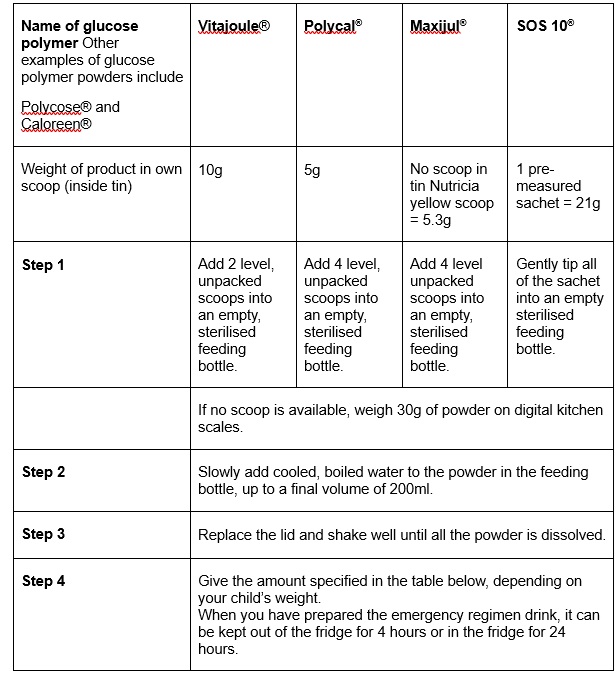
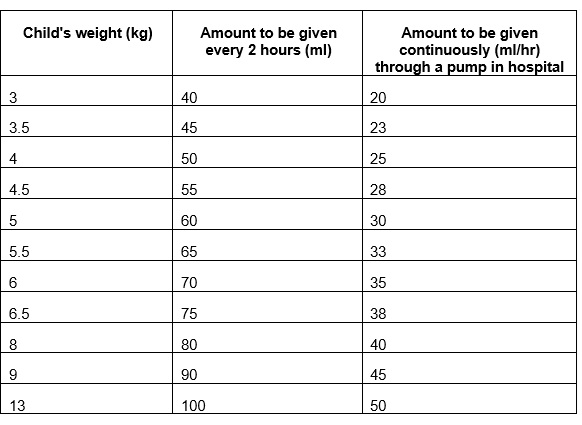
Babies up to 1 year old: 10% carbohydrate emergency regime
- For video instructions that show how to make emergency regime drinks called SOS 10®, visit: https://www.youtube.com/watch?v=IZ3_0kR8ugA
- For video instructions that show how to make emergency regimen drinks using other glucose polymer powders, including vitajoule, visit: https://www.youtube.com/watch?v=ZbjHYiKdUCA
- You can scan this QR code on your smartphone to see the video instructions:

Toddlers 1 to 2 years old: 15% carbohydrate emergency regimen
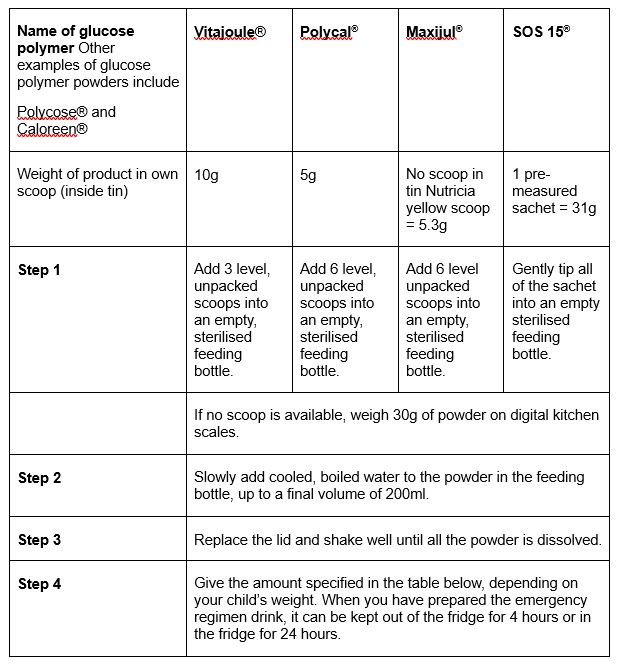
- For video instructions that show how to make emergency regimen drinks called SOS 15®, visit: https://www.youtube.com/watch?v=pFeJcdXKozU
- For video instructions that show how to make emergency regimen drinks using other glucose polymer powders, including vitajoule, visit: https://www.youtube.com/watch?v=ZbjHYiKdUCA
- You can scan this QR code on your smartphone to see the video instructions:

Toddlers 1 to 2 years old: 15% carbohydrate emergency regimen
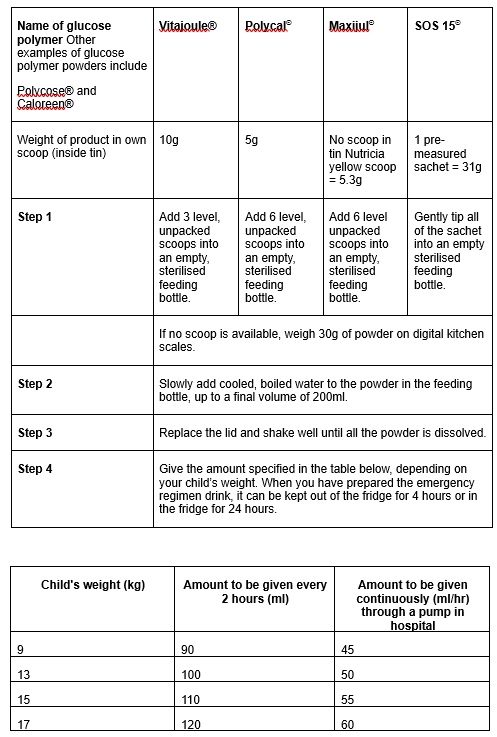
- For video instructions that show how to make emergency regimen drinks called SOS 15®, visit:https://www.youtube.com/watch?v=pFeJcdXKozU
- For video instructions that show how to make emergency regimen drinks using other glucose polymer powders, including vitajoule, visit web: https://www.youtube.com/watch?v=ZbjHYiKdUCA
- You can scan this QR code on your smartphone to see the video instructions:


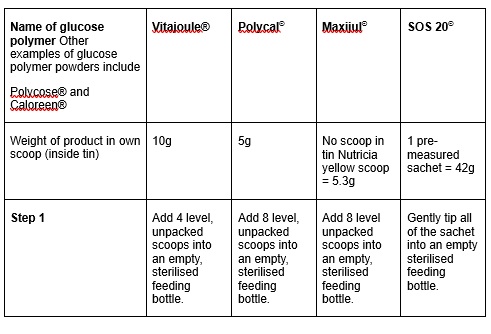
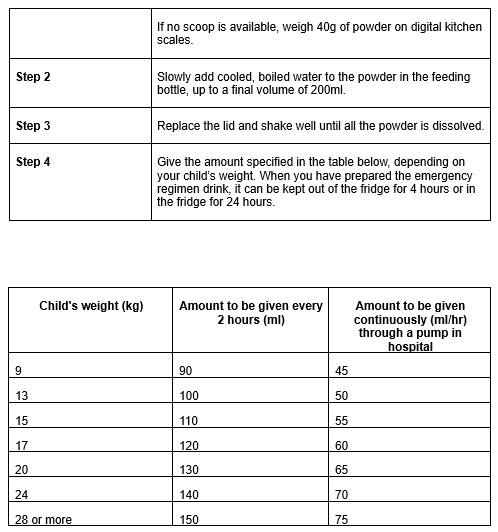
Children 2 to 9 years old: 20% carbohydrate emergency regimen
- For video instructions that show how to make emergency regimen drinks called SOS 20®, visit: https://www.youtube.com/watch?v=jaeAQSeLW3w
- For video instructions that show how to make emergency regimen drinks using other glucose polymer powders, including vitajoule, visit web: https://www.youtube.com/watch?v=ZbjHYiKdUCA
- You can scan this QR code on your smartphone to see the video instructions:

- If you have any clinical concerns about your child, please contact NHS 111, visit the GP or attend the emergency department as needed.
Contact our service
- Tel: 020 7288 5882 / 5883 Monday to Friday 9am to 5pm
Published:
10 Sep 2026
Review:
10 Sep 2028
Reference:
CYP/Paed/KHIC/01