

Achilles tendon injury
Patient Information Leaflet
Healing
- This is a rupture to the tendon at the back of your ankle.
- This normally takes about 9-10 weeks to heal.
- Full rehabilitation can take one year.
- After this injury, there is a 10–30% chance that your Achilles tendon could tear again in the future.
- The tendon can also tear again if it is injured or put under too much stress while it is healing.
- It is very important to follow this care plan and the advice from your Physiotherapist.
- Smoking will slow down your healing.
- We would advise that you stop smoking while your injury heals.
- Talk to your GP or go to https://www.smokefree.nhs.uk for more information.
Pain and swelling
- You may have ankle pain and swelling for three to six months after your injury.
- Swelling is often worse at the end of the day.
- Taking pain medication and elevating your ankle will help.
Walking and your boot
- You must use the boot with wedges.
- Keep the boot on all the time, including in bed at night.
- Always wear a sock in the boot.
- Please tell us if you are diabetic; you may need a special boot.
- You are allowed to put weight through your foot.
- You may find it easier to use crutches in the early stages.
Follow up:
- You will see a Foot and Ankle Specialist about six weeks after your injury.
- They will check the healing of your tendon.
- You have also been referred to Physiotherapy. This will start eight weeks after your injury.
- Contact our team if you have not received your appointment letters within one week.
Any questions
- If you are worried about your symptoms, cannot follow this recovery plan, or have pain somewhere other than your ankle, please contact the Virtual Fracture Clinic team.
Caring for your injury
Personal Hygiene
- You should remove the boot carefully for washing and to change your sock once a day.
- Whilst doing this, you must always keep the toes pointed down, as shown in this picture:
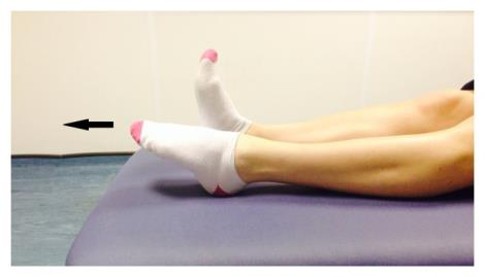
- Do not stretch the calf or do any ankle exercises.
- This will disrupt tendon healing and your long-term recovery.
- It is important to keep your foot as dry as possible in your boot.
- If you notice any redness, soreness or damage to your skin please inform our team immediately.
Preventing a Deep Vein Thrombosis (DVT)
- You are not allowed to do any exercises with this ankle for several weeks.
- This puts you in a higher risk group for developing a DVT (blood clot) which could potentially have very serious effects.
- You will have been prescribed a course of Enoxaparin (a type of heparin), which is blood thinner.
- This is given daily by injection normally for the first four weeks.
- You will be shown the injection technique.
- Try to have this medication at the same time every day.
- If you have any questions about this, or if you have a reaction to the medication, please speak to your GP or district nurse.
- The used injections MUST be disposed of safely in the yellow ‘Sharps Bin’ provided.
Removing the wedges from your boot
- The table below explains when you can begin to remove the wedges in your boot.
- This is done slowly so that your heel is gradually lowered to the ground.
- You should always remove the wedges from the bottom of the stack first.
- Continue to wear the boot day and night, removing only for personal hygiene.
- Make sure you follow this plan closely.
|
|
|
|
|
|
|
|
|
|
|
|
Frequently Asked Questions
I am struggling with my boot. What do I do?
- The boot has a thicker sole; this can make you feel uneven.
- Make sure you wear a supportive shoe or trainer on your uninjured foot. This will reduce stress on other joints.
- If you need more advice, contact the Virtual Fracture Clinic.
- You may find this video helpful: https://vimeo.com/386673062
I am diabetic, does this change things?
- If you have diabetes, please contact us to talk about your boot.
- This is especially important if you have skin problems or cannot feel sensations in your foot.
- We may give you a special boot made for people with diabetes.
When can I start driving?
You can return to driving when:
- You are no longer using your boot,
- You can walk comfortably and
- You can perform an emergency stop pain free.
- Always test your ability to drive in a safe environment first.
How can I get a certificate for work?
- You can get a fitness for work statement from your GP.
What do I do with my boot and crutches when I no longer need them?
- We cannot use the boots again, so please do not return your boot to the hospital.
- You can return your crutches to the Fracture Clinic or Accident & Emergency department.
With thanks to Brighton and Sussex University Hospitals NHS Trust for kindly sharing their information sheets with us with full permission to use contents and images.
Contact our service
Call us on 020 7288 3310 (Monday to Friday 9am to 5pm)
or email whh-tr.fracturevirtualclinic@nhs.net
Published:
04 Sep 2026
Review:
04 Sep 2028
Reference:
SC/T&O/AchiTendInj/02