

Thumb ulnar collateral ligament injury
Patient Information Leaflet
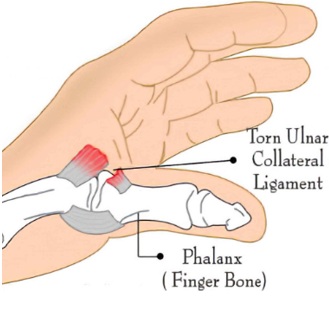
What is the ulnar collateral ligament?
- The ulnar collateral ligament is a strong band of tissue on the inside of your thumb. It connects to the middle joint of your thumb.
- It supports the joint and helps keep your thumb stable when you move it.
What causes injury to the Ulnar Collateral Ligament?
- The ligaments can be damaged if your thumb is forcefully pulled away from your hand.
- This can happen if a ball hits your hand, you fall while holding ski poles, or you fall onto your hand with your thumb stretched out.
- This injury can cause pain and tenderness at the base of your thumb.
- This is because the ligament may be partly torn (sprained) or may have pulled off a small piece of bone (avulsed).
What is the treatment for ulnar collateral ligament injuries?
- Treatment of this injury depends on how badly damaged it is.
- Your doctor will decide whether you need surgery or not
- You may be referred to a Hand Therapist who can help you recover from your injury, either without surgery or after surgery.
Treatment when surgery is not required (conservative management)
Stable injuries
- A partly torn ligament can be painful, but your thumb joint will still be stable.
- The injury will usually heal within four weeks. Your thumb should be back to normal within about six to twelve weeks.
- You may be given a splint to protect your thumb and to reduce pain while it heals.
Unstable injuries
- If the ligament is badly damaged, your thumb joint may be loose or unstable.
- If the ligament stays in its normal position, it will usually heal by itself within four to six weeks.
- Your thumb should be back to normal within three to six months.
- This injury is usually treated with a plaster cast or splint for four to six weeks. This helps the ligament heal.
- You may be referred to a Hand Therapist. They can make you a special splint and help you get your thumb moving and working normally again.
If provided with a splint
- Wear the splint all the time, during the day and at night, for four weeks. After this, you may only need to wear it sometimes for up to another two weeks.
- While wearing the splint, it is important to keep moving the parts of your thumb and wrist that are not injured. This includes the end joint of your thumb and your wrist.
- The Hand Therapist can advise you more about exercises and management of your injury in the first four weeks.
- If you have any problem with your skin (redness or irritation) whilst wearing the splint, please contact the Hand Therapy department for advice.
Removal of the splint and exercises
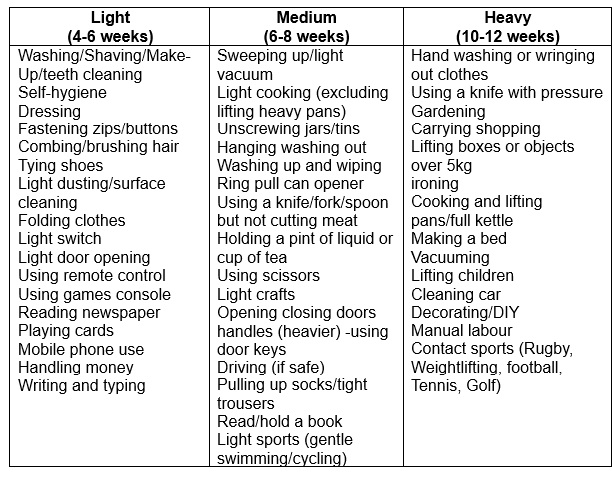
- After four weeks the splint can be removed for light activity (please see the table below for examples of light activity) and for active movement exercises (as shown in the pictures below).
- You can increase resistance on the thumb from six weeks (medium activities) and progress to normal activities gradually.
- Strengthening exercises can begin from six weeks and progress gradually (as shown in the pictures below)
- You can start contact sports and activities that need a lot of strength after 10 to 12 weeks.
Driving
- Driving can begin when you feel safe to control the car, turn the wheel comfortably and perform emergency procedures.
- You should check you are covered by your insurance company.
- Always test your ability to drive in a safe environment first.
- Do not drive while wearing the splint, as it may make it harder to use your hand safely.
Managing pain and swelling
- Pain and swelling of the thumb joint are normal after the injury and should sort itself out over a few months.
- You can use over-the-counter pain medication to help with any pain you may have, please speak to your Pharmacist for advice.
- If you find the exercises painful, try warming the hand first or exercising in warm water.
- Your Hand Therapist can advise further on managing these symptoms.
Surgical Intervention
- If the torn ligament moves out of place and cannot heal properly (often described as a Stener lesion), then surgery may be needed to prevent the development of an unstable joint.
- Surgery usually involves repair of the ligament or the use of a bone anchor to attach the ligament to the bone.
- You will usually need to wear a plaster cast or splint for six weeks after surgery to protect the repair.
- Sometimes, it can be removed after four weeks to allow you to move your thumb more.
- The Doctor or Hand Therapist will advise how long you need to use the splint and when you can remove it for movement.
- Return of full use of your thumb usually takes three months but it can take up to six months to regain full strength.
- From five days after surgery, it is important to move the parts of your thumb and wrist that are not held still by the splint or cast. This includes the end joint of your thumb and your wrist.
Scar management
- You will have a small wound on the side of your thumb joint.
- The Surgeon will advise if you have dissolvable or removable stitches.
- You will be given an appointment for a wound check and/or removal of stiches within two weeks after the surgery.
- Once your wound has fully healed, you can massage the scar with an unperfumed cream.
- This can help make the scar softer and less sensitive. As a guide, massage the scar for about two minutes, three times a day.
Active range of movement exercises at four to six weeks after surgery or conservative management
- Hold the bottom knuckle of your thumb between the thumb and index finger (the finger next to your thumb) of your other hand. Bend the tip of your thumb up and down.
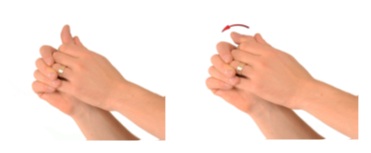
- Move your thumb away from your fingers and then move your thumb back to fingers.
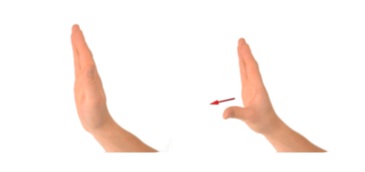
- Use the tip of your thumb to touch the tip of each finger in turn. Once touching the tip of your little finger, slide the tip of your thumb down to the base of your little finger.
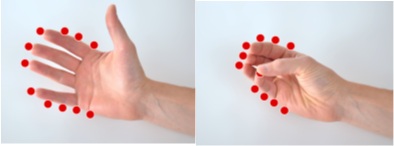
- Bend your thumb down to touch the base of your little finger and then fully straighten your thumb.
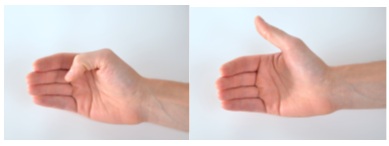
- Repeat each exercise 5 to 10 times, 5 times a day.
Strengthening exercises for the thumb to commence at six to eight weeks after surgery or conservative management
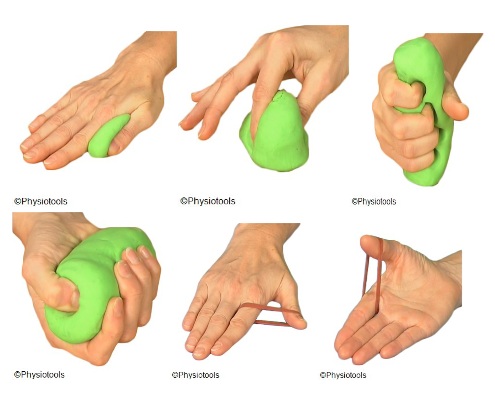
- Use some soft therapy putty, playdoh or soft sponge for resistance.
- Aim for 5 to 10 repetitions, 3 times a day, and progress your exercises slowly as pain allows.
- When your thumb is feeling less painful and stronger you can progress to more resistance with elastic bands.
- Your Hand Therapist can advise and guide you through the exercises.
When can you return to your normal activities?
- Below are examples of light, medium and heavy activities and the timeframe for returning to these types of activity
Contact our service
Please contact the Orthopaedic Clinic if you require any further information before your surgery or if you have not received a post-surgical review appointment.
Tel: 020 7288 5659/3799 Monday to Friday 9am to 5pm.
Email: whh-tr.orthopaedics@nhs.net
Your Orthopaedic Surgeon will refer you to Hand Therapy if required.
If you have been referred but have not received an appointment, please contact the Physiotherapy department.
Tel: 020 7288 5660 Monday to Friday 8am to 4pm.
Published:
14 Oct 2026
Review:
14 Oct 2028
Reference:
EIM/OT/TUCLI/01