

Healthy eating for gestational diabetes
Patient Information Leaflet
This patient guide explains how to manage your blood glucose levels during gestational diabetes (high blood sugar that develops during pregnancy and usually disappears after giving birth).
Making changes to your diet and doing regular physical activities are important as they help keep your blood glucose under control.
If you have gestational diabetes, you are advised to keep blood glucose levels to below the following:
- Fasting (for example before breakfast): 5.3 mmol/L
- 1 hour after eating: 7.8 mmol/L
It is important to keep your blood glucose levels within these target ranges, as this will help to reduce the risks to you and your baby.
One of the best ways to manage gestational diabetes is to have a healthy and balanced diet.
The foods you choose are just as important as monitoring your blood glucose and taking any prescribed medication.
The Eatwell Plate is a tool that can help you get a balanced diet.
You can view an interactive version of the Eatwell Guide at: www.nhs.uk/Livewell/Goodfood/Pages/the-eatwell-guide.aspx
The British Heart Foundation has great healthy meal options and recipes from all over the world: https://www.bhf.org.uk/informationsupport/support/healthy-living/healthy-eating/recipe-finder
If you cannot visit that website, or do not have access to the internet, someone in the dietician team can print these out for you.
Tips for managing blood glucose levels
1. Eat three meals per day, and avoid skipping meals
- Leaving long gaps between eating can make it difficult to manage hunger and blood glucose levels. 2. Avoid sugary foods and drinks
- Try not to eat processed foods, especially sugary drinks, snacks and desserts. Eating these can cause your glucose levels to rise.
- Do not add sugar to foods and drinks.
- Instead, try low or zero calorie sweeteners, also known as artificial sweeteners.
- You don’t need to buy special ‘diabetic’ foods. They can be expensive, high in calories and often contain sweeteners that may cause stomach upset. 3. Eat the right amount and type of carbohydrates
- When you eat carbohydrate foods they turn into glucose, which affects blood glucose levels straight away.
- Bour body relies on these foods as a source of energy.
- Carbohydrates are in many foods, including:
- Breads, chapatti, roti, pita bread, bagels (anything made with flour)
- Rice, pasta, noodles, couscous, quinoa, barley
- Breakfast cereals, cereal bars and crackers
- Fruit and starchy vegetables like sweet potato, potato, yam, plantain
- Beans and legumes
- Milk and yogurt
- Sugary foods and drinks.
- To manage your blood glucose levels, it is important to eat the right type and portion size of carbohydrate rich foods.
Types of carbohydrate
- Some carbohydrates are broken down more slowly, which can help your blood glucose levels stay even.
- Glycaemic Index (GI) is a measure of how quickly foods containing carbohydrates affect your blood sugar levels after you eat them.
- Food and drinks with a high glycaemic index are broken down quickly, causing a quick rise in glucose levels.
- It is important to choose lower glycaemic index carbohydrates as they are more slowly absorbed into the body.
Glycaemic Index food swaps
| Instead of these high-GI foods: | Try these low-GI foods instead: |
|---|---|
| Flaked/puffed or sugar-coated cereal | No added sugar or nutty Muesli |
| Soft white bread | Multi-grain/seeded/rye/sourdough bread |
| White pitta | Mixed grain wrap or wholemeal roti |
| Instant oats | Traditional rolled oats/jumbo oats |
| Mashed potato | New potatoes, sweet potato or yams |
| White rice | Long grain basmati rice, quinoa or wholemeal rice |
| Frozen chips | Wholemeal pasta or noodles |
| Watermelon | Apple, peach, berries |
- Remember portion sizes matter and not all low glycaemic index foods are healthy, so be sure to check the labels and make healthy choices.
- You can find more information about glycaemic index online at the Diabetes UK: www.diabetes.org.uk/guide-to-diabetes/enjoy-food/carbohydrates-and-diabetes/glycaemic-index-and-diabetes
Portion size of carbohydrates
- You may be advised to eat less carbohydrate rich foods, as large portions can give you high blood glucose levels.
- Use this portion plate as a guide:
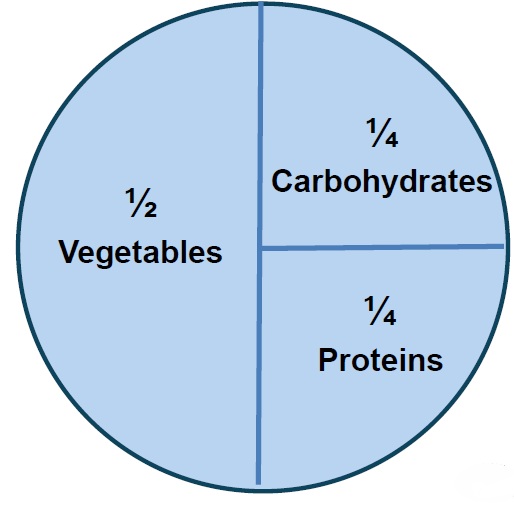
- Carbohydrates are an important part of the diet, so be careful not to cut them out completely.
- This is only a guide, and you may find that these amounts are not exactly right for you.
- If you are worried about your carbohydrate portions, please ask to speak to a Dietitian.
Snacks
- Snacks may be needed if you are hungry between meals, especially if you are eating less carbohydrates at mealtimes.
- As a guide we recommend you only have two or three 10 to 15g carbohydrate snack portions per day. Some examples include:
- 1 small handful of unsalted nuts/seeds
- 1 fruit portion
- 150g of plain natural yoghurt or Greek yogurt
- 2 wholegrain crackers with cheese
- Vegetable sticks with a tablespoon of humous or cream cheese
- For more snack options please refer to our snack guide leaflet: https://www.whittington.nhs.uk/document.ashx?id=14117
Fruit and vegetables
- You can eat as many vegetables as you want without affecting your blood glucose levels.
- 1 portion of vegetables = 3 tablespoons of cooked vegetables or 1 small bowl of salad.
- Fruit should be limited to 3 portions per day and spread throughout the day.
- 1 portion of fruit (80g) = 1 medium orange, 1 small banana or 1 plum.
Protein
- Eat a minimum of 2 to 3 portions of high protein food daily.
- One portion equals:
- 80g meat (a portion about the size of a deck of cards)
- 120g fish (a portion about the size of the palm of your hand for white fish. A portion about the size of a deck of cards for oily fish e.g. salmon, sardines)
- 2 eggs
- 3 to 4 tablespoons of pulses (for example lentils, beans, chickpeas)
- 100g Quorn or tofu (1/2 cup)
- 1 small, cupped handful of plain nuts.
Calcium
- Eat 3 portions of foods with a lot of calcium daily.
- One portion is:
- 200ml milk or fortified alternatives
- 150g yoghurt – natural or Greek
- 25g cheese (about the size of a matchbox).
- Non-dairy foods that contain calcium:
- Calcium enriched soya products
- Green leafy vegetables
- Tofu
- Almonds
- Beans
- Dahl.
Fats
- Reduce your intake of saturated fats.
- Fat does not affect your blood glucose levels directly but eating too much can cause weight gain.
- This can make it more difficult to control your blood glucose levels.
- Butter, cheese, ghee, lard and palm oil are all high in saturated fat.
- Swap these for low-fat alternatives and small amounts of olive oil, rapeseed oil, sunflower oils or spreads.
Keep active
- Research has shown that physical activity after a meal is particularly useful in managing blood glucose levels.
- Try to do a 20-minute walk after meals.
- Regular exercise also will help to keep you fit and prepares you for the birth of your baby.
- The most important thing about physical activity is that you do something that you enjoy.
- Before starting or continuing any new kind of physical activity, always check with your health care professional team.
Example meal plan
Breakfast examples
- 1 slice of wholemeal bread with topping (for example eggs, cheese, peanut butter, avocado, cooked ham, houmous)
- Omelette (add vegetables of choice) and 1 slice wholemeal bread
- 200g natural Greek yogurt with a handful of nuts/seeds and handful of berries
- 1 small chapatti with curry (meat/chicken/paneer)
Lunch examples
- 2 slices of wholemeal bread with chicken/tuna/cheese/egg and salad
- 1 wholemeal wrap with chicken/tuna/cheese/egg and salad
- 2 small (hand size) chapattis with curry and vegetables/salad
- Chicken & vegetable soup and 1 wholemeal pitta bread
- Lentil soup with 1 slice wholemeal bread
- Scrambled eggs with avocado and 2 slices of wholemeal bread
Evening meal examples (check the portion plate diagram above)
- Fist size of wholemeal pasta, with beef bolognese and salad
- Fist size of sweet potato, with baked fish and vegetables
- Chicken fajitas made with 2 small wholemeal wraps and vegetables
- Fist size of basmati rice, with curry (meat/chicken/paneer) and vegetables/salad
- Fist-size portion of noodles, with tofu/tempeh/chicken/prawns and vegetables
- The Diabetes UK website (see below) contains low carbohydrate recipe ideas.
Additional useful information
Diabetes UK: https://www.diabetes.org.uk/diabetes-the-basics/food-and-diabetes/i-have-gestational-diabetes
British Dietetic Association food facts sheet: https://www.bda.uk.com/resource/pregnancy-diet.html
Eatwell guides: https://www.nhs.uk/live-well/eat-well/the-eatwell-guide https://www.bhf.org.uk/informationsupport/support/healthy-living/healthy-eating/recipe-finder
NHS Choices provides online information and guidance on all aspects of health and healthcare, to help you make decisions about your health: www.nhs.uk
Contact our service
- This leaflet should be used with the advice you receive during your pregnancy from your diabetes specialist Dietitian.
- Please do not hesitate to contact the Dietitian on 020 7288 5552 if you have any dietary questions or concerns.