

Carpal tunnel syndrome in pregnancy
Patient information factsheet
What is carpal tunnel syndrome?
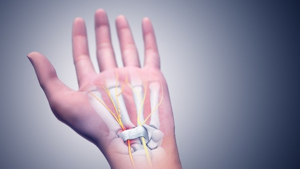
- Carpal tunnel syndrome occurs (happens) when a nerve in your wrist gets squeezed.
- This nerve is called the median nerve.
- It runs through a small space in your wrist called the carpal tunnel, near the base of your hand and thumb.
- During pregnancy, the body holds extra fluid. This can cause swelling in the hands and feet. The swelling can press on the nerve and tendons in the wrist.
- Symptoms can include:
- Tingling or “pins and needles”
- Numb or strange feeling in the hand
- Pain in the hand or wrist
- Weak grip or less strength
- These symptoms are often worse at night or in the morning.
- Symptoms can happen at any time, but they most often start in the third trimester of pregnancy.
- After birth, they usually slowly get better. This happens as the swelling from pregnancy goes down.
- For some women, symptoms last longer.
- They may continue while breastfeeding. In some cases, they can last for 6–12 months after giving birth.
What can I do to manage my symptoms during pregnancy?
- If your wrist or fingers start to swell, it can help to take off any rings.
- Symptoms are often worse at night or early in the morning.
- If they wake you up, try changing how you sleep.
- You can also rest your arm on a pillow to keep it raised.
- If you wake up with numb or sore hands, try gently moving your hands. This can help the feeling go away.
Help reduce swelling
- Try an ice pack, wrapped in a towel on your wrist.
- If you have numbness or can’t feel the ice on your skin, please talk to your health professional.
- Contrast bathing: Put your hand in cold water for 1 minute. Then put it in warm water for 1 minute. Keep switching like this for up to 10 minutes. This may help reduce swelling.
- Self-massage: Some women find it helps to gently rub the arm to reduce swelling. Start at the wrist and move upwards towards the armpit.
Wrist and hand position
- The way you hold your wrist can affect your symptoms.
- Try not to bend your wrist too much forward or backward. This can stop the nerve from getting squeezed more.
Posture
- Poor posture can sometimes make your pain worse.
- Pain in your arm, neck, or between your shoulder blades may be linked to this.
- A physiotherapist can give you advice and show you exercises to help.
Work
- When using a computer, adjust your chair so your wrists stay straight (not bent) while typing.
- Try to do fewer jobs that use strong, repeated hand movements, as these can make your symptoms worse.
- Take regular breaks to rest your hands and arms.
Hand splints
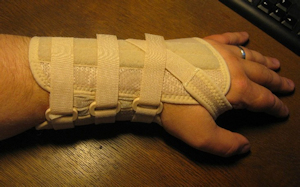
- Wearing a hand splint at night can help keep your wrist straight and reduce pain.
- If your symptoms are very bad, you may also wear the splint during the day.
- You can buy splints from pharmacies or online or ask a Physiotherapist for one.
Exercises
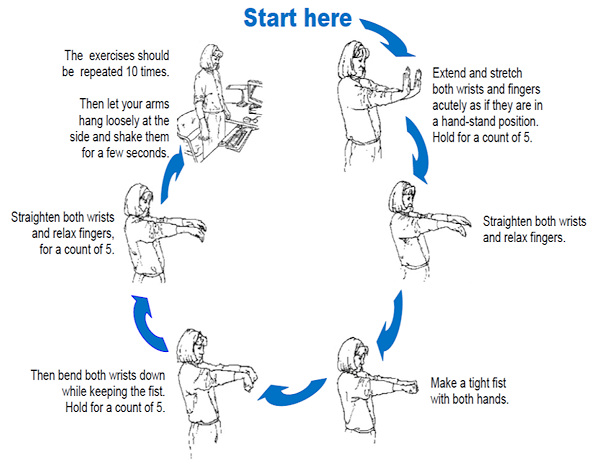
- If your pain is not too bad, gentle exercises can help after resting.
- These exercises can improve blood flow and reduce swelling in your wrists.
- Try to do the exercises 1–2 times each day.
Postnatal advice
- Your symptoms will usually get better about six weeks after your baby is born, as your body returns to normal.
- In the first few weeks after birth, try to protect your wrists and hands while they get stronger.
- Keep wearing your splints at night and during baby care if needed.
- When holding your baby during the day, you can take out the metal part of the splint for comfort.
- Ask for help with bathing your baby and changing nappies when you can.
- Try not to lift with your thumb stretched out, as this can strain your thumb and wrist.
- Using a pillow to support your baby while breastfeeding can help reduce pain.
- If your symptoms last longer than 6 weeks after birth, speak to your GP for more advice.
- Some people may need a steroid injection to help with the pain.
Resources
Chartered Society of Physiotherapy
Provides evidence-based patient information.
Website: <www.csp.org.uk/public-patient/rehabilitation-exercises/carpal-tunnel-syndrome/>
NHS choices
Provides evidence-based patient information.
Website: www.nhs.uk/conditions/carpal-tunnel-syndrome/
Patient
Provides patient information and resources.
Website: https://patient.info/bones-joints-muscles/carpal-tunnel-syndrome-leaflet
Pelvic, Obstetric & Gynaecological Physiotherapy (POGP)
Provides evidence-based patient information which may be recited (audio) in many languages.
Website: <www.thepogp.co.uk/patient_information/default.aspx>
Contact our service
Whittington Bladder and Bowel Care Service
Email: whh-tr.bladderandbowel@nhs.net
Webpage: https://www.whittington.nhs.uk/?c=33288
Whittington Pelvic Health Physiotherapy
Email: whh-tr.outpatienttherapy@nhs.net
Webpage: https://www.whittington.nhs.uk/?c=42977
North central London perinatal pelvic health service - Royal Free London
Email: rf-tr.nclpphs@nhs.net