

Soft tissue shoulder injury
Patient information leaflet
Overview of your injury
- You have a soft tissue shoulder injury.
- This is a sprain to your shoulder.
Healing:
- It normally takes six weeks to heal, but symptoms can continue for three months.
Pain, Swelling and Pins and Needles:
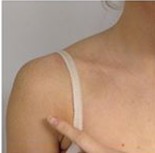
- Your shoulder may be swollen and you will have some pain.
- Take pain medication as prescribed.
- You can use an ice pack or bag of frozen peas wrapped in a damp towel to help with your pain.
- Put this on your shoulder for up to 15 minutes every few hours. Make sure the ice is not in direct contact with your skin.
Wearing your sling
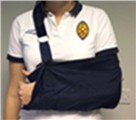
- Your sling can be worn for comfort.
- You can take it off to wash, dress and exercise.
- It does not need to be worn at night. You should stop using your sling as soon as possible.
Exercise and activity
- It is important to keep your shoulder moving to prevent stiffness.
- You can return to activity when you feel ready.
- Start with light tasks and stop if it becomes too painful.
- Regular exercise will prevent stiffness and improve your movement.
- You will find pictures and instructions for your exercises below.
- Start with Stage 1 Exercises.
- As soon as you feel ready you can progress to the next stages.
Follow up
- We are expecting your injury to get better with time and this care plan.
- However, if you have a lot of pain or have not achieved full movement six weeks after your injury then please contact us.
Contact us
- If you have any questions, are concerned about your symptoms or have pain in places other than at your shoulder, please contact us (details below).
Stage 1 Exercises
- Hand, wrist and elbow exercises are only needed while you are wearing a sling.
- You can stop these once they become easy and you have full movement.
- Try to do these exercises four to five times a day.
- Repeat each exercise 10 times.
Hand, wrist and elbow exercises
- Open and close your hand. Next, move your wrist up and down. Repeat 10 times
- After a few days, hold a soft ball or rolled up socks. Squeeze the ball and hold for five seconds. Repeat five times.
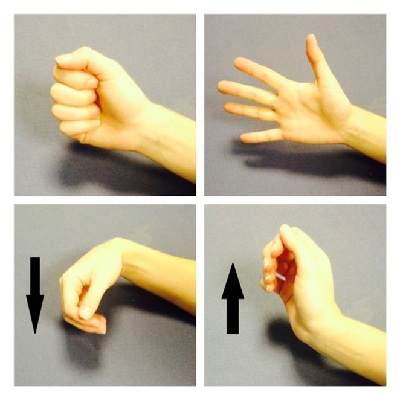
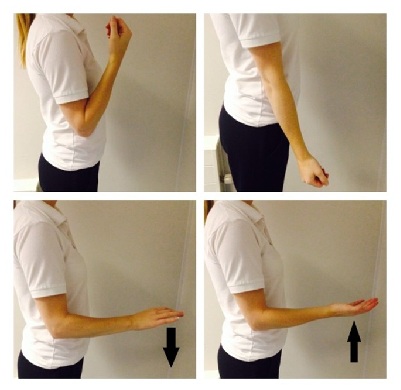
- Bend and straighten your elbow. Repeat 10 times.
- Bend your elbow to a right angle. Slowly turn your palm up to the ceiling and down to the ground. Repeat 10 times.
Posture Exercise
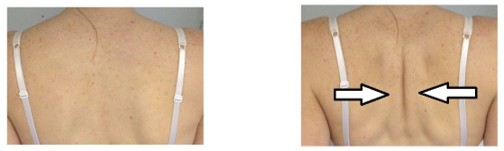
- Bring your shoulders back and gently squeeze your shoulder blades together.
- Hold for 20-30 seconds. Repeat five times.
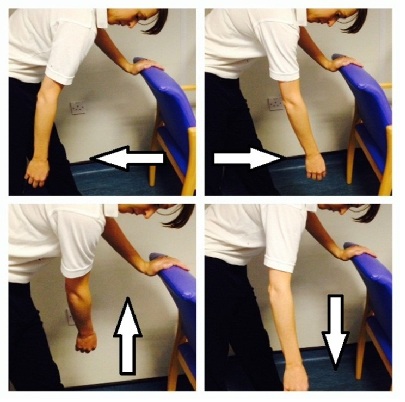
Shoulder Pendulum Exercise.
- Stand next to a firm surface.
- Support yourself with your un-injured arm and lean forwards.
- Let your injured arm relax and hang down to the ground.
- Gently swing your arm, making a small movement.
- Try to do this forward and backward, side to side and in small circles.
- Aim to do this for one to two minutes in total.
- Stop if it becomes too painful. Remember to keep your arm relaxed.
Stage 2 Exercises
- You can start these exercises as soon as you are able to.
- Try to do these exercises four to five times a day. Repeat each exercise 10 times.
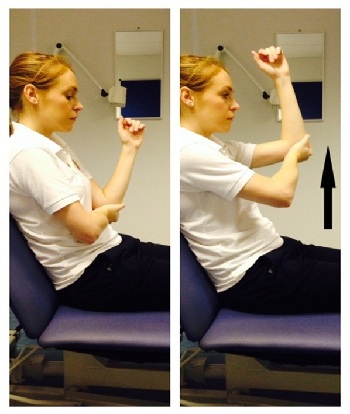
Exercise 1 - Active Assisted Flexion
- Use your other hand to lift your injured arm up in front of you, as shown in these pictures.
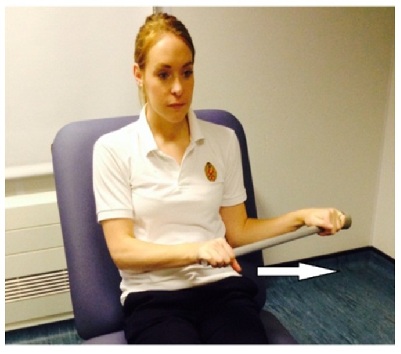
Exercise 2 - Active Assisted External Rotation
- Keep the elbow of your injured arm tucked into your side and your elbow bent. Hold onto a stick, umbrella or something similar.
- Use your good arm to push your injured hand outwards. Remember to keep your elbow tucked in.
- If you don’t have a stick, hold your injured arm at the wrist, guide it outwards with your good hand
Stage 3 Exercises
- You can start these exercises as soon as you are able to do Stage 2 Exercises comfortably.
- Try to do these exercises 4-5 times a day. Repeat each exercise 10 times.
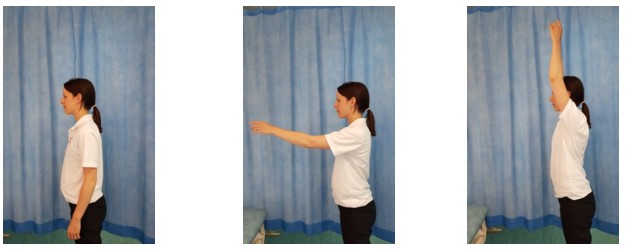
Exercise 1 - Active Flexion
- Lift your arm forwards in front of you.
- Try to raise the arm as high as you can.
- Stop if it is too painful. If this is too difficult, try the same movement with a bent elbow.
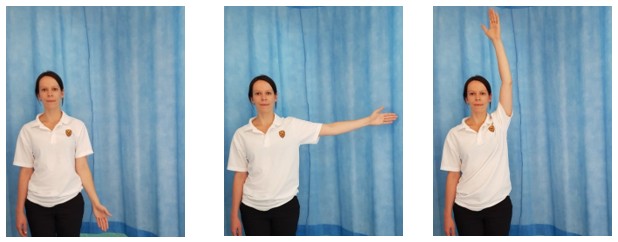
Exercise 2 - Active Abduction
- With your palm facing forwards, move your arm out to the side in a big arc.
- Try to raise the arm as high as you can. Stop if it’s too painful.
- If this is too difficult, try the same movement with a bent elbow.
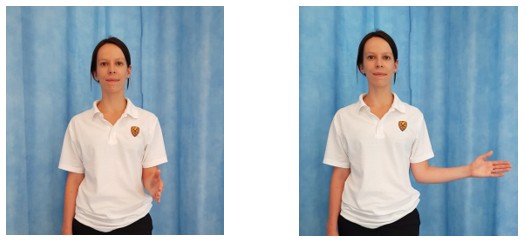
Exercise 3 - Active External Rotation
- Start with your elbow bent by your side.
- Move your forearm out to the side, keeping your elbow bent and near your waist.
Frequently Asked Questions
When can I start driving?
You can return to driving when:
- You are no longer using a sling,
- You can move comfortably and
- You can control the vehicle safely.
Always test your ability to drive in a safe environment first.
How can I get a certificate for work?
- You can get a fitness for work statement from your GP.
How do I contact the Virtual Fracture Clinic?
Call us on 020 7288 3310 (Monday to Friday 9am to 5pm)
or email whh-tr.fracturevirtualclinic@nhs.net
With thanks to Brighton and Sussex University Hospitals NHS Trust for kindly sharing their information sheets with us with full permission to use contents and images.
Published:
17 Jul 2026
Review:
17 Jul 2028
Reference:
SC/T&O/SofTisShInj/02