

Undisplaced Greater Tuberosity Fracture
Patient information leaflet
About your injury
- You have an undisplaced greater tuberosity fracture.
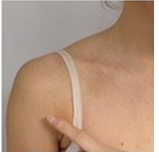
- This is a break to the top of your upper arm bone.
- Your shoulder is a ball and socket joint. You have fractured the outside of the ball part of the joint.
Healing
- This normally takes 6-12 weeks to heal.
- Smoking will slow down your healing.
- We would advise that you stop smoking while your fracture heals.
- Talk to your GP or go to www.smokefree.nhs.uk for more information.
Pain and swelling
- Your shoulder may be swollen, and you will have some pain.
- Taking pain medication and using ice or cold packs will help.
- More information is on the next page.
Wearing your sling
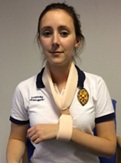
- Use your sling for six weeks, including in bed at night.
- You can take it off to wash, dress and do your exercises.
Exercise and activity
- It is important to start gentle exercises straight away to prevent stiffness.
- You will find pictures and instructions for your exercises below.
- You should not do any heavy lifting or overhead movement for the first six weeks.
Follow up
- You will see a shoulder specialist three weeks after your injury.
- They may do another x-ray to check the position of your fracture.
- They will explain the next stage of your rehabilitation.
Contact us
- If you are worried about your symptoms, contact the Virtual Fracture Clinic.
- Contact them if you cannot follow the following exercise plan.
- Also contact them if you have pain anywhere other than your shoulder.
Caring for your injury: Week 1- 4
- Remember to use your sling for the first six weeks, including in bed at night.
- Take it off to wash, dress and do your exercises. Y
- You may find it more comfortable to sleep propped up on pillows.
- Using a cold pack will help with your pain and swelling.
- You can use an ice pack or bag of frozen peas wrapped in a damp towel.
- Put this on your shoulder for 15 minutes every few hours.
- Make sure the ice isn’t in direct contact with your skin.
- Try to rest your arm, especially in the first 24-72 hours.
Exercises
- Start these exercises straight away.
- Hand, wrist and elbow exercises are only needed while you are wearing a sling.
- You can stop these once they become easy and you have full movement.
- Try to do these exercises four to five times a day. Repeat each exercise 10 times.
Hand, wrist and elbow exercises
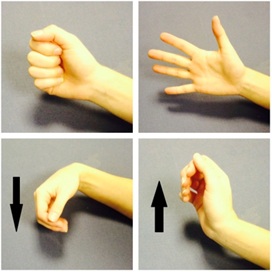
- Open and close your hand. Next, move your wrist up and down. Repeat 10 times
- After a few days, hold a soft ball or rolled up socks. Squeeze the ball and hold for five seconds. Repeat five times.
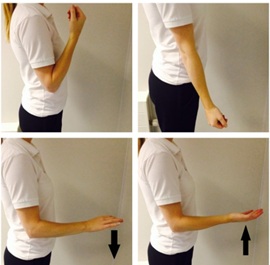
- Bend and straighten your elbow. Repeat 10 times.
- Bend your elbow to a right angle. Slowly turn your palm up to the ceiling and down to the ground. Repeat 10 times.
Posture Exercise
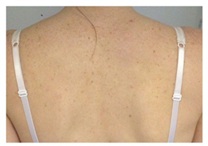
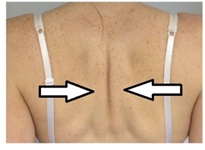
- Bring your shoulders back and gently squeeze your shoulder blades together.
- Hold for 20-30 seconds. Repeat five times.
Shoulder Pendulum Exercise
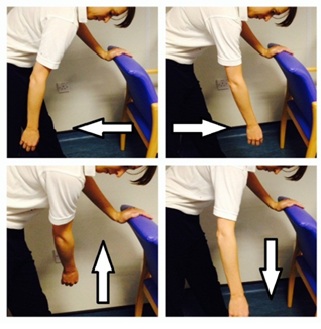
- Stand next to a firm surface.
- Support yourself with your un-injured arm and lean forwards.
- Let your injured arm relax and hang down to the ground.
- Gently swing your arm, making a small movement.
- Try to do this forward and backward, side to side and in small circles.
- Do this for 1–2 minutes in total. Stop if it hurts. Keep your arm relaxed.
Caring for your injury: Weeks 4-6
- Remember to keep using your sling.
Exercises
- Start these exercises three weeks after your injury.
- Try to do them four to five times a day.
- Repeat each exercise 10 times.
Active Assisted Flexion
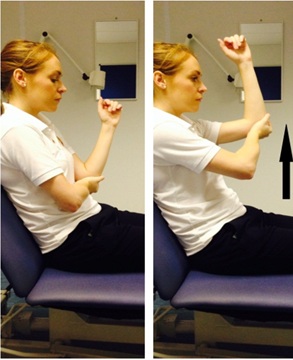
- Use your other hand to lift your injured arm up in front of you, as shown in these pictures above.
Active Assisted External Rotation
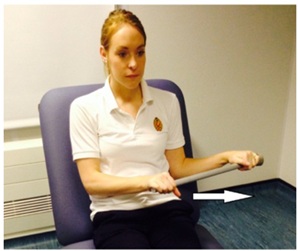
- Keep the elbow of your injured arm tucked into your side and your elbow bent.
- Hold onto a stick, umbrella or something similar.
- Use your good arm to push your injured hand outwards. Remember to keep your elbow tucked in.
- If you don’t have a stick, hold your injured arm at the wrist, guide it outwards with your good hand.
Caring for your injury: Weeks 6-12
- You can stop using the sling.
- You can now return to light activities.
- Gradually increase your day-to-day activity and be guided by any pain or discomfort that you experience.
- Some heavier tasks may still be uncomfortable.
Active External Rotation
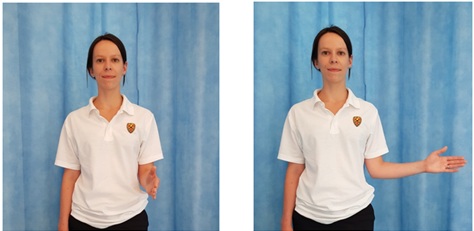
- Start with your elbow bent by your side.
- Move your forearm out to the side, keeping your elbow bent and near your waist.
Frequently Asked Questions
I’m concerned about my symptoms and/or I am struggling to return to exercise.
- Please contact the Virtual Fracture Clinic.
I am struggling with my sling. What do I do?
- Contact the Virtual Fracture Clinic. We can give advice or change your sling if needed.
When can I start driving?
- When you are no longer using a sling
- When you can move comfortably
- When you can control the vehicle safely
- Always test your ability to drive in a safe environment first.
How can I get a certificate for work?
- You can get a fitness for work statement from your GP.
How do I contact the Virtual Fracture Clinic?
Call us on 020 7288 3310 (Monday to Friday 9am to 5pm)
With thanks to Brighton and Sussex University Hospitals NHS Trust for kindly sharing their information sheets with us with full permission to use contents and images.
Published:
28 Jul 2026
Review:
28 Jul 2028
Reference:
SC/T&O/UGTF/02