

Carpal tunnel post decompression surgery
Patient information factsheet
- Carpal Tunnel Syndrome is caused by the compression (squeezing) of a nerve in your wrist.
- This nerve (the median nerve) is responsible for all the feelings you experience in your first and middle fingers, your thumb, and other small muscles in your hands.
- Symptoms can include changes in sensation (pins and needles), weakness and clumsiness in the hand.
- Symptoms can be worse at night when you are asleep, as your hand will often rest in a position which reduces blood flow, compressing the medial nerve.
Treatment
- Surgery may be needed if the median nerve is severely compressed or if other treatments, such as a wrist splint (a support worn on your wrist to help keep it straight), steroid injections or stretches, do not improve your symptoms.
- The surgery relieves the pain by reducing the pressure on the median nerve.
- Surgery usually takes place as a day case.
After your Surgery
- After surgery leave the dressing, bandages and padding on.
- Keep it clean and dry. Do not get it wet.
- After 48 hours (two days), remove the bandages and padding, but leave the small white dressing in place.
- The dressing can be changed if it becomes loose or dirty.
- You may experience some mild/medium pain. You can take painkillers for this.
- If your wound bleeds, press it firmly and raise your hand above the level of your heart. This will slow the blood flow.
- It is normal to experience some swelling in your fingers and hand.
- To stop the swelling, keep your hand raised (above the level of you heart) for 48 hours.
- After 48 hours have passed, do not allow you hand to hang down for long periods of time.
- The pain and tingling you have been experiencing at night, before the operation, should stop.
- Stitches will be removed 10-14 days after your surgery, either by your practice nurse or in the Orthopaedic clinic.
- If you have dissolvable stitches, you will be seen in the Orthopaedic clinic for a wound check within 14 days.
- As you recover, your grip might be weaker and uncomfortable.
- This can be frustrating, but by 6 to 12 weeks as your hand begins to heal, you should feel an improvement in strength.
- Gentle exercises can help recovery.
- If you are experiencing problems with recovery (scar pain or stiffness or not recovering), then please contact your surgeon and ask for hand therapy referral.
Exercises
If exercises are painful, then increase the number of repetitions gradually.
- Move your shoulder and arm regularly.
- Gently clench (make a fist) and unclench your hand.
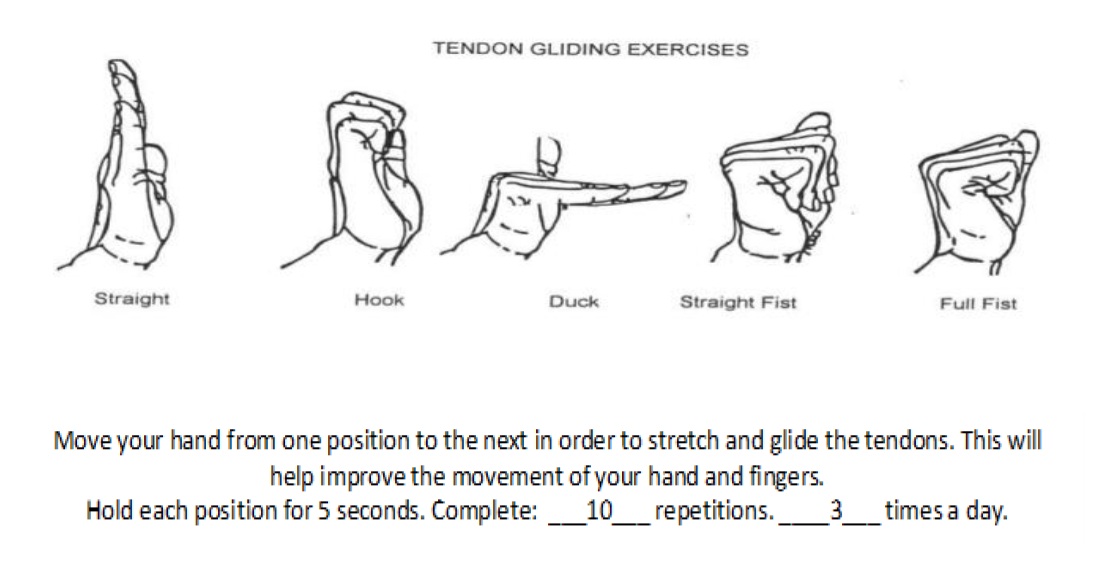
Tendon gliding exercises
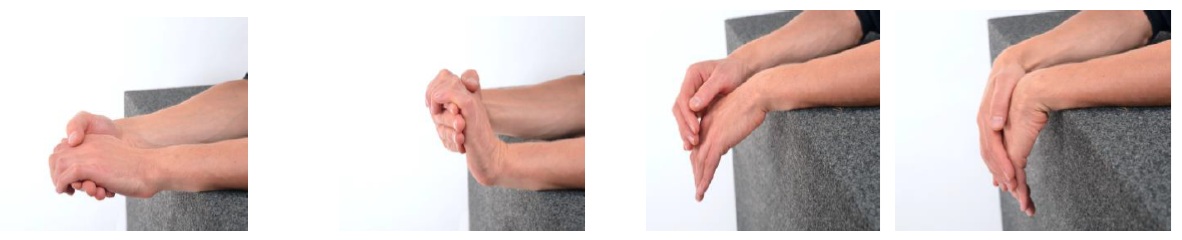
- Slow and gentle movement of the wrist forwards and backwards.
Scar Care
- Once the stitches have been removed and your scar has healed, you can safely get the hand wet in a bath or shower.
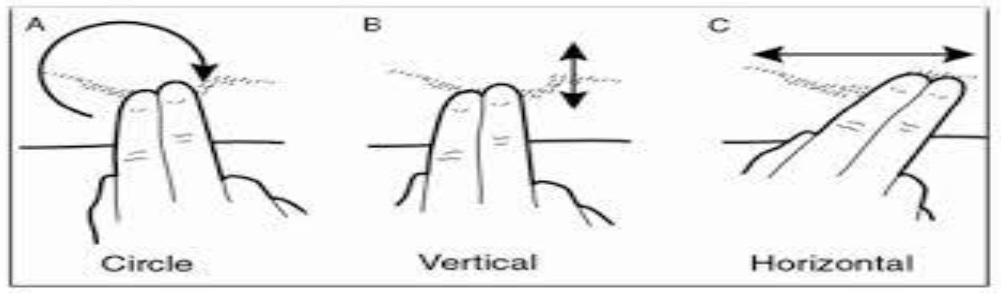
- Scar massage can help it heal and keep it flexible.
- Start massaging the scar to reduce any tightness and thickening. Use an un-perfumed aqueous cream and rub in a firm motion over the scar as shown in diagram below.
- Massage the scar 3 to 4 times a day, increasing pressure gradually.
How soon can I go back to work?
- Getting back into a normal work routine can help you to recover more quickly, although every person will recover differently and has different needs.
- People whose work involves using their hands a lot or heavy lifting, will not be able to return to work as quickly.
- Typing does not cause carpal tunnel syndrome, and returning to gentle typing early on can help with your recovery.
- As a general guide, you can expect to return to work as follows:
- Light manual work: managerial, clerical or secretarial work: 2 to 4 weeks
- Medium manual work: cleaning, care work, nursing or checkout work: 4 to 6 weeks
- Heavy manual work: building work, manual labour or trades: 6 to 10 weeks
- Custodial or rescue services: 6 to 10 weeks
- Your surgeon, general practice doctor or your work's Occupational Health service can give you advice.
- It is your decision when you feel safe and competent to go back to work.
- There is nothing wrong in asking your employer to make adjustments to your work, so that you can get back sooner, rather than later.
Driving
- Your insurance company should be informed about your operation. Some companies will not insure drivers for several weeks after surgery. Check your policy.
- Strong painkillers can make you feel drowsy/sleepy.
- Do not drive if these painkillers cause drowsiness.
- Before driving, test how comfortable you are sitting in the driving seat and holding the controls (wheel, gear stick).
- You should be able to comfortably control the steering wheel, safely control your car and be able to freely perform an emergency stop.
- Your first drive after surgery must not be a long drive. Make small journeys to begin with, so that you can test how well your hand/wrist feels.
- You are responsible and you decide when you feel ready to drive. You do not need your doctor's permission.
Smoking cessation
- Smoking makes healing time longer.
- In extreme cases, can stop healing altogether.
- Stopping smoking during the healing phase of your carpal tunnel site will help recovery.
- For advice on smoking cessation and local support available, please refer to the following website: http://smokefree.nhs.uk or discuss this with your GP.
Useful Websites for further information
For further information about your operation, recovery or return to work:
- The Royal College of Surgeons of England http://www.rcseng.ac.uk/
- British Association of Plastic Reconstructive & Aesthetic Surgeons http://www.bapras.org.uk/
- British Society for Surgery of the Hand http://www.bssh.ac.uk/
- NHS Stop Smoking Service http://smokefree.nhs.uk/
- NHS Choices http://www.nhs.uk/Pages/Homepage.aspx
- Department for Work and Pensions https://www.gov.uk/government/organisations/department-for-workpensions
- GOV.UK https://www.gov.uk/
- DVLA - Driver and Vehicle Licensing Agency https://www.gov.uk/browse/driving/disability-health-condition
- Call 111 for nonemergency medical advice.
*Guidelines taken from Royal College of Surgeons 2023
Published:
12 Feb 2024
Review:
12 Feb 2026
Reference:
EIM/OT/CTPDS/01