
Enfield school hearing screening information
Patient Information Leaflet
Government guidance states that all children at school (in England, Wales, and Northern Ireland) from the age of four years old must have a hearing screening test.
This is called the universal screening programme.
All children attending mainstream schools in Enfield will have their hearing screened during reception year.
The hearing screening is carried out by the school hearing screening team.
As an NHS service we fully comply with General Data Protection Regulation (GDPR) and the Data Protection Act 2018 regarding storing patient information, retention, and ensuring that personal information about your child is stored securely.
More information is available at: http://whittington.nhs.uk/default.asp?c=33205
Enfield School Hearing Screening Service - Who are we?
- School hearing screening tests are completed by Enfield School Hearing Screening Team.
- We are part of the Barnet and Enfield Paediatric Audiology Team (Whittington Health NHS Trust).
- We are based at St Michael's Primary Care centre, Cedar House, Gater Drive Enfield EN2 0JB.
Who do we screen (test)?
Children attending mainstream schools in Enfield.
- These children will have a hearing screening test in reception class, usually when they are five years old.
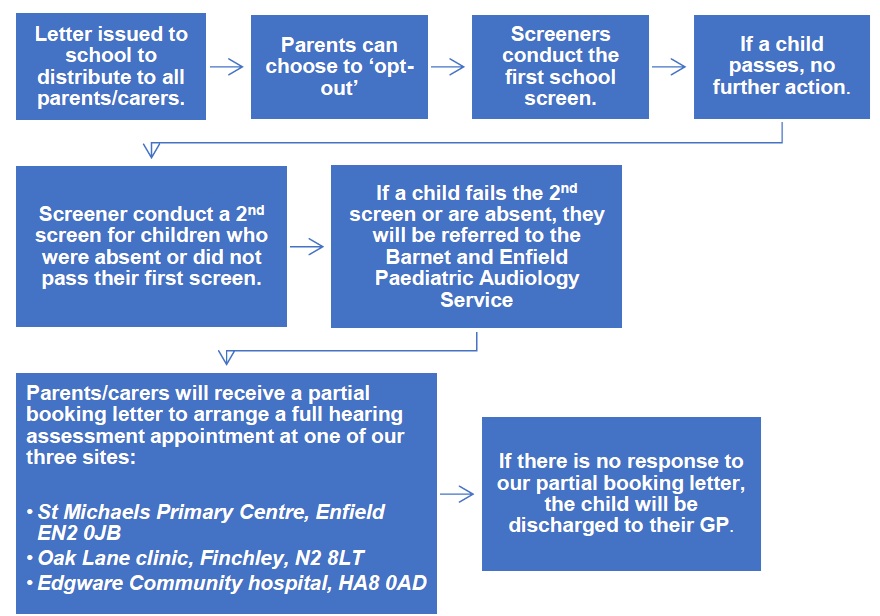
- If you do not want your child to have a hearing screening test, you will need to 'opt-out'.
- This means that as the parent, you will need to say that you do not want your child to have the test.
- If you do not want your child to have the test, please inform the school as soon as possible.
- If you are happy for your child to have the test, you do not need to do anything.
Extra information
- Children who are registered with an Enfield GP who do not pass the school hearing screening will be referred to our Paediatric Audiology service.
- If your child goes to school in Enfield but is not registered with a GP in Enfield, they will still have their hearing screened in school.
- If they do not pass the hearing screen and need further testing, we will send a letter to you and your child's GP.
- This letter will say that the GP must now refer your child to the local Audiology clinic, where you live, for a further assessment.
- We will not be able to check any children who have a PVP shunt fitted (a special device placed in the brain).
- Any child with a PVP shunt will be referred directly to the Paediatric Audiology team for a hearing test.
- Special educational needs schools are not included in the hearing screening programme due to the additional resources required to screen successfully in these schools.
Why is the hearing screening test important?
- Hearing helps us to communicate with other people.
- It is important that children are identified as early as possible.
- This is because undiagnosed hearing loss can affect speech, reading, school success, and social skills.
- By identifying children who might have hearing loss, our service is able to quickly get them diagnosed and onto a treatment plan.
- This is very important for children who may not have received a newborn hearing test.
- Some hearing losses are not always obvious to parents and often children will struggle to describe what they are experiencing.
- Parents can be surprised when hearing loss has been found by the school hearing screening test.
How are hearing screening tests performed in school?
- The health care professional doing your child's hearing screening test is called a 'school hearing screener'.
- The school hearing screener will help your child to understand what they need to do during the hearing screen.
- Sounds will be played through headphones and your child will be asked to do a simple task when they hear the sound.
- For example, building a tower using Lego blocks or raising their hand to let the screener know that the sound has been heard.
- During the test we measure sound in decibels (dB).
- A whisper is about 30dB
- Normal conversation is about 60dB
- A motorcycle engine running is about 95dB
- Hearing is screened at a level of 25dB at 500Hz, 1kHz, 2kHz and 4kHz in both ears.
- These are the four major speech frequencies.
- Each ear is tested individually. Children are required to wear headphones.
- If your child responds at 25dB this is recorded as a pass and no further action is required.
- If your child does not respond at this level, it means they have not met the pass criteria and will need further testing.
- The hearing screener uses a machine called a 'screening audiometer' and it presents the sounds through the headphones.
- Children with special educational needs often find it difficult to have their hearing test done at school.
- They may benefit from having their test done at the audiology clinic.
- The hearing screener will assess the child and make the referral to the audiology department if necessary.
The screening test results and how we will contact you
- You will not be contacted if your child's results have passed the screening test. This means that there is no sign of hearing loss.
- If your child doesn't pass their first hearing screening, they will be re-tested at school around six-eight weeks later.
- If your child fails their second hearing screening, they will be referred to the audiology department.
- You will be contacted within two weeks by the Audiology Team.
- This letter will include your child's results and it will explain the next steps.
- Important! - There are many reasons for why a child might not pass their school hearing screening test. It is not always because there is an issue with a child's hearing.
- For example:
- Glue ear - this is a build-up of fluid in the middle ear that can cause temporary hearing loss.
- Your child may have been distracted or tired during testing.
- Your child had a cold at the time of testing, or up to eight weeks before the test.
- Inherited conditions that stop the ears or nerves from working properly.
- Your child was absent when the screening took place or refused to have the test done.
Booking an appointment with the audiology clinic
- If you receive a partial booking letter from us asking you to make contact, please do so within two weeks of receiving the letter.
- If you do not respond to the partial booking letter within two weeks your child will be discharged from our service.
- You can contact us via telephone or email. Our contact details will be noted on the letter.
- We will always try to offer an appointment as soon as possible, but due to recent service pressures there may be a longer wait than usual for an appointment.
- We appreciate your patience and understanding.
- To book an appointment or if you have any further questions, please get in contact with the School Hearing Screening Team on 0203 316 8074 or via email - enfield.audiology@nhs.net
- If you have concerns regarding your child's hearing, you do not need to wait for the school hearing screening test.
- Please speak to your GP and ask for a referral to paediatric audiology.
Enfield school screening pathway