

Hand and wrist pain
Patient Information Leaflet
What should I know about hand and wrist pain?
- In most cases, hand and wrist pain is not a sign of a serious or long-term problem.
- Symptoms will settle in a few days/weeks with some simple self-care exercises/therapies that you can do at home.
- There are several conditions and types of arthritis that can cause pain or other symptoms in the hands and wrists.
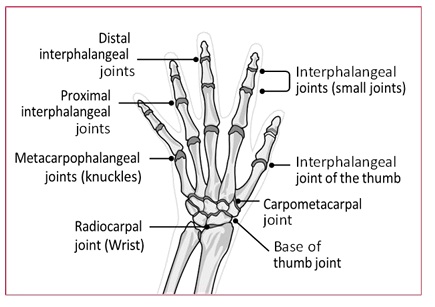
How do hands and wrists work?
- There are 27 small bones that make up each hand and wrist.
- Eight of those bones are in your wrist. Each finger has three bones, and the thumb has two. There are five bones in the palm of your hand, connecting each finger and the thumb with the wrist.
- There are more than 30 muscles that control the hand and wrist. These are in your hands, wrists and forearms.
- Muscles are attached to bones by tendons.
- These are small but very tough pieces of connective tissue. Tendons pass through a bony passage in your wrist, known as the carpal tunnel. The median nerve also passes through this tunnel.
What can I do to help myself if I have hand and wrist pain?
If you are not in terrible pain and don't have other problems that need a Doctor, there are some easy things you can do to help most hand and wrist pain.
Avoid tasks that make the pain worse
Try not to do things that cause your pain or make it worse.
This could be stuff you do over and over, like using a screwdriver, painting, or lifting heavy things.You might be able to do some tasks differently to make it easier on your hands and wrists.
Some problems with your hand and wrist won't get better unless you stop doing certain activities.
Drugs to reduce the pain
- Take painkillers, such as paracetamol and non-steroidal anti-inflammatory drugs (NSAIDs), like ibuprofen.
- There are NSAID gels you can rub into your hand and wrist.
- Be careful not to take too much by combining gels and tablets, as both get into your blood stream.
- With any medication you should always read the information that comes with it, particularly about dosages.
- If you have any questions or worries, talk to a GP or Pharmacist.
Ice and heat
- Putting an ice pack on your hands and wrists can reduce swelling and ease pain. You could use a packet of frozen peas wrapped in a damp towel.
- Never put ice directly on your skin, as this can burn or irritate it. You can apply ice for up to 20 minutes several times a day.
- If your hands are painful and stiff, applying heat could help.
- There are products such as wheat bags you can buy from chemists that you heat in a microwave. You might need to place a cloth or tea towel on your skin to avoid burning it.
- Putting your hand and wrist on a hot water bottle with the cover on, or having a warm bath or shower may also provide some relief.
- Moving your hand around in a bowl of warm water can be helpful and soothing.
- Do not apply heat to your hand or wrist if it's swollen or if you've just injured it, as this can make it worse.
- Wax baths are another form of heat therapy that can relieve pain and stiffness. To get the most benefit it's a good idea to use one before you exercise your hands.
- Ask your GP, a Pharmacist or a Hand Therapist where you can buy one, and for advice on how to use them. Follow the instructions carefully, and make sure you don't overheat the wax. You shouldn't use these if you have cuts or open sores.
- Switching between heat and ice therapy throughout the day may help.
- Ice reduces blood flow, which can help with pain and swelling. Heat increases blood flow, which can help if your hands are stiff, and the muscles are tired. Heat can also help damaged soft tissue to heal.
Wearing splints
- Wearing splints can help support the hand and wrist.
- Some can be used when you're carrying out everyday activities and some are for when you're sleeping and resting.
- A Hand Therapist, Physiotherapist or Occupational Therapist can give you advice on whether a splint could help, which type would be good for you and how to use it properly.
Keep moving your hands and wrists
- Moving your hands, wrists and fingers as much as possible can help ease pain and stiffness. This will also maintain their range of movement, function and strength.
- At the back of this factsheet are some exercises you can do at home. Try to do them as regularly as you can, especially if your hands and wrists are feeling stiff.
- If you have carpal tunnel syndrome, talk to a Physiotherapist, GP or Hand Therapist for specific advice on exercise.
When should I see a healthcare professional?
Hand and wrist pain often gets better with things you can do at home. However, you'll need to visit your GP surgery if:
- your pain isn't getting better after treatment at home for two weeks
- the pain is getting worse
- the pain keeps returning
- the pain is stopping you from doing your everyday activities
- your hands are stiff and swollen, particularly in the mornings, and these feelings don't get better after half an hour
- your hands are swollen and stiff, warm and red
- you feel unwell, and have a high temperature
- you have ongoing tingling, numbness or weakness in the hands or fingers.
It's important to get urgent medical attention, if:
- you think you've broken a bone
- you have extreme pain
- any part of your hand, wrist or fingers is a funny shape or colour
- you have lost the feeling of part or all of your hand
- there was a snap, grinding or popping noise when you injured your hand or wrist
you can't move your hand, wrist or fingers properly.
How are hand and wrist conditions diagnosed?
- A Doctor or Physiotherapist will want to hear about your symptoms and how long you've had them.
- They will examine your hand and wrist, and may check your range of movement, feeling and strength.
- You might be asked to have blood tests to look for inflammation.
- X-rays, ultrasound scans, computerised tomography (CT) scans and magnetic resonance imaging (MRI) scans are sometimes used to help Doctors have a closer look at what's happening inside your hand and wrist.
- Sometimes people might need a nerve conduction study. This is a test that helps Doctors see how well your nerves are working.
Hand Therapy
- If you have ongoing hand and wrist pain or a specific condition that affects the hand and wrist it could be helpful to see a Hand Therapist.
- Hand Therapists are experts who know a lot about hand and wrist problems. Your GP, rheumatology department or orthopaedic department could refer you to one.
Occupational Therapy
- Occupational Therapists are trained healthcare professionals who can help if you're having difficulties with everyday tasks.
- They can help you find other ways of doing activities.
- You can be referred to one through your GP, or you might be able to see one through Social Services, depending on your situation.
- Your workplace might have access to occupational therapy, or you could have private treatment.
Specific hand and wrist conditions
Carpal tunnel syndrome (CTS)
CTS is caused by pressure on the median nerve as it passes through the carpal tunnel.
This tunnel is formed of small bones and a ligament in the wrist.
Symptoms are tingling, numbness and pain, mainly in your hand and fingers, but possibly also in your wrist and forearm.
It's often worse at night.
If you think you have carpal tunnel syndrome, you should get an appointment at your GP surgery.
There are several potential causes of CTS, but often it's not possible to say exactly what's causing it. It can affect:
- pregnant women, people with diabetes, with an underactive thyroid or with arthritis.
- overweight people. Losing weight can help relieve symptoms.
- people who use hand-held vibrating tools as part of their job can be at risk of carpal tunnel syndrome.
- Carpal tunnel syndrome can go away in a few weeks or months. Using a splint or having a steroid injection can help.
- if symptoms don't go away, a minor operation to relieve the pressure in the carpal tunnel can solve the problem.
De Quervain's tendinopathy
- Problems can develop with tendons in the hand and wrist.
- Tendons have a protective covering, or sheath, with synovial fluid in. This thick fluid protects the tendon and allows it to move easier.
- Sometimes tendons or tendon sheaths can become inflamed. This can cause pain, swelling and stiffness and is called tendinopathy.
- It can happen if tendons are overused, for example after playing a lot of sport.
- Arthritis can lead to tendinopathy, and in rare cases so can an infection.
- Sometimes, there might not be an apparent cause.
- De Quervain's tendinopathy is a common condition that can affect tendons in the wrist, causing pain around the wrist and at the base of the thumb.
- Pain normally eases with rest and can get worse with activity.
- Applying ice wrapped in a damp towel and taking an NSAID can help.
- If your condition is not improving and is affecting your quality of life, steroid injections, splints, hand therapy or surgery might also be helpful.
- Most cases of hand and wrist pain will not be a sign of a serious or long-term problem.
Trigger finger
- Trigger finger is the name of a condition in which you can't straighten a finger or thumb properly.
- You might even need to use your other hand to straighten it.
- Very occasionally, a finger may become too painful to straighten and may stay stuck in the same position.
- Trigger finger most commonly affects the thumb, ring and middle finger. More than one finger can be affected at the same time.
- The affected finger might swell, and it can be painful.
- There can be a clicking or popping feeling that comes from the finger, especially in the morning.
- It's thought to be caused by swelling of a tendon or tendon sheath.
- Sometimes the swelling can cause nodules to form. These are small lumps that form under the skin.
- Trigger finger can happen to healthy people for no clear reason. It's more common among women over the age of 40.
- It's more likely if you've had a previous injury to the palm of the hand.
- Other medical conditions such as diabetes, gout, rheumatoid arthritis and an underactive thyroid may also increase someone's risk of getting it.
- Trigger finger can get better without the need for treatment.
- You may need to avoid certain activities if they are making your symptoms worse.
- Non-steroidal anti-inflammatory drugs (NSAIDs) like ibuprofen can help.
- If it doesn't get better on its own and it isn't treated, it's possible for an affected thumb or finger to become permanently bent.
- Treatment can involve steroid injections. In most cases this will sort out the problem.
- In some cases, a small operation can be carried out to stop the tendon from catching.
Dupuytren's contracture
- Dupuytren's contracture can cause the fingers to bend in, towards the palm of the hand.
- It's caused by tissues in the palms of the hands gradually thickening, which then pulls the fingers towards the palm.
- This condition is often mild and might not need specific treatment.
- It's more common in men in their middle age.
- Some heavy, repetitive tasks, such as those that are performed in mining, are thought to increase the risk of Dupuytren's.
- It normally affects the middle, ring and little finger.
- It's not often painful, but it can make it difficult to straighten out fingers and use your hands properly.
- It may affect just one hand but can affect both.
- Treatment is only needed if fingers have started to bend, or if you can't use your hand properly.
- Treatment options available in the earlier stages, include injections of a medicine called collagenase.
- This can break down the thickened tissues and is a quick and easy treatment that doesn't need to be done as an operation.
- You will need to have your fingers straightened and stretched afterwards by a healthcare professional, which might be a bit uncomfortable.
- There are surgical options including cutting the thickened tissue or cutting it out. This can be done as an operation or using a needle in an outpatient clinic.
- Talk to your Doctor to discuss your options if your symptoms aren't improving.
Osteoarthritis
- Osteoarthritis is the most common type of arthritis.
- It can affect hands and wrists, particularly the joints at the ends of the fingers or at the base of the thumb.
- It can cause pain and stiffness and make it difficult to use your hands and wrists properly.
- Osteoarthritis can cause bony lumps to develop on the hands, particularly on the fingers.
- If possible, avoid tasks that make the pain worse and put strain on your hands and wrists.
- Keeping your hands and wrists moving as much as possible can help ease symptoms.
- There are some examples of simple exercises you could do at the back of the booklet. Try to do these every day.
- Taking painkillers, such as paracetamol, or NSAIDs such as ibuprofen can help with the pain and help you to keep moving your hands.
- Capsaicin cream, which is made from extracts from chili plants, has helped some people with osteoarthritis of the hand. It can help block pain messages sent to nerves.
- In some cases, if symptoms don't improve then surgery might be an option.
- Finger joints can be fused. This can improve symptoms, but it will lead to a loss of movement.
- It's also possible to have joint replacements for hand osteoarthritis.
- Another option could be arthroscopy, also known as key-hole surgery, to clean out a joint using a small cut, rather than open surgery.
Rheumatoid arthritis
- Rheumatoid arthritis is an autoimmune condition (when your body's defense system gets a little confused and accidentally attacks healthy parts of your own body) that can cause inflammation in joints.
- This condition can sometimes start in the hands and wrists, with symptoms of pain, swelling and stiffness.
- This is often worse first thing in the morning.
- The stiffness can last for longer than half an hour and tends not to ease with movement.
- Joints can feel warm, and they can sometimes be red.
- Rheumatoid arthritis can affect both hands and wrists in the same way at the same time. The symptoms can start quite gradually.
- If you do get any of these symptoms in your hands, and if you have an overall feeling of being unwell and are very tired, see a Doctor as soon as you can.
- There are drugs that can treat the underlying cause of rheumatoid arthritis, and these can help prevent damage to your joints. The earlier treatment is started, the more effective it's likely to be.
Hand-arm vibration syndrome
- Hand-arm vibration syndrome can affect people who have regularly used vibrating tools and machinery over a long period of time (10 years or more).
- Such tools include pneumatic drills, power drills and chainsaws.
- The early symptoms are loss of feeling, numbness and pins and needles in the fingers.
- Symptoms can often be mild and just affect the ends of the fingers or can cause whole fingers to go numb.
- This can make doing up buttons and picking up small objects like coins difficult.
- It's thought that it could be caused by repeated minor injuries to the small nerves and blood vessels in the fingers.
- If you think you have symptoms of hand-arm vibration syndrome, see a Doctor and report it to your manager if you think it's being caused by something you do at work.
- You might need to stop using vibrating tools and machinery to stop your condition getting worse.
- Stop doing tasks that are causing the pain or making it worse.
- Hand-arm vibration syndrome can lead to another condition called Raynaud's phenomenon.
Raynaud's phenomenon
- Raynaud's phenomenon is a condition that causes a reduction in blood supply to the outer parts of the body, including the fingers.
- It can happen in the cold or in stressful situations. It can also appear when using hand-held vibrating tools.
- During an attack of Raynaud's, the fingers can change colour.
- They may first go white or look waxy. They can then go blue, and possibly even purple or black in severe cases.
- They are then likely to go red, and can be painful, tingly and numb when the blood rushes back.
- In most cases the cause is unknown, and Raynaud's occurs on its own. This is known as primary Raynaud's.
- People with the medical conditions lupus or scleroderma can develop Raynaud's as a complication. This is known as secondary Raynaud's.
- Sometimes secondary Raynaud's can start before the other medical condition - although this is rare.
- Primary Raynaud's is usually not serious, and the symptoms are manageable.
- Secondary Raynaud's can cause ulcers and sores that need treating.
- Keeping warm in cold weather can help reduce the chances of an attack of Raynaud's.
- Wearing several layers of clothing, as well as a hat, scarf and gloves will help.
- Reusable or disposable hand warmers and heated gloves can help.
- It's good to keep the skin of your fingers as healthy as possible by using a moisturiser at least once or twice a day.
- Your pharmacist will be able to tell you which ones are good for people with Raynaud's.
- Exercising regularly is also good for your circulation.
- Smoking is very bad for your circulation and can make Raynaud's much worse. If you smoke, quitting can be the best thing you do.
- Your GP will be able to offer advice and support, and there's useful information on the NHS Smokefree website.
- There are drugs available, such as nifedipine, which can improve your blood flow. These will need to be prescribed by a Doctor.
Going back to work with hand and wrist pain
- If you've had time off work, getting back sooner rather than later is helpful for most people.
- It's better to get back to your normal routine as much as possible, and as soon as possible.
- You may need to take some painkillers to allow you to do so.
- If there are tasks that make your pain worse, try to do them differently to take the strain off your hands and wrists.
- Could you avoid doing these activities for at least a short while? Could you get help with them?
- You might find it easier to do reduced hours, or rotate some of your tasks at work, at least for a time if that's possible.
- Talk to your manager or HR department for support if you're struggling with any aspect of your job.
- If you have an occupational health adviser at your workplace, they can help advise what work you are fit to do and arrange any simple adjustments to help you.
- If you're having difficulties travelling to or from work or need an item of equipment, the Government's Access to Work Scheme might be able to help.
- If you're unable to get back to work after two weeks of absence, you should talk to your Doctor and employer. They might be able to organise physiotherapy, occupational therapy, hand therapy or other treatments that can get you moving again.
- You can get further advice through your local Jobcentre Plus and the Government's Fit for Work website.
Exercises for hand and wrist pain
- The following exercises are designed to keep the hand and wrist flexible.
- It's important to work within your pain limits and not to overstretch yourself if you're in pain.
- A little bit of pain or discomfort while you're exercising that you can cope with doesn't mean you're doing yourself any harm.
- Remember it's best to keep moving as much as you can, as otherwise your symptoms could get worse.
- Try to do these exercises regularly, every day if you can. Start off gently and then gradually increase the amount you do.
- You should stop and seek advice if you have severe pain during or after exercise, or if the pain doesn't go away after a few days.
Finger strengthening:
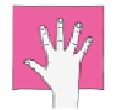

Begin with the palm of your hand on a tissue or towel on a table, fingers apart.
Pull your fingers together by pressing your hand down into the table and bunching up the towel between your fingers. Repeat.
You can also do this without using a towel or tissue, and simply by pressing down on the table and squeezing your fingers together and then stretching them apart.
Finger stretching:
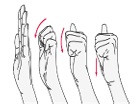
- Start with the fingers extended straight out.
- Make a hook fist; return to a straight hand.
- Make a full fist; return to a straight hand.
- Make a straight fist; return to a straight hand.
Thumb stretch:
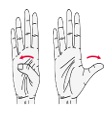
- Hold your hand out in front of you, as if you're saying stop.
- Begin with your thumb positioned outward.
- Move the thumb across your palm and then back to the starting position.
Hand lift:
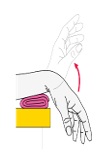
- Place your forearm on a flat surface, like a table, with your hand hanging over the edge, palm facing down. 2. A rolled-up towel under your wrist might provide comfort. 3.Keeping your fingers relaxed, move your hand upward until you feel a gentle stretch, then return to the starting position.
Wrist twist:
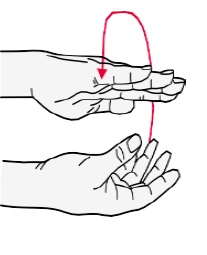
- Bend your elbow to 90 degrees with your palm facing down.
- Rotate your forearm, so that your palm faces up and then down.
- You can stand or sit to do this.
Hand wave:
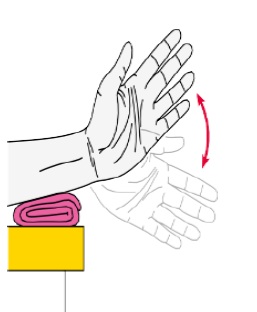
- Support your forearm on a table on a rolled-up towel for padding or on your knee, thumb facing upward.
- Move the wrist up and down through its full range of motion, as if you are waving.
The above exercises have been produced by Versus Arthritis https://www.versusarthritis.org/
Contact our services
MSK CATS and Physiotherapy Services
Tel.: 0207 288 3317
Email: whh-tr.mskinterfaceservice@nhs.net