

Foot and ankle pain
Patient Information Leaflet
Why do I have pain in my foot or ankle?
- Most people experience pain in and around their feet or ankles at some time in their lives.
- It is one of the hardest-working and most complicated parts of the body.
- It has 26 bones and 33 small joints.
- These are held together by soft tissues like muscles, tendons, ligaments, nerves, and blood vessels.
- Most foot or ankle pain does not last long and usually happens because of minor injuries, like sprains or strains.
- If this is the case, then you probably won't need to see a healthcare professional.
- These will slowly get better with some easy self-care, but some will take a few months to fully recover.
- Occasionally some foot and ankle pain will have no obvious cause or may not improve with self-care.
- If your pain keeps getting worse, doesn't get better, or lasts for a few months, it might be caused by changes in your foot or ankle, or another health problem.
- There can be many reasons for long-term pain in and around the feet or ankles, such as:
- badly fitting footwear
- osteoarthritis
- inflammatory arthritis
- connective tissue diseases
- poor blood circulation
- nerve damage.
- You will need to see a healthcare professional if your pain is not getting better.
- Long-term pain can change how you use your feet and ankles and can affect other parts of your body.
How can I treat foot or ankle pain when it starts?
- Most foot or ankle pain can be treated without having to see a healthcare professional.
- Soft-tissue injuries should begin to improve over the first few days with the help of some simple self-care tips.
- You may need to be careful and protect the injured area for several months, until it has fully recovered.
Self-care tips
- Paracetamol and pain-relieving gel should help reduce your pain and discomfort.
- There are four steps to treating pain, known as RICE therapy.
- These can help improve healing in the first 2-3 days.
These are:
Rest - do not stand or walk on the hurt foot or ankle.
Do not do any exercise but gently move it once in a while so it doesn't get stiff.
Ice - put an ice pack or frozen vegetables, covered in a damp cloth, on the painful area for 20 minutes every 2-3 hours.
Compression - wrap a bandage around the area that's painful.
It should be tight enough to support it, but not so tight that it restricts the blood flow.
If you've hurt your toe place a small piece of cotton wool between it and the next toe, then tape them together.
Elevate - raise your foot to reduce swelling.
By gently massaging the painful area from time to time you can help reduce swelling and increase blood flow.
Do not have hot baths, heat packs, ibuprofen, and alcohol in the first few days, as they can affect healing.
When should I see a healthcare professional about foot or ankle pain?
Some foot pain can become more than a short-term problem.
If you cannot treat the pain yourself or have a condition that could affect the joints or soft tissue, it may need further investigation.
You should speak to your Doctor or a footcare specialist if:
- your pain does not improve in the first few days
- your pain is getting worse
- it is still causing problems after two weeks of self-care
- you have sores that are not healing
- your skin has changed colour - especially if it's turned dark blue or black
- your foot has changed shape or is really swollen
- you have a high temperature or feel hot and shivery
- it is red, warm, or swollen - as you may have an infection
- the problem keeps coming back or lasts longer than three months
- you have an inflammatory condition, such as rheumatoid arthritis or scleroderma
- you have diabetes
- you are taking steroids, biologics or other drugs that affect your immune system.
Your Doctor may want to refer you to a specialist in foot care, such as a Podiatrist, Physiotherapist, or an Orthotist, for a diagnosis and treatment.
Who can help my foot or ankle pain?
- There are trained healthcare professionals who specialise in diagnosing and treating problems that affect the foot and lower leg.
A Podiatrist
Podiatrists are trained foot specialists. They used to be called Chiropodists.
They can offer you:
- advice on padding, dressings, specialist insoles, splints and supports
- advice about footwear and exercise
- small non-surgical procedures
- advice on medication.
Different areas have different rules for who can be referred to an NHS Podiatrist.
Some only refer people if they have rheumatoid arthritis, diabetes, or peripheral arterial disease. Other authorities may have broader terms.
If you visit a Podiatrist privately you will need to pay for your appointments and any treatment.
However, they can refer you for some services, such as scans or x-rays, on the NHS.
A Physiotherapist
- Physiotherapists are trained to use movement, exercise, manual therapy, and can give advice to help get your foot and ankle moving again.
- They will show you exercises to practice at home to help your recovery.
- In some areas you can self-refer to an NHS Physiotherapist. Otherwise, your Doctor will request an appointment for you.
- You can see a Physiotherapist privately, though you would have to pay for your treatment.
An Orthotist
- Orthotists are trained to assess and treat problems in the foot and ankle by using specially made braces, splints, callipers, insoles, and footwear.
- Usually, you need to be referred to an Orthotist.
All Orthotists, Physiotherapists, and Podiatrists must be registered with the Health and Care Professions Council (HCPC).
How are foot or ankle problems diagnosed?
- A healthcare professional will usually be able to diagnose by examining your feet.
- They will look for swelling and any changes in the shape of your feet that might cause pain.
- You might also be asked to walk around so they can see how the problem affects the way you move and stand.
- Most of the time they can make a diagnosis without scans, x-rays or blood tests.
- If your pain is being caused by a condition, such as arthritis, they will do tests.
Common causes of foot or ankle pain
- Besides obvious injuries, there are many common reasons for foot pain.
- These problems can often be found by looking at which part of the foot or ankle hurts.
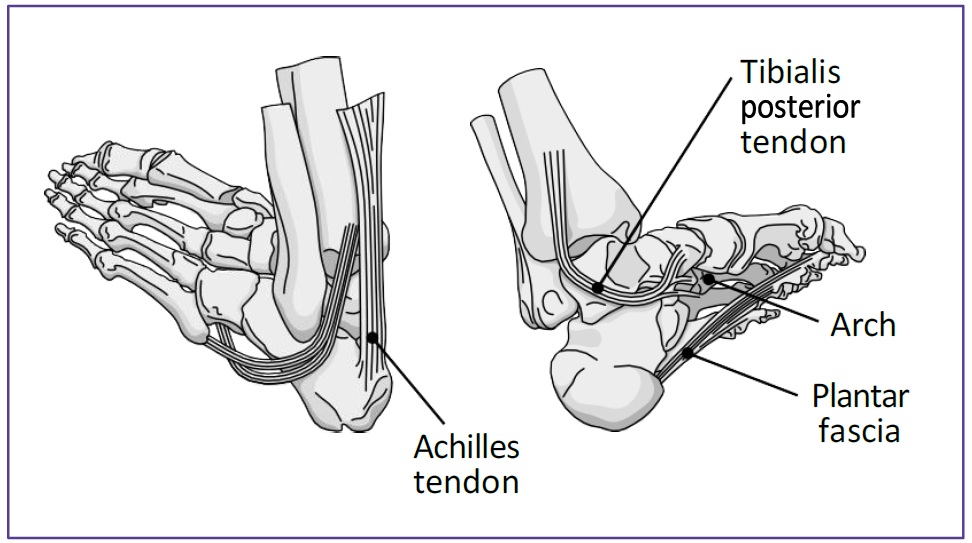
- For example, achilles tendinopathy and tibialis posterior dysfunction are common causes of pain in the tendons that connect the back of the calf, to the ankle, heel, and underside of your foot.
- Tendons are the strong cords that connect muscle to bones and support the structure and movement of your foot and ankle.
Achilles tendinopathy
Achilles tendinopathy is caused by damage or inflammation in the tendon that runs from the calf in the lower leg, through the back of the ankle to the bone in the heel.
The main symptoms are:
- pain in the Achilles tendon which worsens after activity
- difficulty moving the foot up and down
- a grating sensation in the area
- swelling, redness or heat around the tendon
- a lump on the tendon.
It is usually caused by a tear or over-use of the Achilles tendon.
It can affect anyone doing sports involving lots of running.
People with very high or low arches can also be prone to this problem, because these foot shapes put strain on the tendon.
It can take a few weeks to several months to fully recover, but the self-care tips outlined above should help with your symptoms.
Speak to your Doctor or a healthcare professional if:
- you heard a popping or a snapping sound before the pain began
- you are in severe pain that doesn't improve over the first two days
- it does not improve much over two weeks
- the pain keeps coming and going over a long period of time.
Figure 1. The main structures affected by foot pain
Tibialis posterior dysfunction
- The tibialis posterior tendon runs close to the Achilles, from the inside of your calf to the arch of your foot.
- Tibialis posterior dysfunction causes pain, redness, warmth and swelling in the tendon.
- Your ankle or heel may feel weak. It can make walking, standing for long periods of time, or rising to your tip toes difficult.
- The arch of your foot may drop, and your heel could tilt outwards.
- It can feel worse when you are active especially if you are running or jumping.
- It is caused by inflammation, damage or a weakness which over- stretches the tendon.
- If left untreated, it can eventually make the arch of the foot collapse.
- Paracetamol and ibuprofen can help reduce the swelling and pain. You can also help it by following the self-care tips recommended earlier.
- We suggest you see a Doctor, Podiatrist, or Physiotherapist if you think you might need a splint or support for the ankle or arch of the foot.
- Once it is less painful, exercises to stretch the calf muscle and strengthen the tendon should help.
- It may take several months of self-care treatment before it recovers fully.
- If the pain is bad or has not improved after two weeks following the self-care tips speak to your Doctor or a healthcare professional.
Plantar fasciitis
Plantar fasciitis affects the bottom of the foot, causing pain in the centre and inner side of the heel.
It is caused by damage to the strong band of tissue, called the plantar fascia.
This runs from the heel, beneath the arch of the foot to the base of the toes.
The plantar fascia supports the arch and helps the foot work properly.
It spreads your weight evenly through your foot, so you can walk, run, or stand without difficulty.
Having plantar fasciitis can make it difficult and painful to use your foot properly, especially just after you have been resting.
The pain often improves when your foot is active, for example during exercise, but usually returns soon after you stop.
Plantar fasciitis can be caused by:
- a sudden increase in the amount of activity you do
- being on your feet for too long
- exercising on hard surfaces
- overstretching the sole of your foot
- being overweight, as it increases the strain on your heels
- an injury or weakness in the ankle
- high or low arches
- ageing, as it is more common in people over 40
- shoes that do not cushion or support the soles of your feet
- tightness in the calf.
Plantar fasciitis can make lumps of calcium collect on the heel bone. These are called bone spurs and can be very painful.
Weakness in the plantar fascia can also put strain on your ankle and knee.
These self-care tips should help your plantar fascia heal:
- When it's painful, rolling a cold drink can over the base of your foot for about 20 minutes should help.
- Gently massaging and stretching your calf, ankle, and foot when you are resting. This can make it easier to get moving again.
- You can reduce the pressure on the bottom of your foot by wearing wide-fitting, comfortable shoes with a supportive sole and cushioned insole.
- They should fasten with a lace or strap and have a heel that is slightly raised by about 2-3cm, such as a good sports shoe.
- Try to avoid walking on hard surfaces with bare feet, wearing tight pointy shoes, high-heels, backless slippers, flip-flops, or flat shoes.
- Ask your Pharmacist about insoles, heel pads and other pain relief.
- There is no proof that expensive magnetic insoles are any better than regular cushioned insoles.
- It can take up to 18 months to fully recover from plantar fasciitis.
- If you feel these self-care tips have not helped after two weeks, speak to your Doctor, a Physiotherapist or a Podiatrist, who may recommend:
- specially made insoles or foot supports
- stronger pain relief
- steroid injections in extreme cases
- additional medication to help reduce any inflammation.
Over the long-term try to follow a healthy diet.
If you are overweight, try to lose some. Research shows us that weight loss reduces the strain on the plantar fascia and can improve your pain levels.
Bursitis in the foot or ankle
- Bursitis causes pain and inflammation, around hard- working joints such as in the big toe, ball of the foot, heel, or ankle.
- It is caused by swelling in a small pocket of fluid, known as a bursa, or bursae if more than one is affected.
- Normally these small pouches cushion and protect your bones, joints, and tendons from impact, rubbing or pressure.
- However, repeated rubbing, friction, excessive pressure, or injury can cause the fluid inside to increase making the affected bursa inflamed and tender.
- For example, you can get bursitis between your ankle and heel if you keep wearing shoes that rub, pinch, or press down on the area.
- Shoes that are too tight and high heels regularly cause bursitis.
- It often appears as a red, painful, swollen lump. However, it can also cause general swelling that you only notice because of the pain, for instance on the bottom of your heel.
- People with bunions or irritated joints can be prone to bursitis. Rheumatoid arthritis can also cause bursitis, particularly in the ball of the foot.
- The self-care tips recommended earlier should help relieve your pain and inflammation.
- However, instead of bandaging the area, try using adhesive padding on the swelling to protect it from further friction and pressure.
- Resting it on a cushion can also help.
- If you find self-care treatments are not helping speak to a healthcare professional.
Changes in the shape of your arch
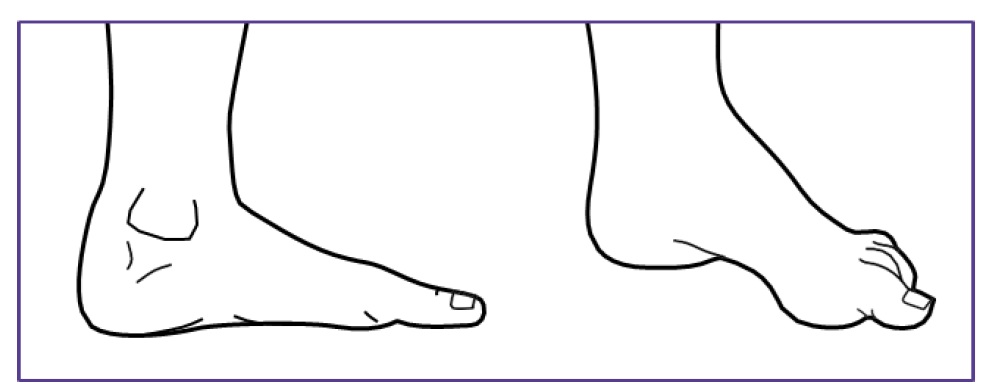
- The arch is the inside mid-section of your foot. It determines how your bodyweight is spread and carried by the bones and joints of your feet.
- For your foot to function at its best the arch should form a smooth arc from the ball of the foot to the heel.
- The height of your arch may never cause you any kind of problems. Some people are born with arches that are higher or lower than average and their bodies adapt to them.
- Other people may find their arch shape changes because of complications such as arthritis, weight, pregnancy, or injury. These changes can make you more likely to develop further problems in other parts of your foot, ankle, knee, hip and back.
- If you are in pain and think your arch shape has changed speak to a healthcare professional about treatments.
- Insoles or supports made specially for your foot shape by an Orthotist could improve pain caused by high or low arches.
Low arches
- A low arch can affect how your foot and ankle works and bears weight.
- For example, it can make you lean in on your ankle and force your heel to spread outwards.
Figure 2. Low and high foot arches
- It can put more strain on your feet, ankles, knees, hips and back.
- People who naturally have flat feet are less likely to experience problems in these areas because their bodies adapt to their natural arch shape.
- However, arches that fall or drop from their normal shape can make you more likely to get overuse injuries.
- Your body posture or balance may also change, which can increase the strain on your legs, knees, hips and back.
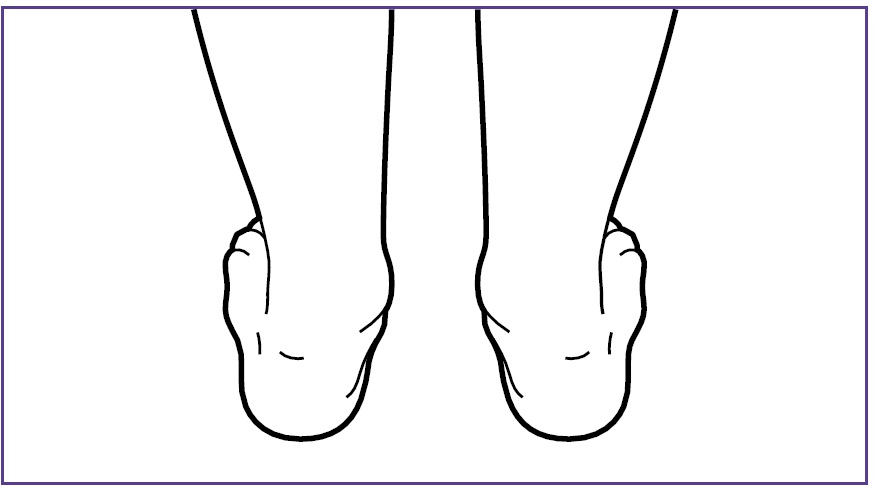
- The condition valgus heel, where the ankle leans inwards at an angle causing the heel to drift outward, is often linked to low arches.
- People with rheumatoid arthritis often develop it because of changes in their joints.
High arches
- People with high arches are more likely to walk on the outer edge of their feet because their arches push their feet and ankles outwards.
- It can put excessive strain on the ankle, heel, and ball of the foot, increasing the risk of problems such as plantar fasciitis.
Figure 3. Valgus heel
Problems linked to low and high arches
- Arches that are higher or lower than average can increase your risk of developing other problems, such as:
- valgus heel
- hammer toes
- retracted toes
- clawed toes
- mallet toes
- bunions
- corns and calluses.
- The self-care tips can help ease pain in your arches.
- Changing your footwear to a well-made running trainer that you feel supports the shape of your arch may prevent further painful changes to the structure of your arches.
- Insoles and arch supports can help but it's best to visit a foot specialist, such as a Podiatrist, to get ones designed specifically for your foot shape.
- If you're buying new footwear, it's best to take any adaptations, such as insoles, padding, or arch supports with you, as you may need a larger shoe size to fit them in comfortably.
- Losing weight, if you need to, can reduce the strain on your arches and may prevent further long-term changes.
- You may find it difficult to do exercises that put a lot of pressure through your feet.
- Swimming is a good way to improve and maintain your fitness because the water supports your body weight.
Other causes of foot pain
Pain in the foot can be a consequence of damage, pressure or rubbing over a long period of time.
- Wearing badly fitting shoes, pregnancy, injury, or putting too much strain through specific parts of your foot can all cause changes in the shape of your feet.
- Often, these changes are painful and can affect your ability to do things.
- Sometimes, it's our choice of shoes that has the biggest impact on the structure of our feet and the problems we develop, such as:
Calluses
- Calluses are patches of rough, hard, slightly raised skin that build up on your feet, particularly on points that take the most pressure or rubbing.
- These patches can be more sensitive and ache more than other parts of your foot. They can be controlled by gently filing the area each week with a pumice or special foot file. If they are left, they can turn into corns.
Corns
- Corns are raised areas of hard, knobbly skin which develop where calluses have been left untreated.
- They often cause a burning sensation.
- A corn is a permanent change to your foot which will need care and management to stop it becoming too painful.
- You can manage corns by gently filing or pumicing them each week.
- You should never cut the skin with a blade.
- Corns and calluses will usually grow back within four to six weeks unless they are properly cared for.
- Wearing softer, roomier footwear and placing a cushioned pad over the corn or callus can help to reduce pressure on the area.
Neuroma
- A neuroma causes sudden shooting, stabbing, or burning pain.
- Most commonly it affects the third and fourth toes and the ball of your foot.
- It can feel like there is a small stone under your foot and your toes may become numb or tingly.
- It is caused by a damaged or irritated nerve and often becomes more painful over time.
- It is also known as Morton's neuroma and can be made worse by:
- tight, pointy, or high-heeled shoes
- shoes or trainers that put excessive pressure on the ball of your foot and toes.
- Athletes and people with low or high arches, bunions or hammer toes commonly get neuromas.
- You can ease the pressure on the neuroma by placing a cushioned pad on it.
- Using soft insoles and wearing wide, comfortable shoes with a low heel and a soft sole can also help.
- If it continues to cause problems your Doctor or a Podiatrist can recommend further treatments.
Bunions
- A bunion is a bony lump that develops on the side of the joint at the bottom of the big toe.
- It can change the shape of the joint making it bigger, so it sticks out more. This is called hallux valgus.
- In extreme cases, it can alter the angle of your big toe, making it bend towards your other toes.
- You may find your big toe loses flexibility and becomes stiff, which is known as hallux rigidus.
- Soft, wide-fitting shoes reduce the pressure on the joint.
- Bunion pads and insoles can also help relieve pain around the joint.
- Ask a Pharmacist for advice or speak to your Doctor if it continues to cause problems.
Clawed, mallet, retracted and hammer toes
- Clawed, mallet, retracted or hammer toes are conditions that cause the toes to curl or lift out of line.
- The main difference between each condition is the joints that are affected in the toe.
- However, they tend to be treated the same way.
- These conditions are linked to several other foot problems, including bunions, flat feet, high arches, tendon problems and badly fitting shoes that squash your feet.
- Arthritis and problems with the nerves in the foot can also cause them.
- Hard skin can build-up over the raised toe joints making them uncomfortable and more prone to sores, calluses, and corns.
- You can manage these problems by wearing soft, cushioned, wide-fitting shoes, using insoles and applying padding to the painful area.
- Paracetamol, ibuprofen and pain-relief gels or creams can also help.
- Your Doctor or a Podiatrist may recommend using rubber, leather or silicone splints to relieve your discomfort.
However, these changes in the toes can only be permanently corrected with surgery.
Sores
- Changes in the structure of the foot can make you more likely to get blisters or open sores.
- It is important to keep wounds clean and protected with a clean dressing or padding, to stop them getting infected and help them heal.
- Also known as ulcers, these wounds can be particularly problematic for people with conditions such as:
- rheumatoid arthritis
- Raynaud's phenomenon
- lupus
- scleroderma
- diabetes.
- Some sores may not heal without specialist treatment and in extreme cases they could cause an infection in the bone, called osteomyelitis.
- It's important to tell your rheumatology team about any wounds.
How can arthritis affect your feet?
- Several types of arthritis can affect your feet and ankles.
- Some, such as osteoarthritis, can be managed with painkillers, non-steroidal anti-inflammatory drugs (NSAIDs) and exercises that strengthen and stretch the soft tissue around the affected joint.
- If your pain does not improve, your Doctor may recommend a steroid injection into the joint to reduce the swelling and pain and get your foot and ankle moving more.
- Inflammatory conditions such as rheumatoid arthritis are likely to need disease-modifying anti-rheumatic drugs (DMARDs) or biologics.
- These long-term treatments should address the inflammation causing your pain.
Osteoarthritis
- Osteoarthritis can affect any joint in your foot or ankle, making it painful and swollen at times.
- It can cause new bone to grow in and around the joint, which changes the shape of your foot, often making the joint look larger and more knobbly.
- When it affects the joint at the base of the big toe you may develop a bunion.
- If it affects your little toe, it can cause a small lump, called a bunionette, to appear on the joint at the base of the toe.
Inflammatory conditions
- Inflammatory arthritis causes swelling, pain, heat, and redness around the joints, which can affect your whole foot.
- There are several types of arthritis that are described as inflammatory conditions.
- These conditions can cause sores to appear on your feet which may take a long time to heal or may keep getting worse.
- If you do get sores speak to your Doctor as soon as possible as they could become infected.
- Inflammatory arthritis can usually be diagnosed by a physical examination of your joints, blood tests or scans.
- There are several types that commonly affect different parts of the feet, including:
Rheumatoid arthritis
- Rheumatoid arthritis is an autoimmune condition that can affect any joint in the feet, and occasionally, the ankles.
- It is caused by a fault in the immune system, which makes it attack healthy cells in your body, as if they were germs or viruses.
- When this happens in and around a joint, it can make it swollen, stiff, hot, and painful.
- It can cause long-term damage to the affected joints in your feet or ankles.
- It's not uncommon for people with rheumatoid arthritis to get painful pea-sized lumps, called nodules, in their heels, toes and soles of their feet.
Psoriatic arthritis and reactive arthritis
- Psoriatic arthritis and reactive arthritis are both triggered by an over-reaction in the immune system.
- These conditions are often linked to conditions where pain spreads along the back and underside of the heel, such as plantar fasciitis and Achilles tendinopathy.
- They can also cause a condition known as dactylitis, or sausage toe.
- This makes the entire length of one or two of your toes swollen, painful and difficult to move.
- Reactive arthritis usually lasts a relatively short amount of time, often between six to twelve months at most.
- Psoriatic arthritis tends to need long-term management.
Ankylosing spondylitis
- Ankylosing spondylitis commonly affects the lower back but can also cause pain in the heels.
- This can increase your risk of developing conditions such as plantar fasciitis and Achilles tendinopathy.
Gout
- Gout is a very painful type of arthritis.
- It is caused by crystals collecting inside a joint and commonly affects the foot, particularly the big toe joint.
- During a gout attack the joint can be inflamed for up to two weeks.
- Without medication, further attacks can cause permanent damage to the joint, which could then lead to osteoarthritis.
Other arthritis-related conditions that can affect your feet
Lupus
- Lupus sometimes affects your joints and tendons making the toes drift outwards and the arches flatten.
- This can be painful and may make your feet feel stiff after periods of rest.
Raynaud's phenomenon
- Raynaud's can occur on its own or with rheumatoid arthritis, scleroderma, or lupus.
- It makes your toes feel cold, numb, and painful. They may change colour from white, to blue, then red.
- These sensations usually stop when your feet warm up. However, going from cold to hot too quickly can make your pain worse.
- Wearing warm socks or silver lined socks may help prevent these painful attacks.
- Raynaud's can also cause painful sores, known as chilblains, on your toes.
The organisation Arthritis UK (formerly Versus Arthritis) publishes information booklets on each of these conditions and treatments.
Your Doctor's surgery or rheumatology department should also be able to provide you with their leaflets.
Surgery
- Surgery is usually a last option if self-care, exercise, and specialist treatment do not help.
- Most foot surgery aims to correct the position of the joints by resetting the bones or fusing a joint in the corrected position.
- An operation may be recommended to:
- correct valgus heel or hammer toes
- remove a neuroma or rheumatoid nodules
- remove part of the bone from a bunion and reshape the toes
- relieve pain.
- Joint replacements for the ankle and foot are not yet as successful as knee or hip replacements.
- Your Doctor will tell you if surgery could help.
Exercises for the foot and ankle
- Start gently and slowly build up the amount you are doing once each exercise becomes easier or more comfortable.
- It's normal to feel some slight aches as you move your foot or ankle.
- However, if movement makes it feel worse or is causing bursts of more intense pain, stop and consult a healthcare professional.
Tip: If your feet or ankles are stiff in the morning you may find it easier to exercise once they have had time to loosen up. A warm bath or shower can help ease stiffness.
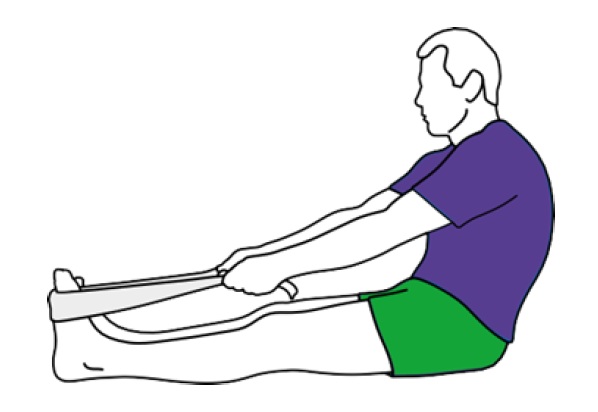
Achilles tendon and plantar fascia stretch
- Loop a towel around the ball of your foot and pull your toes towards your body, keeping your knee straight.
- Hold for 30 seconds. Repeat three times on each foot.
Towel pickup
- Sit down with a towel on the floor in front of you. Keeping your heel on the ground, pick up the towel by scrunching it between your toes.
- Repeat 10 to 20 times. As you improve, add a small weight, such as a tin of beans, to the towel.
Plantar fascia stretch
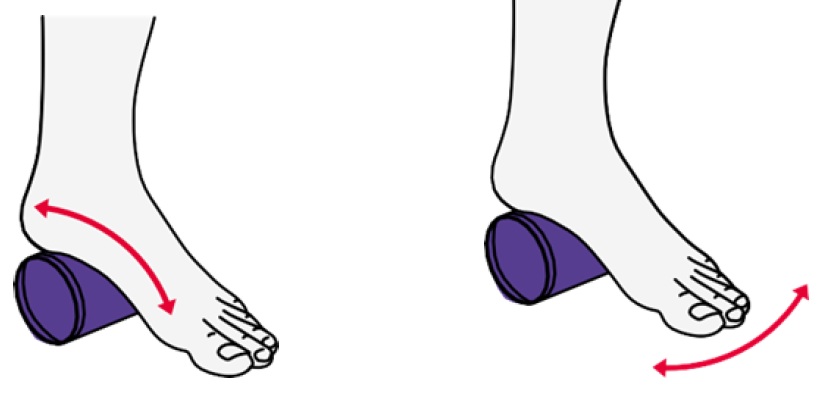
- Sit down and rest the arch of your foot on a round object, such as a tin of beans. Roll your foot on the tin in all directions for a few minutes.
- Repeat this exercise twice a day.
Wall push
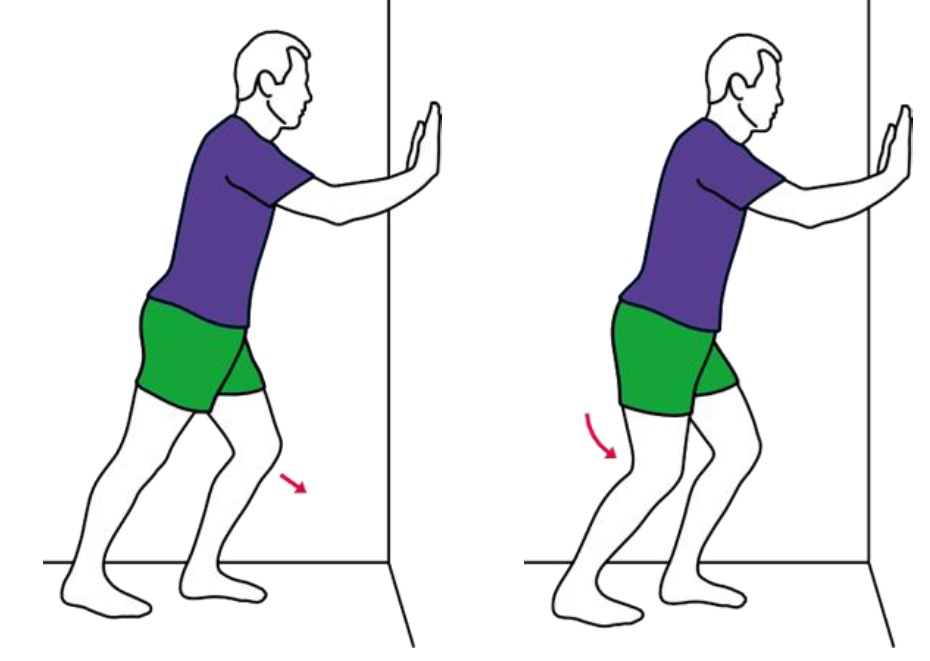
- Facing a wall, put both hands on the wall at shoulder height and place one foot in front of the other. The front foot should be around 30cm (12 inches) from the wall. With the front knee bent and the back knee straight, bend the front knee towards the wall, until the calf in your back leg feels tight. Relax and repeat 10 times.
- Repeat exercise a) but bring the back foot forward a little, so that the back knee is slightly bent. Repeat this 10 times.
Sitting plantar fascia stretch
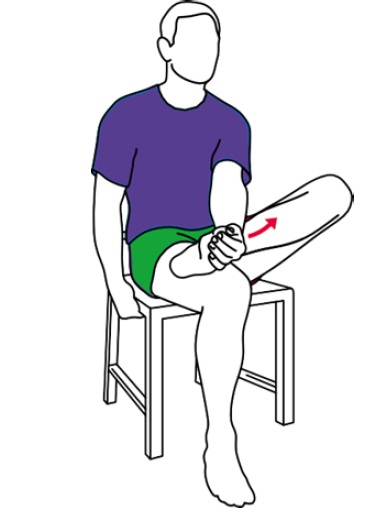
- Sit down and cross one foot over your knee. Grab the base of your toes and pull them back towards your body, until you feel a comfortable stretch.
- Hold for 15 to 20 seconds. Repeat this three times.
Standing heel raise
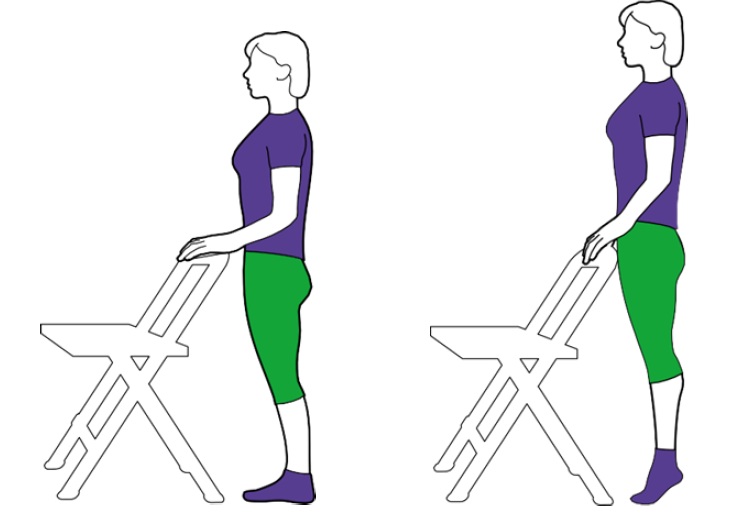
- Standing in front of a counter or chair, using it for support, rise up on your tiptoes, with your knees straight.
- Slowly lower your feet back down. Repeat 10 times.
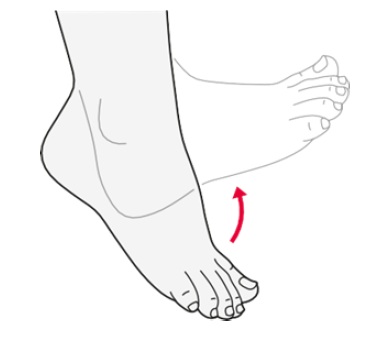
Ankle range of motion
- Bend your ankle up towards your body as far as possible, then point your toes away from your body.
- Repeat this 10 times.
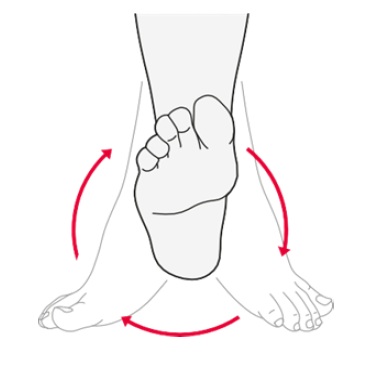
Ankle rotation
- Move your ankle around slowly in a circle.
- Do this 10 times one way, then repeat in the opposite direction.
Toe spread
- With your feet resting on the floor, spread your toes apart as far as possible. Hold for five seconds.
- Repeat this exercise 10 times.
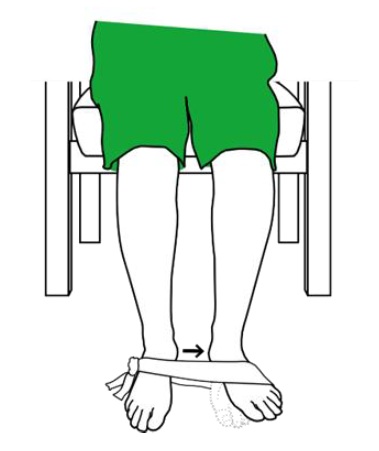
Ankle out
- Make a loop out of a piece of elastic fitness band, and hold it in place, either with the leg of a table or chair, or with your other foot.
- Place one foot in the loop. Keeping your heel fixed on the ground, turn your toes outwards against the resistance of the band.
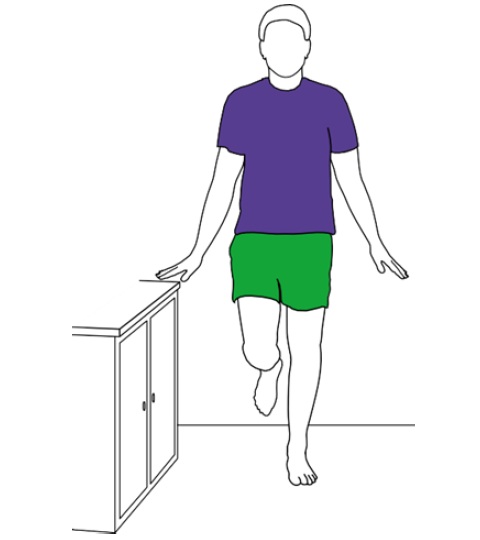
Basic balance
- Using a stable object such as a kitchen counter for support, balance on one foot.
- Build up how long you do this for, aiming for one minute.
- Try to do this three times and repeat the set twice a day.
- Take any opportunities to practise standing on one leg - building it into your daily activities will help you improve.
- When you feel confident with this basic balance exercise, you can make it harder by standing on a cushion or pillow. Build up the amount you do slowly.
Contact our service
- MSK CATS and Physiotherapy Services
Tel.: 0207 288 3317
Email: whh-tr.mskinterfaceservice@nhs.net