

A healthy bladder
Patient Guide
How your bladder works
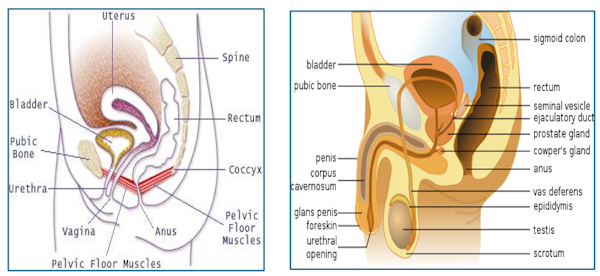
- Urine (pee) is stored in the bladder, a stretchy muscle in the lower tummy, behind the pubic bone.
- Between toilet visits, the bladder relaxes and fills with urine. When you go to the toilet, the bladder squeezes to push urine out through a tube called the urethra.
- A healthy bladder can usually hold 400–600ml of urine.
- Most people go to the toilet to empty their bladder 4–7 times a day.
Female Bladder (left) and Male Bladder (right)
What can go wrong with the bladder?
Bladder problems are very common, but many people feel embarrassed to talk about them. The good news is that there are ways to manage, improve, and sometimes even cure these problems.
Stress incontinence
- Some people leak urine when they cough, sneeze, laugh, run, jump, or move suddenly.
- This is called stress incontinence.
- It usually happens when the pelvic floor muscles or the muscles that help keep urine in are weak or damaged.
Overactive bladder (OAB)
- An overactive bladder happens when the bladder squeezes too soon, even when you are trying to hold your urine in.
- Symptoms include:
- A sudden need to pass urine
- Leaking before you can reach a toilet
- Going to the toilet often
- Having to wake up at least once a night to pass urine.
Mixed incontinence
- Some people have both stress incontinence and an overactive bladder at the same time. This is called mixed incontinence.
Problems emptying the bladder
- Sometimes the bladder does not empty properly.
- This can cause urine to dribble out all the time. This is called overflow incontinence.
- It is important to see a doctor or GP for advice and treatment.
Bladder infections/urinary tract infections (UTIs)
A bladder infection, also called a UTI, is usually caused by bacteria getting into the bladder through the urethra.
Symptoms can include:
- Needing to go to the toilet more often
- Dark, cloudy, or strong-smelling urine
- A burning feeling or pain when passing urine
- Feeling like your bladder is not fully empty
- Pain in the lower tummy.
These symptoms should be checked by a doctor or GP as soon as possible.
They may ask for a urine test.
If you see blood in your urine, you should get an urgent GP appointment because it could be a sign of a serious problem.
Nocturia
- Nocturia is when you wake up often in the night to go to the toilet.
- As people get older, getting up once or twice a night can be normal.
- Sometimes it can be caused by an infection, an overactive bladder, or too much fluid building up in the body during the day.
- If this happens a lot, speak to your GP.
Smoking
- Smoking can make bladder problems and overactive bladder worse.
- It is also the biggest risk factor for bladder cancer and is linked to about half of all cases.
- Stopping smoking can improve your health at any age.
- If you would like help to quit, speak to your GP or ask about a stop smoking service.
What can you do?
Pelvic floor exercises
- Exercises that strengthen the pelvic floor muscles can help improve bladder control and treat incontinence.
- See the pelvic floor exercise leaflet for more information.
Drinking enough fluids
Try to drink 1.5–2 litres of fluid each day.
Do not drink too little, as this can make your urine stronger and irritate the bladder.
Drinking too little can also increase the risk of constipation, urine infections, and bladder or kidney stones.
Some drinks can irritate the bladder and make symptoms worse. It may help to have less of these drinks:
- Drinks with caffeine, such as tea, green tea, coffee, and cola
- Fizzy drinks
- Citrus fruit juices, like orange juice
- Alcohol
You could try replacing them with drinks such as:
- Diluted squash
- Herbal teas
- Decaffeinated tea or coffee
- Soup
Some foods, especially spicy foods or foods with caffeine, may also irritate the bladder. Cutting down on these may help.
Bladder retraining
Bladder retraining can help if you feel the need to go to the toilet very often but only pass small amounts of urine, and you do not have an infection.
Try waiting an extra 5 minutes before going to the toilet, even if it feels uncomfortable.
Once this feels easier, try waiting 10 minutes, then slowly increase the time.
This may take days, weeks, or months.
At first, you may leak more urine because you are waiting longer to get to the toilet. Over time, this should improve.
You can wear a continence pad if it helps you feel more confident and less worried about accidents.
While you are waiting, try to distract yourself.
Thinking too much about your bladder can make the urge feel stronger:
- Keep busy
- Make a shopping list
- Count backwards
- Sit on a hard chair
- Curl your toes and squeeze your buttocks (bum muscles)
- Stay calm - don’t get upset
- Tell your bladder that YOU are in charge, and not the other way around!
Try to go to the toilet every 2–4 hours to empty your bladder. Do not hold your urine for longer than 4 hours.
Preventing urine infections
- Washing the genital area once a day with water is usually enough to help prevent urine infections.
- Soap, bubble bath, shower gel, and vaginal douches can irritate the skin and affect its natural protection.
- You can use aqueous cream instead of soap to gently wash the outside genital area.
Other tips that may help prevent urine infections include:
- Avoid tight underwear, especially thong styles
- Always wipe from front to back after using the toilet
- Empty your bladder after sex
- Cranberry products may help prevent infections.
- If you take blood-thinning medicine, speak to your GP before using cranberry tablets or cranberry juice.
Resources
Bladder and Bowel Community (B&BC)
Provides information and support services.
Website: www.bladderandbowel.org
Email: help@bladderandbowel.org
Bladder and Bowel UK
Provides information and support services.
Website: www.bbuk.org.uk
Email: bbuk@disabledliving.co.uk
Telephone: 01612144591
Bladder Health UK Provides information and support services, including a chat forum and active social media.
Website: www.bladderhealthuk.org
Email: info@bladderhealth.org
Telephone: 01217020820
International Urogynaecology Association (IUGA)
Provides evidence-based patient information translated into several languages.
Website: www.yourpelvicfloor.org/conditions
Pelvic, Obstetric & Gynaecological Physiotherapy (POGP)
Provides evidence-based patient information which may be recited (audio) in many languages.
Website: www.thepogp.co.uk/patient_information/default.aspx
Contact our service
Whittington Bladder and Bowel Care Service
Email: whh-tr.bladderandbowel@nhs.net
Webpage: https://www.whittington.nhs.uk/?c=33288
Whittington Pelvic Health Physiotherapy
Email: whh-tr.outpatienttherapy@nhs.net
Webpage: https://www.whittington.nhs.uk/?c=42977
North central London perinatal pelvic health service - Royal Free London
Email: rf-tr.nclpphs@nhs.net