

Constipation advice
Patient information factsheet
What is constipation?
- Constipation is when your stools (poo) are hard and you go to the toilet less often than is usual for you.
- You may need to strain a lot, and it can cause tummy pain or discomfort.
- It can sometimes lead to piles (haemorrhoids) or small tears around the anus (where your poo comes out) called anal fissures.
- Constipation can be treated through making changes in your lifestyle.
Simple ways to help with constipation:
Increase fibre in your diet
- Aim for 8 portions of vegetables and fruit a day (a portion is about ¼ cup chopped vegetables or 1 piece of fruit)
- Add 2 tablespoons of crushed linseed (flaxseed) to your cereal in the morning
- Eat prunes and other dried fruit
- Eat kiwi fruit
- Eat fruit and root vegetables with skin
- Eat peas, beans, lentils and nuts
- Add tamarind to your food
- Eat cereals containing whole-wheat, whole-grain and bran
- Eat wholemeal bread or high fibre white bread
- Eat porridge oats.
Drink enough to hydrate your bowels
- Aim to drink1.5 - 2 litres (6-10 glasses) of non-caffeinated fluid a day.
- Drink enough so your urine is a pale straw like colour.
Do more physical activity
- Exercise helps your guts work better and move food through your body.
- Try to be active or go for a walk for about 30 minutes most days.
Build a good toilet routine
- Your bowel habits can be trained, and regular routines help your body work better.
- Try having a hot drink and a high-fibre breakfast to help start a bowel movement.
- After eating breakfast, try sitting on the toilet about 20–30 minutes later.
- Don’t ignore the urge to go to the toilet.
Consider use of over the counter or GP prescribed medications
- If you don’t get enough fibre in your diet, you can try a fibre supplement like Fybogel.
- If your stool (poo) is very hard, you can try a stool softener such as Laxido or Movicol.
How to open your bowels without straining
- Straining too much can weaken your pelvic floor muscles over time.
- This may lead to worse bladder, bowel, or vaginal problems later on in life.
- Follow the tips below to help you avoid straining.
Positioning
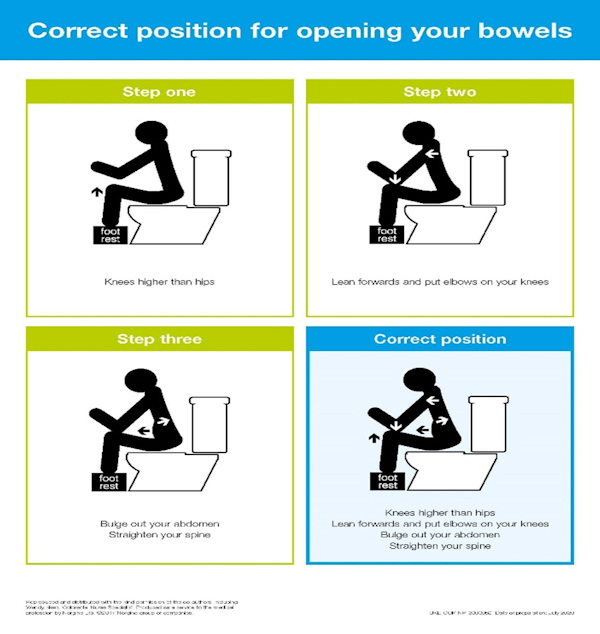
- Sit fully on the seat and relax your pelvic floor muscles: do not hover.
- Support your feet on a step so that your knees are higher than your hips.
- Lean forwards with your elbows on your knees (keep your back straight).
- Try rocking the pelvis back and forth or your knees side to side.
- Try supporting the perineum (skin between vaginal and back passage).
- If you have a vaginal prolapse, try supporting the back wall of the vagina:
Place a clean finger or thumb into the vagina and push against the back wall of the vagina toward the anus while you are opening your bowels.
Breathing tips
- Don’t hold your breath.
- Breathe out slowly and let your tummy and waist gently expand, like blowing up a balloon.
- As you breathe out, you can make a sound like “shh,” “moo,” or “idge”.
- Repeat this a few times to help your body learn the movement.
Contact our service
Whittington Bladder and Bowel Care Service
Email: whh-tr.bladderandbowel@nhs.net
Website: Bladder and Bowel Care Service
Whittington Pelvic Health Physiotherapy
Email: whh-tr.outpatienttherapy@nhs.net
Webpage: Pelvic Health Physiotherapy
North central London perinatal pelvic health service - Royal Free London
Email: rf-tr.nclpphs@nhs.net
Webpage: North central London perinatal pelvic health service - Royal Free London
Published:
05 Jun 2026
Review:
05 Jun 2028
Reference:
ACS/B&B/CA/01