

Ectopic pregnancy
Patient information factsheet
What is an ectopic pregnancy?
- In a normal pregnancy, after the egg is fertilised, it attaches to the womb.
- In an ectopic pregnancy, the growing embryo attaches somewhere outside the womb.
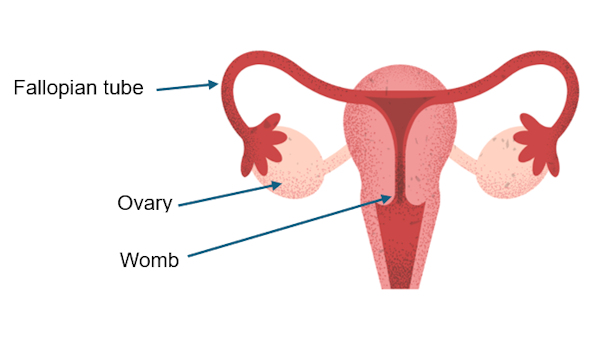
- This is usually in the fallopian tubes (connecting the ovaries to the womb), but it can also happen in the cervix (lower narrow part of the womb), ovary, a C-section scar, or the abdomen (tummy area).
- 2% of all pregnancies are ectopic pregnancies.
- In an ectopic pregnancy the fertilised egg does not develop into a baby.
- Your health may be at risk if the pregnancy continues.
Why do ectopic pregnancies happen?
- In many cases there is no cause for an ectopic pregnancy.
- In normal pregnancies the fertilised egg takes around five days to travel from the ovary to the womb.
- If something causes the egg’s journey to be slowed down there is a chance it will attach somewhere else, not in the womb.
- The most common reason for the journey to be slower is that the fallopian tubes are damaged.
Pelvic infection
- Conditions like pelvic inflammatory disease (PID) or infections (such as Chlamydia and Gonorrhoea) can damage the fallopian tubes.
- Infections such as Chlamydia do not often have symptoms.
- The infection may have been a long time ago and may have been treated with antibiotics, but damage to the tubes remains.
Pelvic or abdominal surgery
- Operations on the abdomen or pelvis can leave scar tissue which can damage the fallopian tubes.
- For example, having had an operation for an appendicitis or to remove an ovarian cyst may cause scarring.
Previous ectopic pregnancy
- Once you have had one ectopic pregnancy, the risk of developing another ectopic pregnancy in the future is about 10%.
Assisted reproductive treatment
- IVF (in vitro fertilisation) can slightly increase the risk of an ectopic pregnancy.
- The risk of ectopic pregnancy increases with age.
How is an ectopic pregnancy diagnosed?
- The most common symptom of an ectopic pregnancy is vaginal bleeding.
- There may also be pain.
- Some people do not have any symptoms in the early stages.
- Doctors are not usually able to diagnose an ectopic pregnancy on symptoms alone.
- It is usually diagnosed from a transvaginal ultrasound scan.
- This is a type of scan that looks inside your womb using a small device inserted carefully into the vagina.
- If an ectopic pregnancy is very small, it may not be possible to see this on a scan.
- We may need to do blood tests to measure the pregnancy hormone.
- If a pregnancy continues to grow within the fallopian tube, it can cause the fallopian tube to rupture (burst).
- This may cause severe pain and internal bleeding and will need an emergency operation.
What happens to an ectopic pregnancy?
There are several things that can happen to an ectopic pregnancy if it is not treated:
The pregnancy stops growing
- Sometimes a pregnancy stops growing on its own, and the body takes care of it naturally and absorbs it, like an early miscarriage
- When this happens, no treatment is needed.
A tubal miscarriage
- In this case, the pregnancy stops growing, and the fallopian tube starts to squeeze and move the pregnancy into the abdomen (tummy area).
- Your body naturally takes care of the pregnancy and absorbs it. No treatment is needed.
The pregnancy continues to grow
- If the pregnancy continues to grow, then it stretches the fallopian tube and can cause the tube to rupture (burst).
- This is life-threatening for the carrier.
- There have been reports of people with undiagnosed ectopic pregnancies giving birth to healthy babies, but this is very rare.
- Most ectopic pregnancies cannot grow beyond the very early stages of pregnancy. If they do continue to grow, they need urgent treatment.
How is an ectopic pregnancy treated?
- The treatment of an ectopic pregnancy depends on your symptoms, ultrasound (scans) findings and your pregnancy hormone levels.
- There are three treatment options: expectant, medical and surgical.
Expectant management
- This means the doctors will keep a close eye on things and wait (watchful waiting), without giving any treatment to end the pregnancy.
- You might be offered this if you are feeling okay.
- The doctors may also suggest it if the scan shows that the fallopian tube hasn’t burst and your pregnancy hormone levels are low and still going down.
- If this happens then the pregnancy may stop growing and reabsorb naturally.
- We will watch closely to make sure this is happening.
- With expectant management, you will need to go to the hospital often for blood tests. This will happen over a few weeks.
- If your hormone levels stop going down, or if you start to feel pain, the doctors might need to give you some treatment.
- It is important that if you start to feel pain, or if the pain suddenly gets worse, you go to the emergency department right away.
- You should not travel outside of London until your ectopic pregnancy is over or your treatment is finished.
Medical management
- Sometimes we can treat an ectopic pregnancy with a drug that stops the pregnancy from growing.
- This involves having an injection of a drug called Methotrexate.
- We only use this drug in a small number of cases.
- This drug can have side effects, and it is not suitable for everyone.
- We would only do this if you were well and there is no sign of fallopian tube rupture on the scan.
- If successful, this treatment can save the fallopian tube and prevent you needing an operation.
- You will need to have regular blood tests for a few weeks to make sure the pregnancy hormone goes all the way down.
- You must not get pregnant for three months after treatment.
- This is because there is a small risk of the baby developing abnormalities if you conceive too soon after the injection.
- Until the hormone levels have fully gone down, there is still a small chance that the tube could burst.
- If you get tummy pain, diarrhoea, or feel dizzy or faint, you should go to the emergency department right away.
Surgical management
- Doctors would suggest an operation if:
- There was any bleeding inside
- The ectopic pregnancy was very big
- There was a heartbeat on the scan
- You were in a lot of pain.
- The operation is usually done by key-hole surgery (a laparoscopy).
- You will be asleep for the operation (given a general anaesthetic).
- There are two different types of operation, a Salpingectomy or Salpingostomy:
**Salpingectomy **
- This means removing the whole fallopian tube with an ectopic pregnancy inside it.
- This is the most common type of operation and will be done if your other fallopian tube looks healthy.
Salpingostomy
This means making a cut in the fallopian tube and removing the ectopic pregnancy.
This type of operation may be done if the other tube has already been damaged or removed.
There is a 10–15% risk of any pregnancy tissue being left in the fallopian tube after a salpingostomy.
People who have this procedure will still need to have blood tests afterwards.
So that we can make sure the pregnancy hormone levels drop.
This shows us that the operation has been successful.
Both types of operations are done in a similar way and so the risks are similar.
If the affected tube is already damaged, then we may have no option but to remove it (salpingectomy).
Leaving the tube behind (salpingostomy) has a slightly better fertility rate for future pregnancies than taking the tube out completely (65% versus 55%).
However, the risk of having another ectopic pregnancy in the future is slightly higher if we leave the tube behind, compared to if we remove it altogether (15% versus 10%).
We need your consent by law to do either of these procedures. The risk and benefits will be fully explained to you by the Doctor before you have the procedure.
Future pregnancies
- The most important thing to think about before trying to get pregnant again is whether you feel emotionally and physically ready.
- If you have had medical management of your ectopic pregnancy (Methotrexate injection), you should use birth control (contraception) for three months before trying to get pregnant again.
- If you have had expectant or surgical treatment of your ectopic pregnancy, we suggest you wait until you have had one normal period.
- If you do get pregnant before your next period, this does not make it more likely that you will have another ectopic pregnancy.
- Your menstrual cycle may not return to normal straight away.
- It is important to have an early scan in any future pregnancy, around five to six weeks, to make sure the pregnancy is growing in the right place.
- Your future fertility may be affected by having an ectopic pregnancy. If you have any questions about this, please speak to one of our Doctors in the unit.
Contraception after ectopic pregnancy
- The coil (IUCD) is not recommended if you have had an ectopic pregnancy. It may increase your risk of having a further ectopic pregnancy if you become pregnant.
Further Support
Ectopic Pregnancy Trust https://ectopic.org.uk/
Miscarriage Association <https://www.miscarriageassociation.org.uk/ >
Contact our service
Women’s Diagnostic Unit
Telephone 020 7288 3786
Monday to Friday 8am to 6:30pm