

Post-discharge asthma
Patient information leaflet
Asthma care after your child leaves hospital
Overview
- This leaflet has been given to you as your child was treated in hospital for asthma.
- It will guide you on how to continue treating their asthma once discharged.
- If you have any worries, concerns, or questions about your child, please make sure you ask the team before discharge or book an appointment with your GP.
What is asthma?
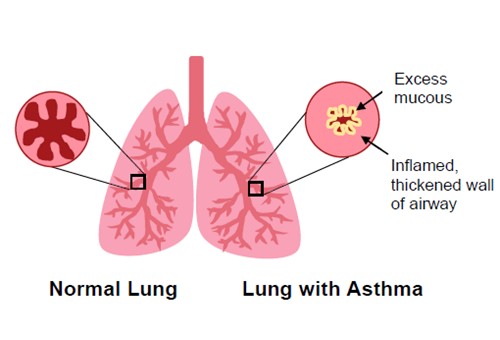
- Asthma is a common condition that affects the airways, which are the small tubes that carry air into and out of the lungs.
- Asthma is a life-long condition, but the symptoms come and go.
- There are many things that can trigger asthma, such as viruses, dust, and pollen.
- These can make the airways narrow and sticky with mucus, which makes breathing harder.
What is the difference between ‘preventer’ and ‘reliever’ inhalers?
- There are many different types of inhalers.
- They are usually grouped into two types: “relievers” and “preventers.”
- Each type has different medicines that help your breathing in different ways.
- It is important to always use a spacer with an inhaler.
- A spacer is a plastic empty tube that slots over the inhaler at one end and has a mouthpiece on the other end.
- If you do not use a spacer with an inhaler, most of the medicine will not reach your lungs. This means it will not work properly.
Relievers
What do they do?
- Salbutamol (‘the blue inhaler’) is a medication used to relieve the symptoms of asthma.
- It only helps when the symptoms of asthma are present, it does not stop them happening.
How do they do it?
- Salbutamol is a ‘reliever’ medication.
- It works by relaxing a type of muscle in the airways called ‘smooth muscle’.
- This helps make the airways wider, relieving the symptoms of asthma.
When are they used?
• Relievers are only needed when asthma symptoms are present. • They do not need to be used regularly if there are no symptoms.
Preventers
What do they do?
- ‘Preventer’ inhalers are prescribed for some children to prevent the symptoms of asthma.
- They generally contain a steroid.
How do they do it?
- Preventors reduce the inflammation and mucus production in the lungs.
- This makes the airways less likely to become narrow.
When are they used?
- If prescribed, preventor inhalers must be used every day, even when there are no symptoms.
- If there are no symptoms when using a preventor, this means the preventor is working.
- If the preventor is not used regularly or the wrong technique is used, the symptoms could come back.
When to give your child Salbutamol after discharge
- If your child was treated with Salbutamol in hospital, they may need more once discharged.
- They will only need more Salbutamol if they have symptoms.
Symptoms to be aware of:
- Coughing
- Wheeze
- Chest Pain
- Tracheal Tug (Sucking in and out at the base of the neck)
- Chest Recessions (Sucking in and out in-between/ below the ribs)
- Nasal Flaring (Nostril moving in and out).
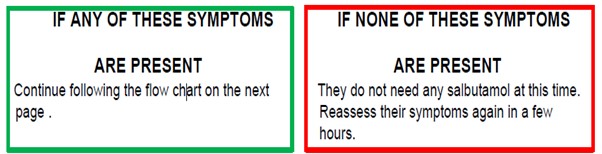
Fast breathing (respiratory) rate (number of breaths per minute)
- Count the number of breaths by looking at their chest and count how many times it moves up in 60 seconds.
- If the number is higher than the ‘acceptable respiratory rate’, they have a fast respiratory rate.
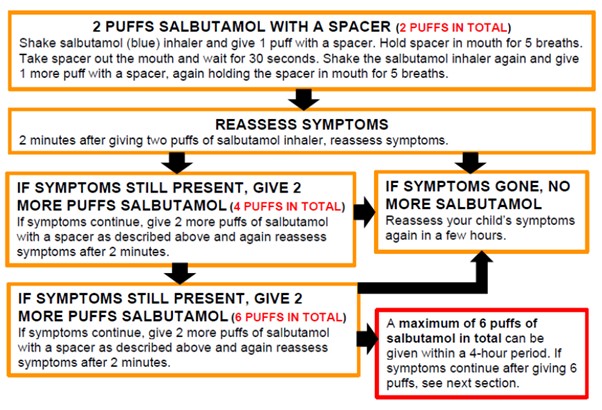
Flow chart
When to call 111 or take your child back to A&E
- If their symptoms return less than 4 hours after having Salbutamol or they need 6 puffs of Salbutamol, and their symptoms are still there.
- At any point, they look unusually exhausted, scared, have blue lips or mouth, or they are unable to talk in full sentences.
- In any of these situations, call 111 to ask for advice. Alternatively, take your child back to A&E.
- The concern is that your child’s asthma may be worsening, and they may need additional treatment.
- If you are unable to get medical advice or bring your child to hospital quickly, call 999 for an ambulance.
GP Review within 48 hours (2 working days)
- Your child must see their GP within 48 hours (2 working days) of leaving hospital. This will need to be booked with the GP upon discharge.
- This is to make sure they are not at risk of another attack.
- This appointment is important to keep, even if they feel better or are back to their baseline.
- If their symptoms get worse before the GP appointment, or they cannot go 4 hours without using their salbutamol (blue) inhaler, do not wait.
- You must call 111 or go to A&E straight away, even if the GP appointment is within the next 48 hours.
More information
Please visit the Asthma + Lung UK website https://www.asthmaandlung.org.uk/symptoms-tests-treatments/treatments or scan the QR codes below.

Contact our service
If you have any non-urgent questions, concerns or comments about your child’s asthma, their treatment or the information you have been provided with, please call us on 020 7288 5231/5059 or email us at whittpaedasthma@nhs.net. We are available Monday to Friday 9am to 5pm. We will aim to respond to any emails within 48 hours.
Published:
20 Jul 2026
Review:
20 Jul 2028
Reference:
CYP/Paed/PDAsthma/01