

Pelvic girdle pain (PGP) and low back (lumbar) pain in pregnancy
Patient information factsheet
- Pelvic girdle pain (pelvic pain) and lumbar (lower back) pain is common during pregnancy.
- It is estimated that up to 6 in 10 women experience pain in the low back region, between the ribs and the top of the pelvis.
- Around 2 in 10 women experience pain in the front or back of the pelvis or top of the thighs.
- A smaller number of women get pain at the front of the pelvis, called symphysis pubis dysfunction.
- The pelvic girdle has joints at the back and front of the pelvis called the sacroiliac joints. It also has the pubic symphysis joint which is at the front. This connects the two pelvic bones together.
- The lower back (lumbar spine) is made up of five bones called vertebrae, with joints and discs between them. The lowest bone connects to the sacrum at the base of the spine.
Lumbar and pelvic anatomy
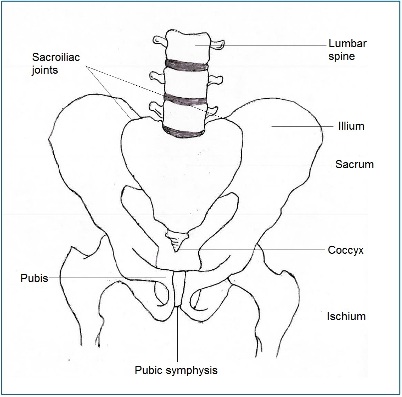 The joints are supported by ligaments and muscles.
What activities are difficult or painful with pelvic girdle pain and low back pain?
- Walking
- Standing on one leg, for example climbing stairs
- Rolling in bed
- Pain moving from sitting to standing
- Opening your legs apart, for example, getting out of a car
- Heavy housework or lifting
What causes pelvic girdle pain and lumbar pain?
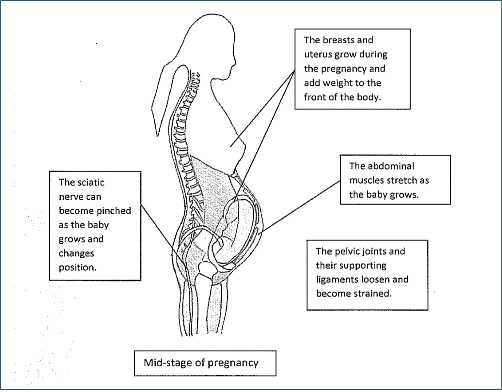
- During pregnancy, the joints in your lower back and pelvis have to work harder.
- A hormone called relaxin makes the ligaments softer and stretchy.
- This helps your body make room for the growing baby and prepare for birth.
- As your baby grows, you gain weight, your tummy and pelvic floor muscles stretch, and your balance shifts forward.
- This changes your posture.
- These changes can cause new back or pelvic pain or make old problems worse. • If the joints in your pelvis do not move evenly, you may get pelvic girdle pain.
Mid-stage of pregnancy
Self-management of pelvic girdle pain and low back pain
- Good posture and strong muscles can help reduce pressure on your back and pelvis.
- Many people can ease pain and discomfort by following a few simple tips.
Pacing
- Try to stay as active as you can, but rest before the pain gets too bad.
- Switch between sitting and standing often, about every 5–10 minutes.
- Turn standing tasks into sitting ones where possible.
- Shop online instead of going out, use a stool at work or home, and sit at a table to prepare food instead of standing.
- Ask for help at home if you need it.
- Ask for a risk assessment at work to discuss pacing as a part of your ‘reasonable adjustments’ during pregnancy.
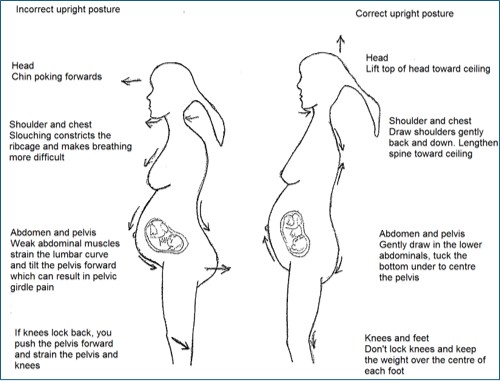
Standing
- Stand up straight and tall. If your pelvis tilts forward, gently tuck your tailbone under like you are flattening your lower back, and keep your knees straight.
- Keep your shoulders, hips and ankles in line, don’t let your hips sway forward.
- Your knees should be straight, don’t lock your knees backwards.
Walking
- Stand up tall.
- Don’t waddle. Keep your hips pointing straight ahead, feet hip-width apart.
- Take smaller steps.
- Walk more slowly.
Stairs
- Use the rails for upper body support.
- Try one step at a time, leading upstairs with the stronger leg and downstairs with the weaker leg.
Sitting
- Sit in a chair with the base of your spine against the base of the back rest.
- Feel that you are sitting on your bony seat bones, not your tailbone.
- Make sure your feet touch the ground or a foot rest.
- Try a pillow lengthwise along the back rest, not sideways.
- If you need more support for the small of the back, use a small rolled-up towel or cushion.
Sit to stand
- Move forward to the front of the chair.
- Move your feet behind your knees and lean your nose over your toes.
- Use your arms to push up.
- Tighten/contract your abdominal and buttock muscles as you stand up.
Getting in/out of the car
- Put a plastic bag on the seat to help you move easily into position.
- Sit on the seat and then swivel, with little steps, so your knees stay together.
- Make sure you remove the plastic bag before you drive.
Sleeping
- Sleep on your side and use pillows between your knees,
- Try a small pillow under your stomach,
- Try sleeping on a folded duvet or mattress topper.
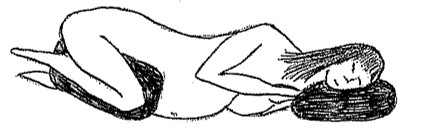
Turning in bed
- Tighten/contract your abdominal and buttock muscles, and firmly squeeze the pillow between your knees as you move
- Try turning without twisting: lift your upper body with your arms into a half-sitting position. Then, turn carefully, keeping your shoulders, hips and knees in line
- Try ‘top to tail’ turning: lift your upper body with your arms into a half-sitting position, keeping your knees together, swing your lower legs over the edge of the bed so you are sitting.
- Move your head pillow to the bottom of the bed.
- Swing your lower legs up to where your head was previously and lower your upper body with your arms into your side. Lying so your head is at the bottom of the bed on the pillow.
Lifting
- If you can, try to lift less to reduce strain on your pelvis and lower back.
- When picking something up from the floor, kneel on one knee instead of bending your back. Make sure that you gently tighten your tummy and bottom muscles as you stand up.
- Use a backpack for carrying, rather than a bag.
- If you have another child, encourage them to climb onto your lap instead of lifting them up.
- If your job involves lots of lifting, talk to your employer about making changes to help you and discuss suitable adaptations.
Exercise
- Try to do 150 minutes of moderate exercise each week. You can split this into 20-30 minute sessions.
- Stay fit by using an exercise bike, swimming (but avoid the frog kick as with breaststroke), walking in a pool, aqua aerobics, or low-impact/seated aerobics.
- Improve your core strength and posture with pregnancy Pilates or yoga.
- Sit on an exercise ball for 20 minutes or more each day.
- Do deep tummy muscle and pelvic floor exercises every day.
- If your doctor or healthcare professional has given you any rules about exercise, always follow their advice.
Deep abdominal exercises
- Your deep abdominal muscles help to support and strengthen your back and pelvis.
- Draw lower tummy muscles in towards your spine. Hold this position for up to 10 seconds as you continue to breathe normally. Avoid bracing your abdomen or holding your breath.
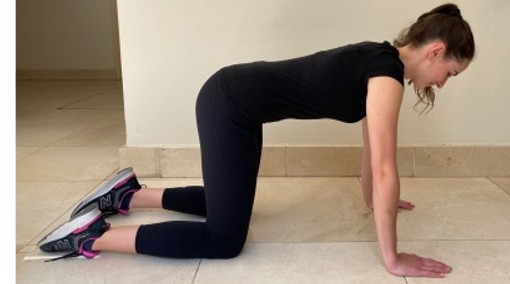
- You can exercise these muscles in any position; for example, standing, sitting, lying down or on all fours.
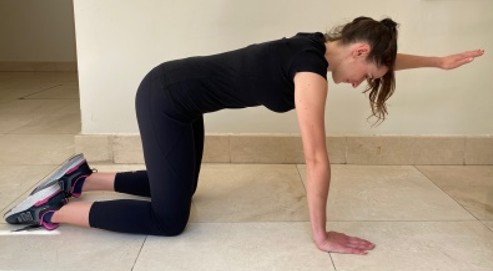
- To progress this exercise, lift one arm in front whilst you keep your deep abdominal muscles drawn in. Keep your shoulder blades still and your back level. Hold this position for up to 10 seconds and then bring back to the resting position. Repeat up to 8-10 times alternating arms.
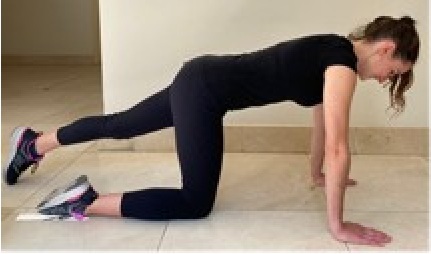
- To progress further, extend one leg behind as you keep your abdominal muscles drawn in. Be careful to keep your pelvis and back still and level as you extend the leg behind. Hold for up to 10 seconds and then repeat 8-10 times alternating each leg.
Pelvic Floor exercises
- The pelvic floor is a group of muscles at the bottom of your pelvis.
- They stretch from your tailbone at the back to your pubic bone at the front.
- They also wrap around your back passage (anus), vagina, and urine opening (urethra).
- The pelvic floor is important for:
- Helping you stay dry by preventing leaks of urine, wind, or poo.
- Supporting your pelvic organs and tummy organs.
- Helping with sexual function and pleasure.
- Your pelvic floor gets weaker during pregnancy and after birth.
- Pelvic floor exercises can help keep it strong and improve control.
There are two types of pelvic floor exercises.
1. Long holds
- This exercise helps make your pelvic floor stronger and able to function for longer.
- Tighten the muscles around your back passage, vagina and front passage as if trying to stop yourself passing wind and urine at the same time. Hold this contraction for a maximum of 10 seconds.
- Rest for at 5-10 seconds, then repeat the contraction until you get tired or for a maximum of 10 repetitions.
2. Short lifts
- This exercise helps you to improve your timing and co-ordination of your pelvic floor muscles. It is important to be able to work your pelvic floor muscles quickly, so they can react to sudden stresses, such as coughing, laughing or exercise (which puts pressure on the bladder).
- Tighten the pelvic floor muscles quickly and then relax them fully.
- Repeat this, tightening and relaxing steadily as many times as you can up to a maximum of 10 times. Aim for a strong muscle tightening with each contraction.
- Try to do 10 long squeezes and 10 quick squeezes, 3 times a day.
- Start by doing them lying down or sitting, then try standing as you get stronger.
- Apps like the NHS “Squeezy” app can help you remember.
- Do not stop and start your urine when you are peeing. This is not a safe or recommended exercise.
Supports
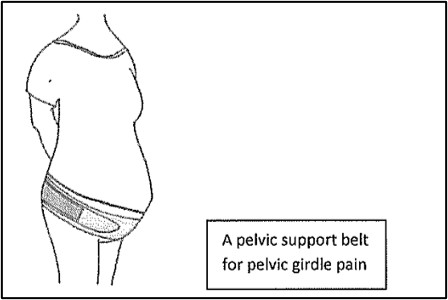
- Pelvic support belts may help reduce pelvic girdle pain when you are standing or walking.
- Pelvic belts can be bought online. Measure the widest part of your hips to get the correct size.
- A physiotherapist can give you a tubigrip abdominal support. It is stronger than a bump band and can be worn all day.
- If you are finding it very hard to walk, Physiotherapists can give you crutches for a short time.
Pain relief
- Heat or ice may help ease your pain.
- You can try a small ice pack wrapped in a towel on your pubic bone, or a hot water bottle on your lower back.
- Use it for about 10 minutes at a time, up to 3 times a day.
- Do not put heat or ice directly on your skin, or on your bump or tummy.
- Try deep tissue massage.
- Take paracetamol or codeine as prescribed by your health professional, especially for sleeping.
- Do not take any anti-inflammatory tablets or creams until after giving birth.
- Try acupuncture.
- Try a Transcutaneous Electrical Nerve Stimulation (TENS) machine. This is a small, battery-operated device with leads connected to electrodes, which are attached to the skin. Small electrical impulses are delivered to the affected area of your body, which you feel as a tingling sensation. You can buy or hire units from pharmacies and online for use in labour and also for pain relief in pregnancy.
Contact our service
Whittington Bladder and Bowel Care Service
Email: whh-tr.bladderandbowel@nhs.net
Webpage: https://www.whittington.nhs.uk/?c=33288
Whittington Pelvic Health Physiotherapy
Email: whh-tr.outpatienttherapy@nhs.net
Webpage: https://www.whittington.nhs.uk/?c=42977
North central London perinatal pelvic health service - Royal Free London
Email: rf-tr.nclpphs@nhs.net
Webpage: https://www.royalfree.nhs.uk/services/maternity-services/maternity-support/north-central-london-perinatal-pelvic-health-service
Published:
17 Jun 2026
Review:
17 Jun 2028
Reference:
EIM/PelvPhysio/ PGP&LBLPP/04