

Pelvic organ prolapse
Patient information factsheet
What is a prolapse?
- The uterus, bladder, and other pelvic organs are supported by soft tissues and muscles inside the pelvis.
- These supports attach to the pelvic bones.
- A prolapse happens when the tissues stretch or tear, especially if the pelvic floor muscles are weak.
- This can cause the walls of the vagina to stretch and sag downward over time.
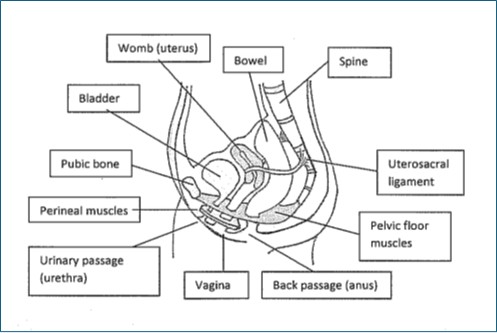
- Many women who have had a baby have some stretching or sagging of the vaginal walls. Often, this causes no symptoms at all.
- A prolapse is not dangerous and does not always get worse over time.
- Most women only seek help if it starts to bother them.
What does it feel like?
- Some women feel sensations of heaviness or pulling in the vagina.
- Others feel like something is coming down or out.
- Sometimes there can be pain in the vagina or lower tummy.
- Sometimes a lump can be felt with a finger inside the vagina, or outside the vagina if the prolapse is low.
- These sensations can change during the day and are often feel worse after standing for a long time, heavy lifting, or being active.
- Because the bladder and bowel are close to the vagina, a prolapse can sometimes cause problems with urinating (peeing) or emptying the bowels (pooing).
Prolapse in different parts of the vagina
Cystocele
- This is the stretching of the soft tissues at the front of the vagina. This can make it hard to pee or cause a sudden strong need to pee.
Uterine
- This is the stretching of the ligaments that support the cervix. This can cause the uterus to drop into the vagina.
- This may make it hard to fully empty the bladder or bowel or cause a sudden strong need to pee.
Rectocele
- This is the stretching of the soft tissues at the back of the vagina. This can make it hard to empty the bowels.
Common Causes
- Pregnancy and childbirth can stretch the ligaments and tissues that support the pelvic organs.
- They can also weaken or damage the pelvic floor muscles, which help hold these organs in place.
- Aging and menopause can make the pelvic floor muscles weaker.
- Lower levels of oestrogen during menopause can also cause the supporting tissues to shrink and become less strong.
Increased pressure in the abdomen
- Think of your body like a tube. If you keep squeezing or bending it, the end can get weak and start to bulge.
- The same can happen with a prolapse.
- Things like heavy lifting, long-term coughing or sneezing, constipation, and straining on the toilet can all increase pressure in your tummy.
- This pushes down on the uterus, bladder, or bowel.
- Being overweight or having large fibroids can also add extra pressure.
What can I do to manage symptoms of prolapse?
To help yourself:
- Try to avoid standing for long periods. If you have symptoms, take short sitting breaks or do some tasks while sitting instead of standing.
- Be careful with heavy lifting. Try to split heavy loads into smaller parts or ask for help when needed.
- Be careful with carrying things or bending for long periods. Change what you are doing often or use tools like trolleys or stools to help.
- Be careful with high-impact exercise. Choose low-impact activities like swimming, walking, Pilates, or yoga instead. If you have no symptoms, build up your core strength before trying high-impact interval training.
- Try not to strain when you empty your bowels. Eating healthy foods, drinking plenty of water, and having fruit, vegetables, and regular exercise can help prevent constipation. If you are still having trouble, see your Doctor or Physiotherapist for advice.
- Lose some weight - particularly if you are carrying extra weight around your middle.
- Support the wall of the vagina with a clean finger or thumb when you empty your bladder or bowel if you are having difficulty.
- Lie flat for 15 to 30 minutes if your prolapse symptoms feel worse than usual. This helps take pressure off your body. Try doing pelvic floor exercises too, as they can sometimes help reduce the feeling of prolapse.
Start daily pelvic floor exercises
- Please use the pelvic floor muscle leaflet for the exercises and/or or speak to a pelvic health Physiotherapist.
- They can give you advice to help strengthen your pelvic floor muscles.
- These exercises may not fix the prolapse, but they can help control symptoms and stop it from getting worse.
- It is important, once you know how, to use your pelvic floor muscles at the right time to stop further stretching of the ligaments.
- Learn to tighten your pelvic floor muscles strongly when you cough, sneeze, blow your nose, or lift something.
- With practice, this becomes easier to remember.
- Learn to gently tighten your pelvic floor and keep it slightly engaged when standing and walking, like maintaining good posture.
Pessary Supports
- Vaginal pessaries are small devices placed inside the vagina to support the vaginal walls and help reduce symptoms.
- You can still do pelvic floor exercises while a pessary is in place.
Surgery
- Surgery should be a last option, because the prolapse can come back over time.
- Having stronger pelvic floor muscles may help recovery after surgery and reduce the chance of it happening again.
Resources
International Urogynecological Association (IUGA)
Provides evidence-based patient information translated into several languages.
Website: https://www.yourpelvicfloor.org/conditions/
Pelvic, Obstetric & Gynaecological Physiotherapy (POGP)
Provides evidence-based patient information which may be recited (audio) in many languages.
Website: https://www.thepogp.co.uk/patient_information/default.aspx
Royal College of Obstetricians and Gynaecologists (RCOG)
For patient information and leaflets on many topics including exercise.
Website: https://www.rcog.org.uk
Published:
17 Jun 2026
Review:
17 Jun 2028
Reference:
EIM/PelvPhysio/PelOrgProl/01