

Lateral ankle avulsion fracture
Patient information leaflet
This small break to the outside of the ankle is treated like a sprain.
Healing
- This normally takes about six weeks to heal.
- Smoking will slow down your healing.
- We would advise that you stop smoking while your fracture heals.
- Talk to your GP or go to https://www.smokefree.nhs.uk for more information.
Pain and swelling
- Your ankle may be swollen and painful.
- Swelling is often worse at the end of the day.
- It is normal to have mild pain and swelling for three to six months after your injury.
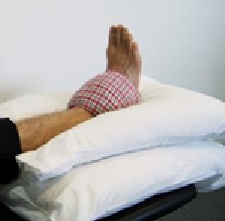
- Taking pain medication, raising your ankle and using ice or cold packs will help.
- More information is on the next page.
Walking and your boot
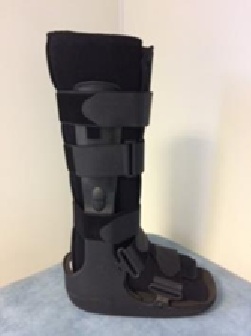
- The boot protects your ankle and will make you more comfortable.
- Wear the boot when you are standing and walking for the first six weeks.
- You can take it off at night and when resting.
- Please tell us if you are diabetic, as you may need a special boot.
- You are allowed to put weight through your foot.
- You may find it easier to use crutches in the early stages.
Exercises
- It is important to start exercises as soon as possible. Instructions are further down this leaflet.
Follow up
- Most people recover well by following this advice. You will not usually need another appointment.
- Contact our team if you still have bad pain or swelling after 12 weeks, or if you are still wearing the boot after 8 weeks.
Any questions
- If you are worried about your symptoms, cannot follow this plan, or have pain somewhere other than your ankle, contact the Virtual Fracture Clinic team.
Caring for your injury: Week 1-2
Remember to wear your boot whenever standing and walking for the first two weeks.
- You can remove the boot when resting and at night.
- Wear a long sock in your boot.
Use a cold pack will help with your pain and swelling.
- You can use an ice pack or bag of frozen peas wrapped in a damp towel.
- Put this on your ankle for up to 15 minutes every few hours.
- Make sure the ice isn’t in direct contact with your skin. Wrap it in a clean tea towel or similar.
Rest your ankle
- Try to rest your ankle, especially in the first 24-72 hours.
- Raise your ankle on a stool or cushions so that it is above the level of your hip.
- This will help to reduce your swelling.
Exercises
- Move your ankle and foot early. This helps your blood flow and lowers the risk of a blood clot (Deep Vein Thrombosis).
- Do these exercises three to four times a day.
- Start these exercises straight away. Stop if they become painful.
 |
 |
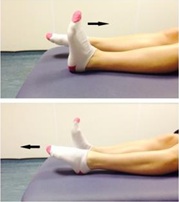 |
|---|---|---|
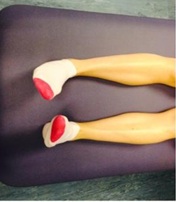
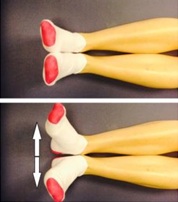
| 1. Make gentle circles with your foot in one direction and then the other direction. Repeat this 10 times. | 2. With your heels together, move your toes apart to turn the foot outwards. Repeat this 10 times. Do this movement gently within comfort. | 3. Point your foot up and down. Repeat this 10 times. |
Caring for your injury: Week 3-6
You should now stop using your boot, if you haven’t already
- Start by walking without the boot around your own home.
- Build up to walking without it outside or for longer walks.
- You should not be using your boot after six weeks post injury.
It is normal to still have mild discomfort and swelling
- This may continue for three to six months.
Activity and Exercise
- Gradually increase your level of activity.
- You should avoid impact activity for three months.
- This includes running, jumping and dancing.
- You can now progress your exercises.
Stretches
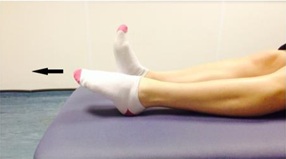 |
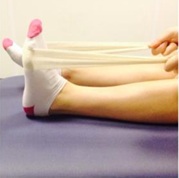 |
|---|---|
| 1. Point your toes down as far as they go, place your other foot on top and apply some pressure. This will stretch the top of your foot. Hold for 30 seconds. | 2. Sit with your leg straight out in front of you. Put a towel or bandage around your foot and pull it towards you. Feel a stretch in the back of the calf. Hold for 30 seconds. |
Balance
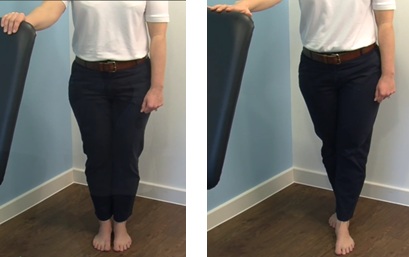
Level 1: These exercises are for people who couldn’t stand on one leg before their injury.
- Stand with your feet as close together as possible. Hold onto a firm support in safe space. Hold your balance for 30 seconds.
- Now try removing your hand. Try to keep your balance for 30 seconds.
- Hold onto a firm support. Put one foot in front of the other, as close together as you can. Hold this for 30 seconds. If you can, try to let go of the support and keep your balance. space. Hold your balance for 30 seconds.
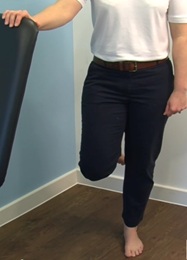
Level 2: These exercises are for people who could stand on one leg before their injury.
- Hold onto a firm surface in a safe space. Try to stand on one leg. Hold this for 30 seconds. Stop if you experience pain. When you can do this comfortably, try the next exercise.
- Try to stand on one leg without holding on to a support. Try to hold this for 30 seconds. When you can do this comfortably, try the next exercise.
- You can try these exercises with your eyes closed. Make sure you are always in a safe environment with a support to hold if needed.
Contact the Virtual Fracture Clinic if you are struggling to recover your movement or return to activity.
Frequently Asked Questions
I am struggling with my boot. What do I do?
- The boot has a thicker sole; this can make you feel uneven.
- Make sure you wear a supportive shoe or trainer on your uninjured foot. This will reduce stress on other joints.
- If you need more advice, contact the Virtual Fracture Clinic.
I am diabetic, does this change things?
- If you are diabetic, please contact us to discuss your boot.
- This is particularly important if you have problems with your skin or sensation.
- We may provide you with a specialist diabetic boot.
When can I start driving?
You can return to driving when:
- You are no longer using your boot,
- You can walk comfortably and
- You can perform an emergency stop pain free.
Always test your ability to drive in a safe environment first.
How can I get a certificate for work?
- You can get a fitness for work statement from your GP.
What do I do with my boot and crutches when I no longer need them?
- We cannot reuse boots, so please do not return them to us - please dispose of the boot yourself.
- Crutches can be returned to the Fracture Clinic or A&E.
Contact the Virtual Fracture Clinic
Call us on 020 7288 3310 (Monday to Friday 9am to 5pm)
or email whh-tr.fracturevirtualclinic@nhs.net
With thanks to Brighton and Sussex University Hospitals NHS Trust for kindly sharing their information sheets with us with full permission to use contents and images.
Published:
06 Aug 2026
Review:
06 Aug 2028
Reference:
SC/T&O/LatAnkAvulFract/02