

Excisional treatment for abnormal cells on the cervix (day treatment centre)
Patient Information Leaflet
What is an excisional treatment?
- This is a minor procedure to remove an area of the cervix (neck of the womb) that has abnormal cells.
- It may be performed using a laser or a heated loop or a fine needle.
- A sample is then sent to a laboratory for further investigation.
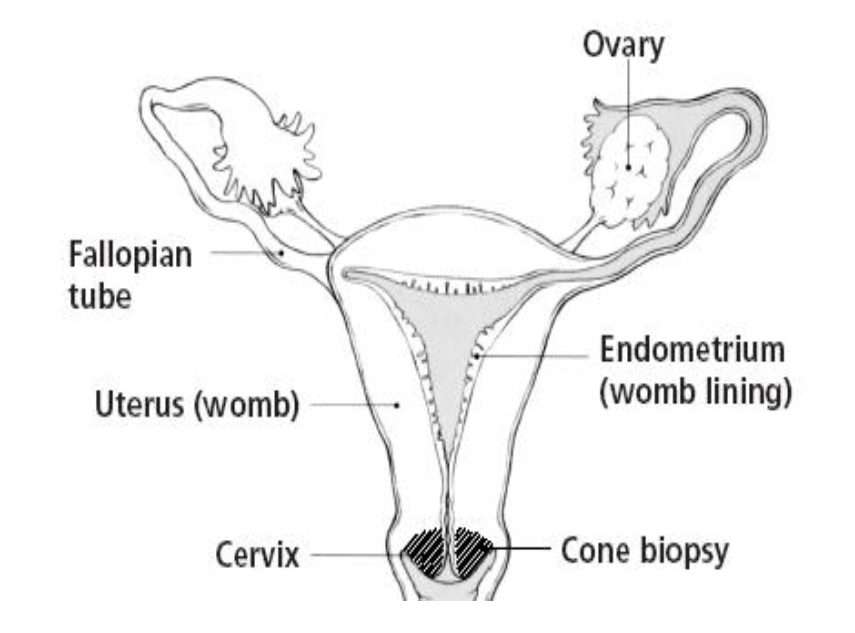
- This procedure is often done in a clinic, under local anaesthesia (numbing a small area).
- However, sometimes we might need to use sedation or a general anaesthetic (medication that makes you unconscious) and do it in the day treatment centre.
Reasons for having this procedure
- Cervical pre-cancer may have been diagnosed by an earlier colposcopy examination and from a small biopsy (a small sample is taken) in the clinic.
- This procedure is helpful because it gives Doctors a sample of tissue.
- By looking at the sample, they can find out the type of abnormal tissue present, how extensive it is and whether the abnormal area has been completely removed.
- 95% of patients who have this treatment will have their follow-up cervical screening smear test return to normal.
- For the remaining 5% further treatment may be necessary at a later stage.
- It is for this reason that regular follow-up smears with your Doctor are important.
Preparation for day treatment
- A week or two before the procedure you will have a medical check-up with a Nurse. This may include some or all of the following checks:
- Your medical history
- Your blood pressure
- A blood test
- Your height and weight
- A chest x-ray
- A heart tracing called an electrocardiogram (ECG)
- Please bring any medications that you are taking with you in their containers.
- If you are taking warfarin, or any other blood thinning drug you will need to stop taking it a few days before the procedure under the supervision of the Doctor.
- Please discuss this with the Nurse.
- If you are taking aspirin, you must stop taking it seven days before the procedure.
- Please tell the Nurse if you have diabetes or any allergies.
- If you do not attend the check-up, the procedure cannot go ahead.
- If you are having sedation, you must not eat anything for six hours before the procedure.
- You may sip water until 2-3 hours before surgery.
On the day of your operation
- Before you come to hospital, please remove any nail varnish and any jewellery (including rings from belly button, labia or clitoris/vulva).
- Please come into the day surgery unit at the date and time given in your letter.
- A Nurse will check you in and give you a gown to change into.
- Your Surgeon will see you and ask you to sign a consent form to confirm that you understand the procedure and agree to go ahead with it.
- You may sign this earlier at your medical check-up.
- Your Anaesthetist (a specialist doctor who sedates patients) will see you to discuss your anaesthetic.
- Please ask any questions that you may have about your procedure.
- You will be taken to the operating theatre.
The procedure in the Day treatment centre
- You will usually have sedation and a local anaesthetic or a general anaesthetic and be asleep throughout the procedure.
- The Surgeon will insert a speculum (a medical device to open your vagina) and perform a colposcopy examination exactly as you had done in the clinic. The abnormal area will be removed.
- The removed sample will be sent to the laboratory for further investigation.
- The procedure will take about 20 minutes.
- Sometimes a gauze dressing may be placed inside the vagina to soak up blood - this is called a vaginal pack.
After the procedure
- You will return to the day surgery ward to rest for 2-3 hours.
- You can have a hot or cold drink and a snack as soon as you feel like it.
- Please ask the Nurse for painkillers if you have any period type pains.
- If you have a vaginal pack in place, the Nurse or Doctor will remove it before you go home.
- You can go home after a Nurse has checked that it is safe for you to do so.
- A letter will be sent to your GP and you can be given a copy if you wish.
- You and your GP will receive a letter with the results and a follow-up appointment in the smear test clinic, colposcopy clinic or with your GP for a repeat smear test in six months.
- We aim for you to receive your results by four weeks. - In the rare case that you need more treatment soon after the procedure, we can set up an earlier appointment for you.
Going home
- You must arrange for a relative or friend to take you home and stay with you for 24 hours (if you have had general anaesthesia or sedation).
- Do not drink alcohol, drive or use machinery (this includes a kettle) or make important decisions for 24 hours to allow the effects of the general anaesthetic to wear off.
- Most patients who undergo treatment can resume most of their everyday activities within a day.
- If you have pain, you should take painkillers as directed, but the pain usually wears off a few hours after the procedure.
- The procedure will not usually change the timings of your next period.
- You can expect to have some light blood-stained and messy discharge or light bleeding for up to one month following the procedure.
- The bleeding is usually very light but some days it may be like a period. For heavier bleeding see the "Risks and Complication" section of this leaflet.
- Do not use tampons for four weeks after the procedure and use sanitary towels instead. This is to reduce the risk of infection after the procedure.
- Do not have sexual intercourse for four weeks. This is also to reduce the risk of infection.
- Do not lift heavy items that need two hands and avoid tiring physical exercise for two weeks. This advice is to reduce the risk of heavy bleeding after the procedure.
- Do not travel abroad during the time of recovery unless your specialist Doctor agrees that it is safe for you to do so.
- You can usually return to work the next day after your procedure, provided it does not involve heavy lifting.
Follow-up appointment
- This is usually six months after your procedure.
- You will have a cervical screening smear test and a human papillomavirus (HPV)-DNA test, to make sure that the virus responsible for the changes has disappeared.
- If both tests are reported as normal, you will be discharged back to the care of your GP to have annual smears for a further nine years.
- If the smear test or HPV-DNA test are positive, you will be asked to attend another colposcopy appointment.
- Do not get pregnant before this appointment.
Risks and complications
- This is a very safe procedure, but there are some risks, and these include:
Bleeding
- As described earlier, some bleeding is to be expected.
- However, 3% of patients will experience heavier bleeding, which may require further cautery (burning away of tissue).
- If you have a heavy bleed, that is not your period, and soaks through a sanitary towel within two hours, you should contact your GP or attend the Accident and Emergency Department of the Whittington Hospital or any other NHS Hospital.
- You may need to have a vaginal pack or some more treatment to stop the bleeding.
Infection
- 5% of patients undergoing this procedure may develop an infection. Most commonly this occurs 10 days after the procedure.
- If the vaginal discharge starts to smell or you develop a high temperature, you should contact your GP as you may need a course of antibiotics.
- As 95% of patients remain well, we do not usually prescribe antibiotics for this procedure.
Preterm labour
- Having this surgery will not affect your ability to have children.
- However if you are already pregnant, there is a small chance (about 5% more) that your water might break before 37 weeks.
- This could cause your baby to come earlier than expected.
- You must tell your Doctor and Obstetrician (specialist pregnancy Doctor) when you are pregnant so that they can check the length of your cervix (the neck of the womb) starting from 14 weeks of your pregnancy.
Closure of the cervix (cervical stenosis)
- This may occur in up to 3% of patients after the procedure.
- People most at risk of this are those who have irregular or no periods.
- This might be because of the menopause (when your body stops having periods), breast feeding after pregnancy, contraceptive injections or hormonal disorders.
- The cervical opening becomes constricted (narrowed), which can result in painful periods.
- To reduce this risk, those who have gone through the menopause and who are having the procedure will usually be advised to use hormone replacement therapy (HRT) for three months (if there are no problems) to create monthly bleeds whilst the cervix heals.
- Those with a hormonal imbalance or using contraception that stops periods are advised to use a combined oral contraceptive pill for at least three months (if there are no problems).
Please talk to your Surgeon before the procedure if you have any concerns about these risks.
Further information
Colposcopy department: 020 7288 5118 or whh-tr.womenshealthadmin@nhs.net Monday - Friday 9.00 am to 4.00 pm
Clinical Advice (Nurses Line): 0207 288 3138.
Please leave a message and you will receive a response within 24 hours (weekdays).
Associated leaflets in other languages
Published:
29 Sep 2024
Review:
27 Sep 2026
Reference:
ACW/WH/ETACC(DTC)/05